Planning your first trip to South Korea can feel surprisingly overwhelming.
A quick search will give you hundreds of places, thousands of attractions, and enough itinerary ideas to make your browser tabs start begging for mercy. Seoul, Busan, Jeju, Gyeongju, Nami Island, the DMZ, mountain parks, beaches, temples, markets, cafes – where do you actually begin?
The good news is that first-time visitors do not need to see everything.
In fact, trying to visit too many places is one of the easiest ways to make a Korea trip feel rushed. South Korea may look small on a map, but each region has its own pace, food, scenery, and travel style. Seoul feels fast and layered. Busan is coastal and relaxed. Jeju is wide, windy, and nature-focused. Gyeongju feels like Korea’s ancient past is quietly sitting beside modern streets.
This guide highlights the best places to visit in South Korea for first-time travelers and explains how each destination fits into a realistic itinerary.
If you are still planning your arrival, start with How to Get from Incheon Airport to Seoul and Best Areas to Stay in Seoul before choosing the rest of your route.
This article may contain affiliate links, which means we may earn a small commission if you book through them, at no extra cost to you.
Table of contents
Before You Start Planning
Before choosing destinations, think about how much time you actually have.
A common first-time mistake is trying to squeeze Seoul, Busan, Jeju, Gyeongju, Nami Island, the DMZ, and a national park into one short trip. On paper, it looks exciting. In real life, it can become a suitcase-dragging endurance sport.
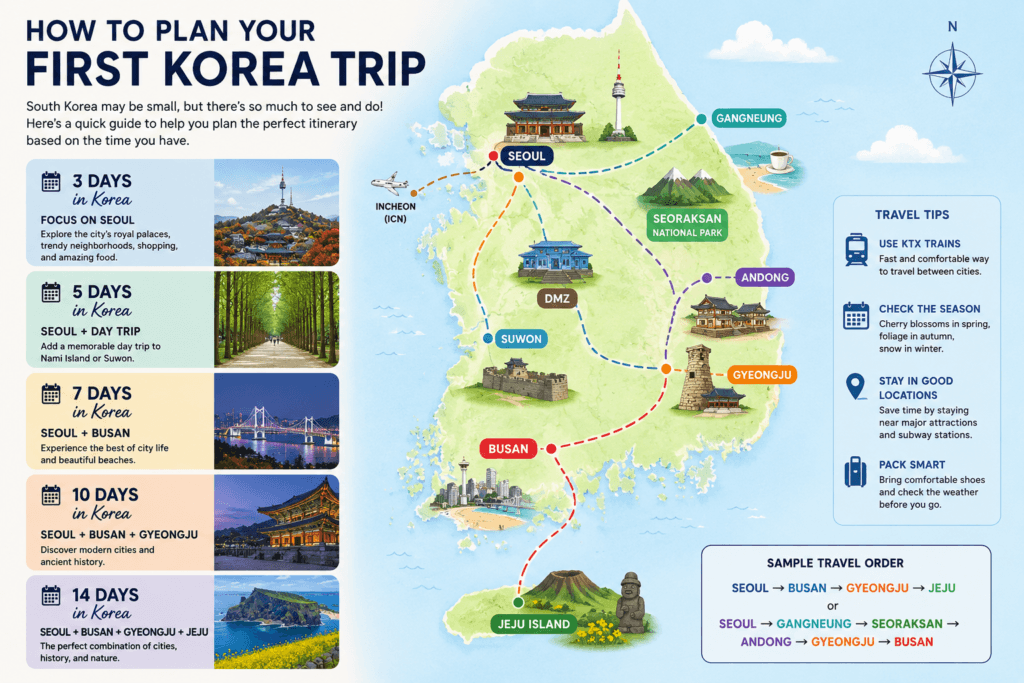
A more realistic first Korea itinerary looks like this:
| Trip Length | Best Route |
|---|---|
| 3 days | Seoul only |
| 5 days | Seoul plus one day trip |
| 7 days | Seoul and Busan |
| 10 days | Seoul, Busan, and Gyeongju |
| 14 days | Seoul, Busan, Gyeongju, and Jeju |
If you only have three days, stay in Seoul. There is more than enough to fill a short trip with palaces, markets, shopping districts, cafes, neighborhoods, and food.
With five days, add one easy day trip such as Nami Island Guide 2026, the DMZ, or Suwon.
With seven to ten days, Busan and Gyeongju become much easier to include.
With two weeks, Jeju Island finally starts to make sense. Jeju deserves time. It is not a quick little side quest with ocean views. It is a full island with long drives, different regions, and a habit of making travelers wish they had booked one more night.
For seasonal planning, read Best Time to Visit South Korea in 2026 before locking in your route.
1. Seoul
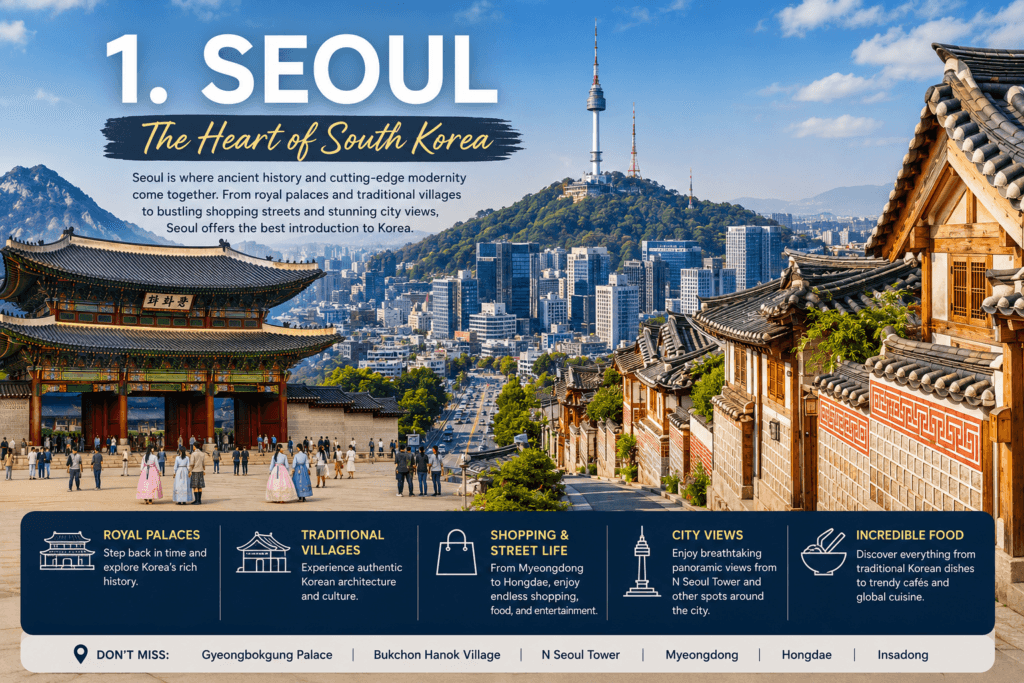
Seoul should be the first stop for most first-time visitors to South Korea.
The capital gives you the best introduction to Korean history, food, shopping, public transportation, nightlife, cafes, palaces, and everyday city life. It is modern, fast, and bright, but it also has royal palaces, hanok villages, traditional markets, Buddhist temples, old neighborhoods, and quiet alleys hiding between the glass towers.
What surprises many visitors is how easily traditional and modern Seoul sit beside each other. In one day, you can visit Gyeongbokgung Palace, walk through Bukchon Hanok Village, eat Korean BBQ, shop in Myeongdong, explore Hongdae, and finish the evening with skyline views from N Seoul Tower.
That is why Seoul deserves more time than many travelers expect.
For most first-time visitors, three days is the minimum. Four to five days is better if you want to enjoy the city without sprinting through every neighborhood.
Start with these guides:
- Gyeongbokgung Palace Guide 2026
- Bukchon Hanok Village Guide 2026
- Myeongdong Travel Guide 2026
- Hongdae Travel Guide 2026
- N Seoul Tower Travel Guide 2026
- Insadong Travel Guide 2026
- Seoul 3-Day Itinerary 2026
- Seoul 5-Day Itinerary 2026
Seoul is also the best base for many day trips, including Nami Island, the DMZ, Suwon, and theme parks such as Everland.
If this is your first Korea trip, build the rest of your itinerary around Seoul rather than treating it as a quick arrival city.
2. Busan
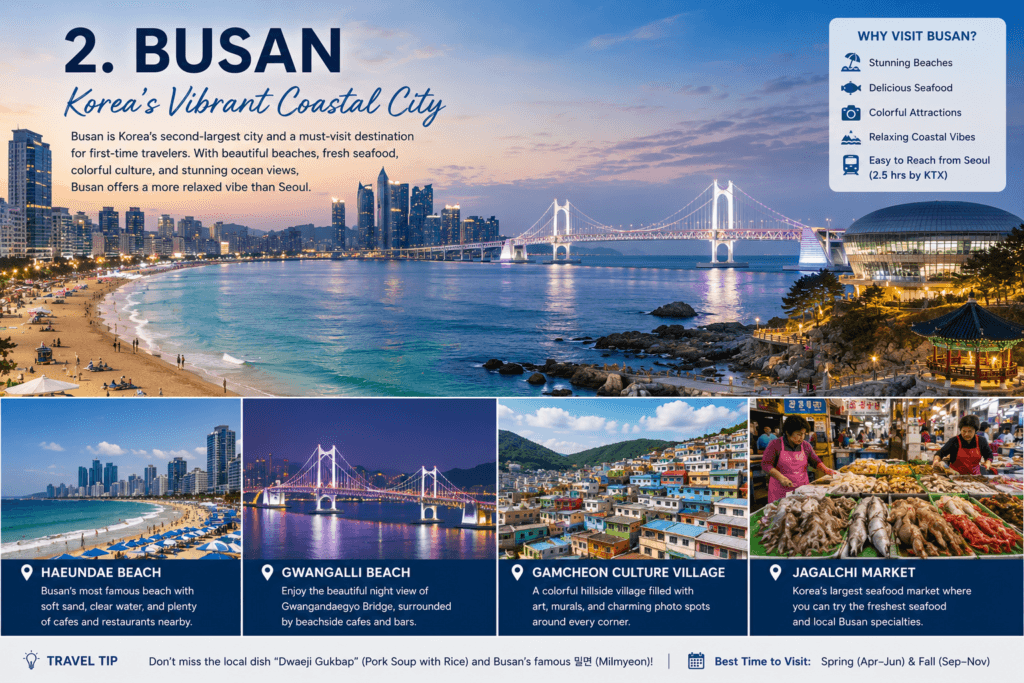
Busan is the best second city to visit in South Korea.
If Seoul feels fast, vertical, and constantly moving, Busan feels wider, saltier, and more relaxed. It is Korea’s second-largest city, but the atmosphere is completely different from the capital. Beaches, seafood markets, coastal walks, hillside villages, seaside temples, and night views give Busan its own personality.
Many travelers come for the beaches, especially Haeundae and Gwangalli. But Busan is not just a summer destination. Jagalchi Market, Gamcheon Culture Village, Haedong Yonggungsa Temple, coastal cafes, and seafood restaurants make the city worth visiting in almost any season.
Busan works especially well after Seoul because the contrast is clear. Seoul gives you palaces, shopping, nightlife, and dense city energy. Busan gives you ocean air, seafood, bridge views, and neighborhoods that feel more spread out.
Plan at least two days in Busan. Three days is better if you want to visit the beaches, markets, temples, and coastal areas without rushing.
Useful Busan guides:
- Busan Travel Guide 2026
- Haeundae Beach Guide 2026
- Gwangalli Beach Guide 2026
- Jagalchi Market Guide 2026
- Gamcheon Culture Village Guide 2026
- Haedong Yonggungsa Guide 2026
- Busan 3-Day Itinerary 2026
- Best Areas to Stay in Busan 2026
Busan is easy to reach from Seoul by KTX, making it one of the most practical additions to a first Korea itinerary. Read Korea KTX Guide 2026 before booking trains.
3. Jeju Island
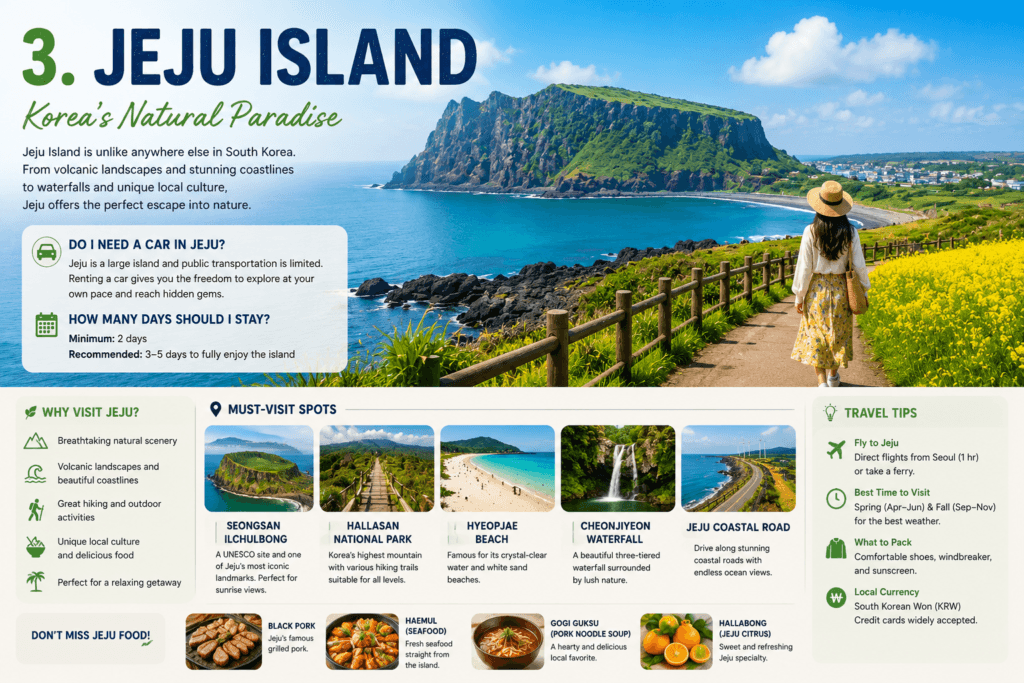
Jeju Island is South Korea’s best destination for nature.
It feels completely different from Seoul or Busan. Instead of subway stations and shopping streets, Jeju is about volcanic landscapes, coastal roads, beaches, waterfalls, mountain trails, ocean-view cafes, black pork dinners, and slow drives where the scenery keeps interrupting your schedule.
Many first-time visitors underestimate Jeju because it looks like a small island on a map. It is not. Jeju is large enough that driving from one side to the other takes time, and the best attractions are spread across different regions.
The island is famous for Hallasan, Seongsan Ilchulbong, Udo Island, Hyeopjae Beach, Aewol, waterfalls, tangerines, seafood, and Jeju black pork. It is also one of the best places in Korea to slow down after several busy days in Seoul.
Jeju is not ideal as a rushed one-night stop. Three days is the minimum for a basic visit, while four to five days is much better for first-time travelers.
Plan with these guides:
- Jeju Travel Guide 2026
- Jeju 5-Day Itinerary 2026
- Seongsan Ilchulbong Guide 2026
- Hallasan National Park Guide 2026
- Udo Island Guide 2026
- Hyeopjae Beach Guide 2026
- Aewol Travel Guide 2026
- Jeju Black Pork Guide 2026
- Best Cafes in Jeju 2026
Jeju is best for travelers who love nature, photography, beaches, hiking, cafes, and road trips. If you are staying in Korea for 10 to 14 days, Jeju is absolutely worth considering.
4. Gyeongju
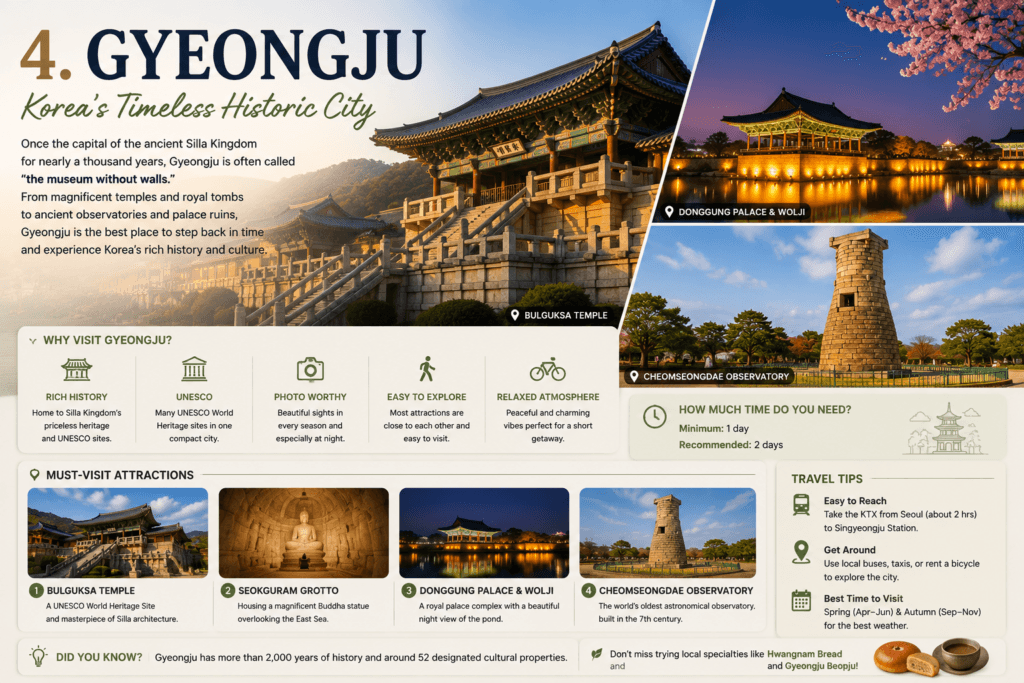
Gyeongju is the best city in Korea for history lovers.
Once the capital of the Silla Kingdom, Gyeongju is often called a “museum without walls.” That nickname sounds dramatic, but it makes sense once you arrive. Ancient tombs, temples, palace ruins, observatories, and historic sites are scattered throughout the city.
Unlike some historical destinations that feel distant or difficult to understand, Gyeongju is surprisingly easy to explore. Many major sights are close together, and the city has a calm atmosphere that makes it perfect after the energy of Seoul or Busan.
Gyeongju works especially well between Busan and Seoul, or as part of a longer southern Korea route. One day is possible, but two days is much better if you want to see Bulguksa Temple, Seokguram Grotto, Donggung Palace and Wolji, Cheomseongdae, and the ancient tomb areas without racing through them.
Useful guides:
- Gyeongju Travel Guide 2026
- Bulguksa Temple Guide 2026
- Seokguram Grotto Guide 2026
- Donggung Palace and Wolji Guide 2026
- Cheomseongdae Guide 2026
Gyeongju is the place to visit when you want Korea’s deeper cultural story, not just the modern version you see in Seoul.
It is quiet in a way that sneaks up on you. One moment you are walking between ancient tombs, and the next you realize the city has calmly stolen half your afternoon.
5. Nami Island
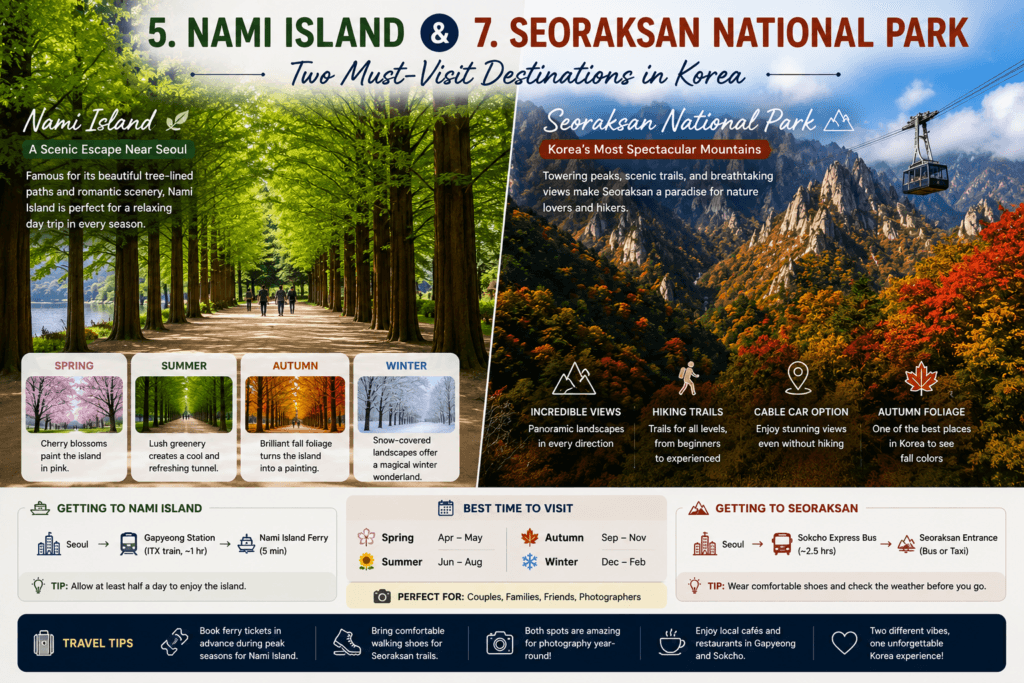
Nami Island is one of the easiest and most popular day trips from Seoul.
The island is famous for tree-lined paths, seasonal scenery, photo spots, and a gentle atmosphere that works well for couples, families, and first-time travelers. It is especially popular in spring, autumn, and winter, but each season gives the island a different look.
Spring brings blossoms and soft colors. Summer turns the paths green and shaded. Autumn is the most famous season, with red and gold leaves creating the classic Nami Island photos. Winter can bring snow-covered roads that feel especially scenic.
Nami Island is not a must for every traveler. If your trip is short and you care more about palaces, food, markets, and city neighborhoods, Seoul itself may be a better use of time. But if you want a simple day trip with beautiful scenery and easy planning, Nami is one of the safest choices.
Plan half a day to one full day depending on whether you combine it with nearby attractions such as Garden of Morning Calm, Petite France, or Alpaca World.
Read Nami Island Guide 2026 before deciding whether it fits your route.
Travelers who want an easy day without managing transfers can consider a Nami Island day tour from Seoul.
6. DMZ
The DMZ is one of the most unique day trips you can take from Seoul.
The Korean Demilitarized Zone separates North and South Korea and remains one of the most historically significant border areas in the world. For many international travelers, visiting the DMZ adds important context to Korea’s modern history.
Although the subject is serious, organized tours make the experience relatively straightforward. Most visitors join a guided tour from Seoul rather than trying to visit independently. Tour routes, access rules, and included stops can change depending on security conditions, weather, and operational restrictions, so always check current tour details before booking.
The DMZ is not a casual sightseeing stop in the same way as a palace or market. It is more reflective. Visitors often leave with a better understanding of the Korean War, division, and the ongoing reality of the peninsula.
Plan one day for the DMZ.
If you are interested in history, politics, or modern Korea, it can be one of the most memorable parts of your trip.
For planning, use DMZ Tour Guide 2026 and consider a DMZ guided tour from Seoul if it matches your itinerary.
7. Seoraksan National Park
Seoraksan National Park is one of Korea’s most spectacular mountain destinations.
Located in Gangwon Province, it is famous for dramatic peaks, hiking trails, waterfalls, temples, cable car views, autumn foliage, and rugged mountain scenery. Many Koreans consider Seoraksan one of the most beautiful natural areas in the country.
Autumn is the most famous season, when the foliage turns the park into one of Korea’s top fall destinations. However, Seoraksan is worth visiting in other seasons too. Spring brings fresh greenery, summer offers lush scenery, and winter can create snowy mountain views.
You do not need to be an expert hiker to enjoy Seoraksan. Some areas are accessible for casual visitors, while longer trails are better for active travelers. The cable car, when operating, can also make the mountain views easier to enjoy.
Seoraksan works best as a full-day trip or overnight stay. It is possible from Seoul as a long day, but the travel time can be tiring.
If nature is your priority, Seoraksan deserves a place on your Korea itinerary, especially in autumn. Just do not try to squeeze it between shopping in Myeongdong and dinner in Busan. The mountain deserves a proper day.
8. Gangneung
Gangneung is one of Korea’s most underrated coastal cities.
Located on the east coast, it is known for beaches, coffee streets, seafood, pine forests, coastal drives, and a more relaxed atmosphere than Busan. Korean travelers often visit Gangneung for weekend getaways, but international visitors still overlook it compared with Seoul, Busan, and Jeju.
That makes Gangneung a good choice if you want a quieter coastal trip.
The city is especially famous for its cafe culture near the sea. Anmok Coffee Street is one of the best-known areas, but the broader city offers beaches, local restaurants, and easy access to nearby east coast scenery.
Gangneung became more internationally known after the 2018 Winter Olympics, but it still feels calmer than Korea’s biggest tourist destinations.
Plan one to two days.
Read Gangneung Travel Guide 2026 if you want a Korea itinerary that goes beyond the usual Seoul-Busan-Jeju route.
9. Suwon
Suwon is one of the easiest history-focused day trips from Seoul.
The city’s main attraction is Hwaseong Fortress, a UNESCO-listed fortress that wraps around much of the historic center. Visitors can walk along sections of the fortress walls, see gates and pavilions, and enjoy views over the city.
Suwon is less famous internationally than Gyeongju, but it is much easier to add to a short trip because it is close to Seoul. If you have limited time and want a cultural day trip without traveling across the country, Suwon is a strong option.
It works best as a half-day to full-day trip from Seoul.
Suwon is especially good for travelers who enjoy history, architecture, walking routes, and quieter alternatives to central Seoul attractions.
If your Korea trip is only five days, Suwon can be a smart choice. If your trip is ten days or longer, Gyeongju usually offers a deeper historical experience.
10. Andong
Andong is one of the best places to experience traditional Korean culture beyond Seoul.
The city is most famous for Hahoe Folk Village, a UNESCO-listed historic village where traditional houses, Confucian culture, and rural scenery are preserved in a living village setting. Unlike a simple recreated attraction, Hahoe still feels connected to real cultural history.
Andong is not as easy to fit into a first-time Korea trip as Seoul, Busan, or Gyeongju. It requires more travel time and suits visitors who have a deeper interest in traditional culture, folk villages, architecture, and slower regional travel.
That is why Andong is best for longer trips or second-time visitors.
If you only have one week in Korea, focus on Seoul and Busan first. If you have two weeks or you love cultural heritage, Andong can be a rewarding addition.
Plan one day at minimum, though an overnight stay makes the trip more comfortable.
Andong is not flashy. It does not shout for attention. It quietly offers a more traditional side of Korea, which can feel especially meaningful after several days in big cities.
Which Places Should You Prioritize?
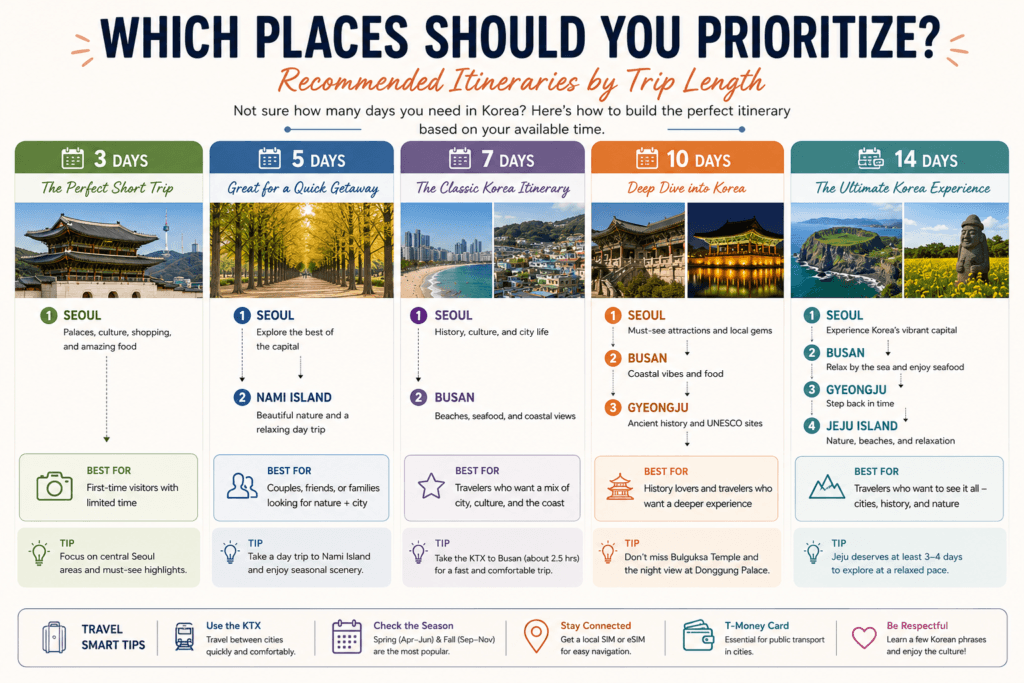
You do not need to visit all ten places on your first trip.
The best route depends on your travel length and interests.
If You Have 3 to 5 Days
Focus on Seoul.
Add one day trip if you have enough time.
Best choices:
- Seoul
- Nami Island
- DMZ
- Suwon
For short trips, do not add Busan or Jeju unless you are willing to move quickly and sacrifice depth.
If You Have 7 to 10 Days
Prioritize Seoul, Busan, and Gyeongju.
This route gives you the best mix of city life, beaches, food, and history without adding domestic flights.
Best choices:
- Seoul
- Busan
- Gyeongju
- Nami Island or DMZ if time allows
This is one of the most practical first-time Korea routes.
If You Have 10 to 14 Days
Add Jeju Island.
Best choices:
- Seoul
- Busan
- Gyeongju
- Jeju Island
- Optional day trip from Seoul
This route gives you the most balanced introduction to South Korea.
If You Love Nature
Prioritize:
- Jeju Island
- Seoraksan National Park
- Gangneung
- Busan coastal areas
Jeju is the best all-around nature destination, while Seoraksan is best for mountain scenery.
If You Love History
Prioritize:
- Gyeongju
- DMZ
- Suwon
- Andong
- Seoul palaces
Gyeongju is the strongest choice for ancient Korean history. The DMZ is best for modern history.
Common Mistakes First-Time Visitors Make
The biggest mistake is trying to visit too many places.
South Korea is easy to travel around compared with many countries, but moving between regions still takes time. Trains, flights, check-ins, luggage storage, and transfers can quietly eat up your itinerary.
Another mistake is not spending enough time in Seoul. Many visitors see Seoul as just the starting point, but the city deserves several days. Palaces, neighborhoods, food markets, shopping districts, river parks, cafes, and nightlife cannot be understood in one rushed afternoon.
Some travelers skip Busan because they think it is just another big city. It is not. Busan’s beaches, seafood, hills, and coastal temples make it feel completely different from Seoul.
Season matters too. Nami Island, Seoraksan, Jeju, and cherry blossom or autumn foliage spots change dramatically depending on when you visit. Always check the season before deciding which destinations are worth prioritizing.
Finally, do not ignore Korea’s transportation network. KTX trains, airport buses, subway systems, domestic flights, and day tours make travel easier, but only if you plan them properly. Read Korea KTX Guide 2026, Seoul Subway Guide, and T-money Card Guide before your trip.
Frequently Asked Questions
What is the number one place to visit in South Korea?
For most first-time visitors, Seoul is the most important destination. It offers the best mix of history, food, shopping, nightlife, public transportation, and cultural experiences.
Is Busan worth visiting?
Yes. Busan is worth visiting for beaches, seafood, coastal scenery, markets, and a more relaxed atmosphere than Seoul. It is the best second city for many first-time Korea itineraries.
Should I visit Busan or Jeju?
If you have limited time, Busan is usually easier to include because it connects well by KTX. If you have more time and love nature, Jeju Island is worth the extra planning and domestic flight.
How many days do I need in South Korea?
Most first-time visitors should plan 7 to 14 days. With 7 days, focus on Seoul and Busan. With 10 days, add Gyeongju. With 14 days, add Jeju Island.
Is Nami Island worth visiting?
Nami Island is worth visiting if you want an easy and scenic day trip from Seoul. It is especially beautiful in autumn, winter, and spring, but it is not essential for every itinerary.
Is the DMZ worth visiting?
Yes, if you are interested in Korean history and the division of the peninsula. The DMZ is one of the most unique day trips from Seoul, but you should check current tour conditions before booking.
Is Jeju worth visiting on a first Korea trip?
Yes, but only if you have enough time. Jeju is best with at least 3 days, and 4 to 5 days is better. It is not ideal as a rushed overnight add-on.
What is the best first-time Korea itinerary?
A strong first-time route is Seoul for 4 to 5 days, Busan for 2 to 3 days, and Gyeongju for 1 to 2 days. If you have two weeks, add Jeju Island.
Recommended Travel Services
These can make your first Korea trip easier:
- Korea eSIM for travelers
- Incheon Airport transfer to Seoul
- KTX train ticket or rail pass options
- Nami Island day tour from Seoul
- DMZ guided tour from Seoul
- Jeju rental car options
- Seoul hotel deals for first-time visitors
Related Guides
Continue planning your trip with these guides:
- Best Time to Visit South Korea in 2026
- How to Get from Incheon Airport to Seoul
- Best Areas to Stay in Seoul
- Seoul 3-Day Itinerary 2026
- Seoul 5-Day Itinerary 2026
- Busan Travel Guide 2026
- Jeju Travel Guide 2026
- Gyeongju Travel Guide 2026
- Korea KTX Guide 2026
- T-money Card Guide for Tourists
Final Thoughts
If you are planning your first trip to South Korea, start with Seoul.
Then build your route around the experience you want most. Choose Busan for beaches, seafood, and coastal city energy. Choose Jeju Island for nature, road trips, volcanic landscapes, and slower travel. Choose Gyeongju for ancient history. Add Nami Island, the DMZ, Suwon, Seoraksan, Gangneung, or Andong when they match your time and interests.
The best Korea itinerary is not the one with the most pins on a map.
It is the one that gives each place enough time to feel different.
South Korea combines ancient history, modern cities, mountain scenery, coastal views, incredible food, efficient transportation, and small everyday moments that often become the most memorable part of the trip.
For many travelers, one trip to Korea is not enough.
That is perfectly normal. Korea has a quiet talent for making people plan the second trip before the first one is even over.