If you are visiting Seoul, you will probably use the subway sooner or later.
Actually, “sooner” is more likely.
Whether you are heading to Myeongdong, Hongdae, Gangnam, Dongdaemun, Gyeongbokgung Palace, or the Han River, the subway is usually the fastest, cheapest, and most practical way to move around the city.
At first, the system can look intimidating. Seoul has multiple lines, huge transfer stations, busy platforms, and enough colored route maps to make your first coffee feel underpowered.
The good news is that the Seoul subway is much easier than it looks.
Station signs are displayed in Korean and English, announcements are available in multiple languages, trains arrive frequently, and navigation apps make route planning simple. Many travelers arrive expecting a confusing transportation system and leave wondering why their own city has not taken notes.
This guide explains how to use the Seoul subway in 2026, including fares, T-money cards, useful apps, transfer tips, subway etiquette, and the mistakes first-time visitors should avoid.
If you are still planning your first few days in Seoul, read How to Get from Incheon Airport to Seoul and Best Areas to Stay in Seoul before choosing your hotel.
This article may contain affiliate links, which means we may earn a small commission if you book through them, at no extra cost to you.
Table of contents
Why Most Travelers Use the Seoul Subway
The Seoul Metropolitan Subway is one of the easiest ways for visitors to explore the city.
For most tourist routes, it is faster than taxis, cheaper than private transfers, and much less affected by traffic. Seoul road traffic can be slow, especially around rush hour, rain, weekends, and busy shopping districts. The subway keeps moving while cars outside are quietly questioning their life choices.
The subway also connects many of Seoul’s most popular areas.
The network connects Myeongdong, Hongdae, Dongdaemun and access points for the Han River. You do not need to squeeze them into one day to appreciate that convenience.
For first-time visitors, the subway is not just transportation. It changes how easy Seoul feels. Once you understand the system, the city opens up quickly.
Before Your First Subway Ride
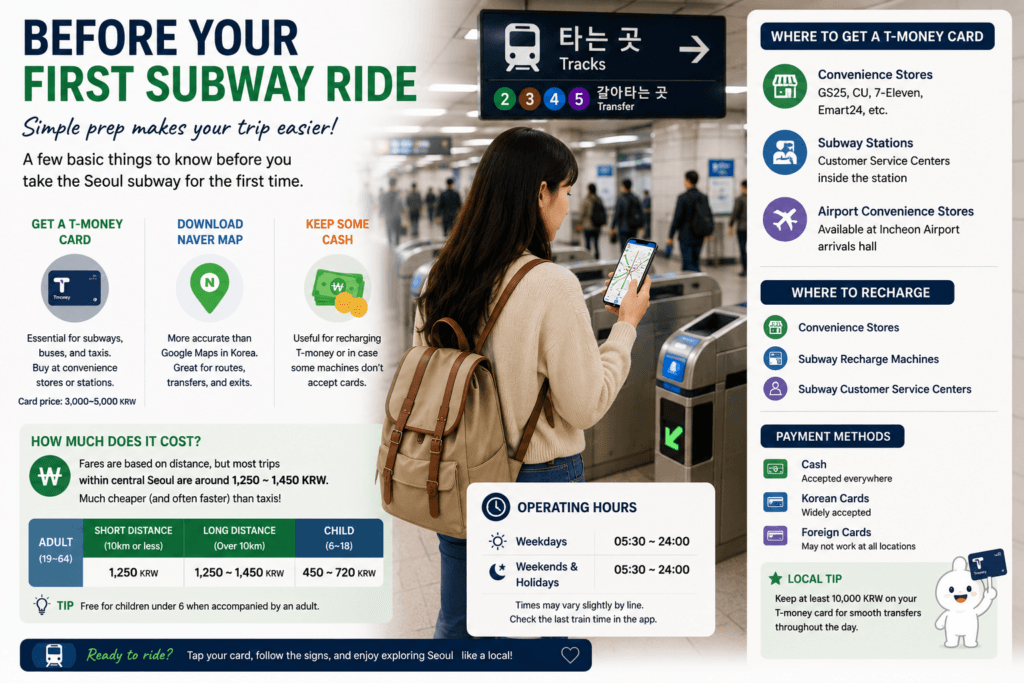
Before entering the subway for the first time, prepare three things: a transport card, a navigation app, and a little cash.
Get a T-money Card
A T-money card is the easiest way to pay for public transportation in Korea.
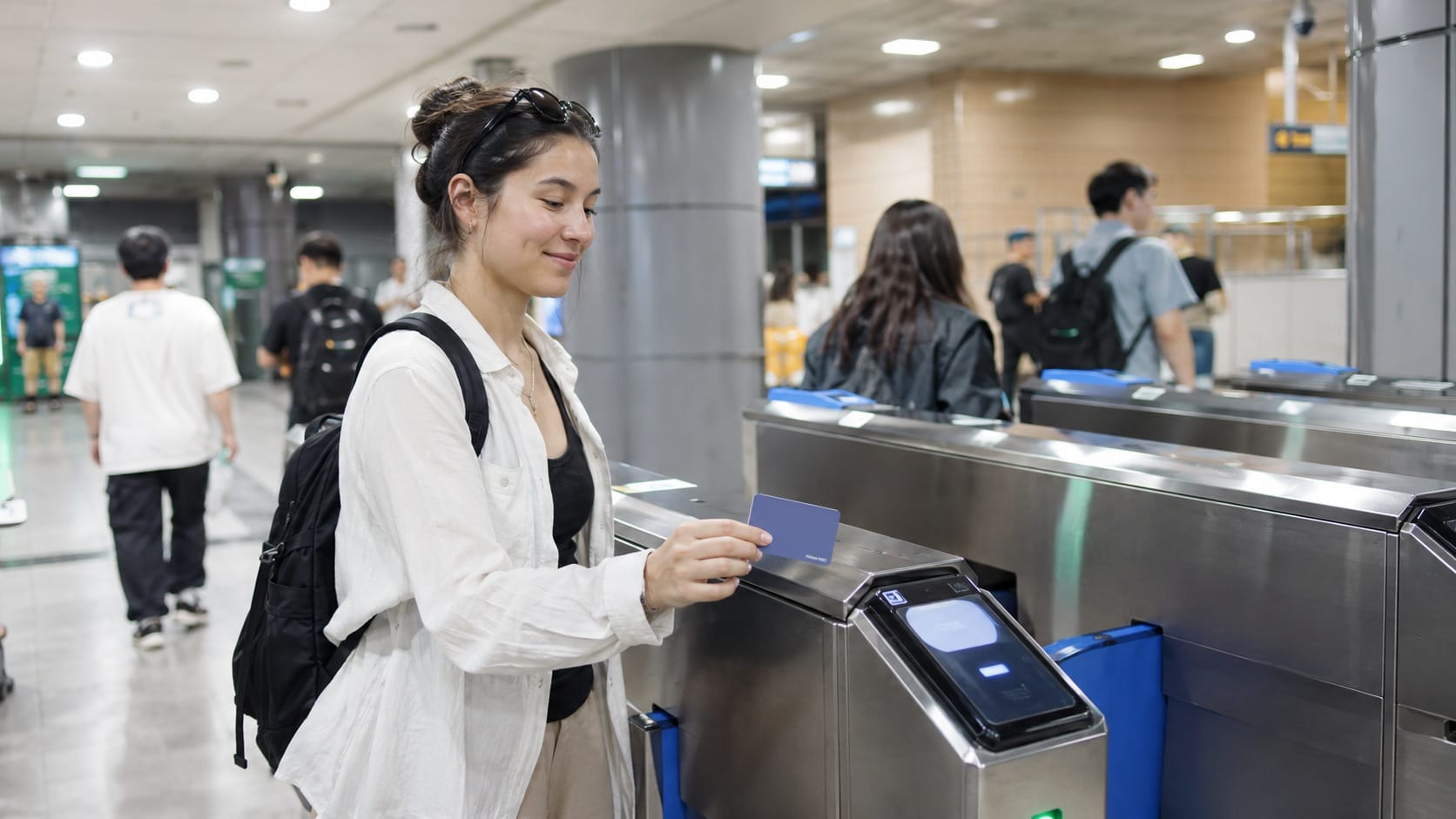
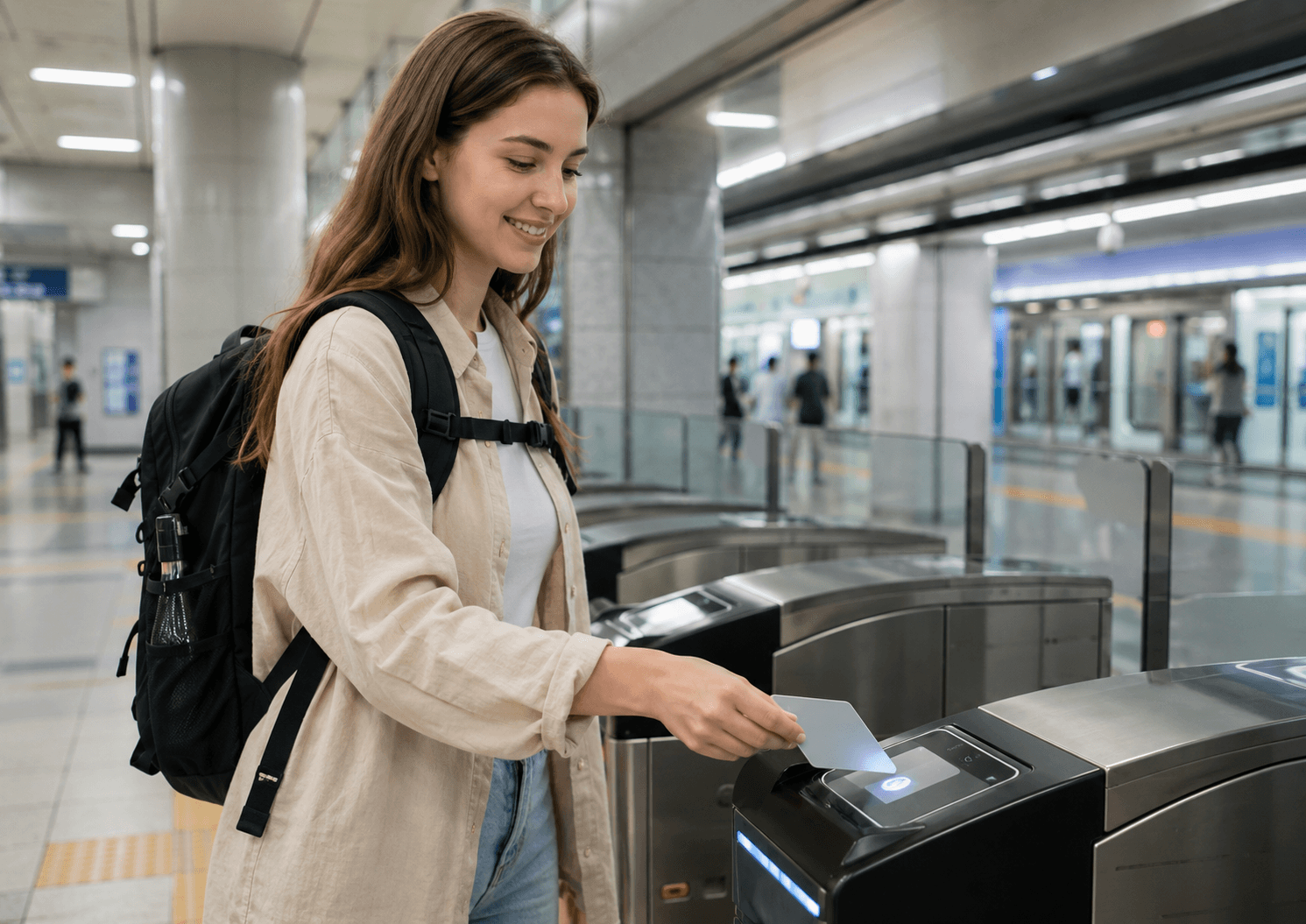
Instead of buying a single ticket every time, you tap the card when entering and exiting subway gates. You can also use it on buses and many taxis, which makes it much more convenient than carrying separate tickets.
Most first-time visitors should use T-money or a similar rechargeable transportation card. It is simple, reliable, and accepted widely across Seoul.
You can buy transportation cards at convenience stores, subway stations, airports, and some tourist service locations. After buying the card, charge it with Korean won before using it.
For a full guide, read T-money Card Guide for Tourists in Korea.
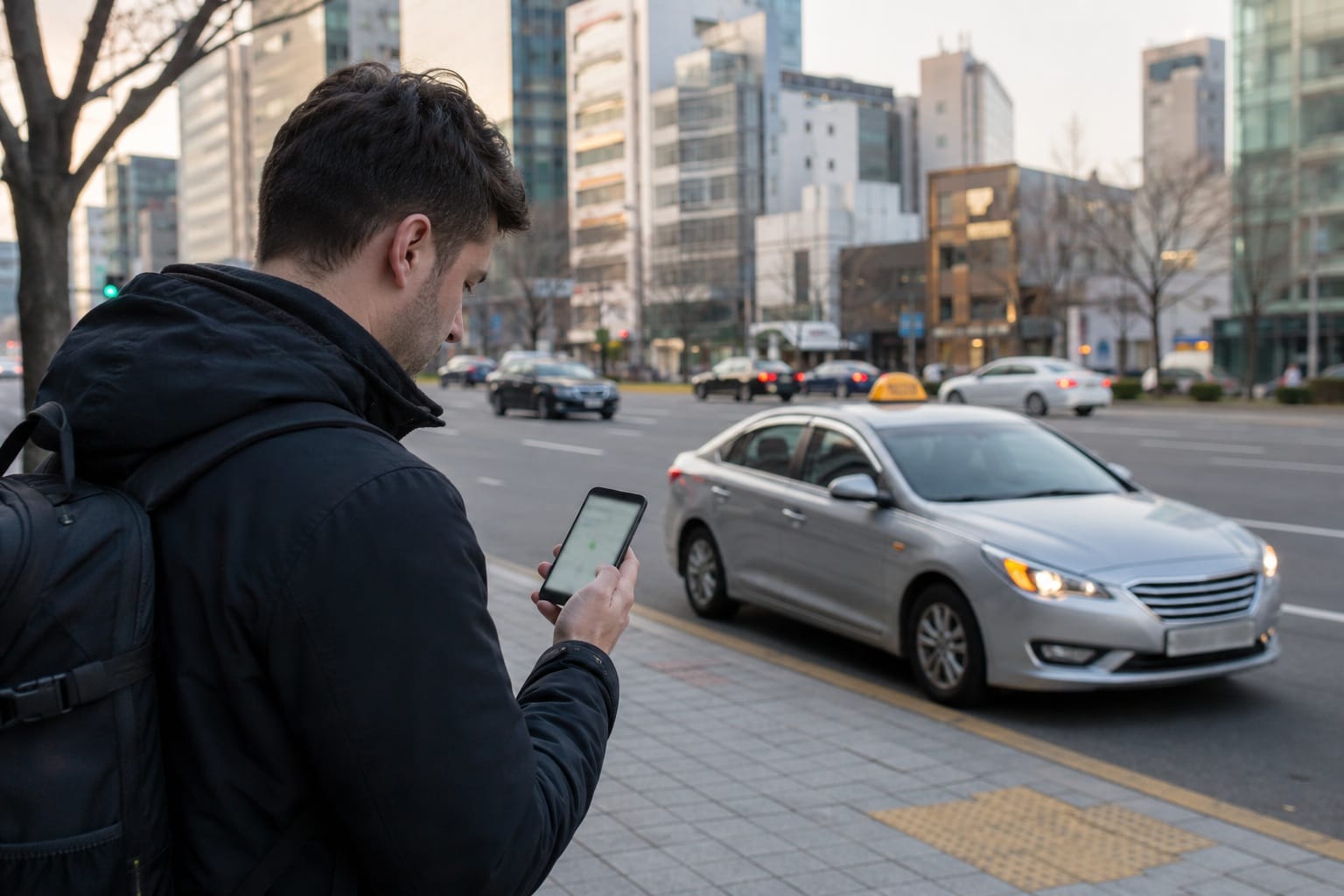
Download Naver Map or KakaoMap
Do not rely only on Google Maps for public transportation in Korea.
Google Maps can be useful for general searching, but local navigation apps usually provide better route planning, transfer information, exit numbers, and public transport details.
Most travelers should download either Naver Map or KakaoMap before arriving. Both apps can help you check subway routes, station exits, travel time, and transfers.
If you plan to use maps from the moment you land, set up a Korea eSIM for travelers or read Best eSIM for Korea 2026 before your trip.
Keep Some Cash Available
Korea is very card-friendly, but cash is still useful for transportation cards.
Keep cash for ordinary T-money top-ups and places where your payment method is not supported. There is now another option for specific products: Seoul’s March 17, 2026 announcement confirms overseas Visa/Mastercard payments at new machines on Lines 1–8 for short-term Climate Cards and single-journey tickets. A service fee applies; the announcement gives an average of about 3.7%. This does not mean every T-money recharge point accepts your overseas card—or that the card itself opens the subway gate.
For money tips, read Korean Currency Guide 2026, Cash vs Card in Korea 2026, and Korea ATM Guide 2026.
How Much Does the Seoul Subway Cost?
The Seoul subway is one of the best-value parts of traveling in the city.
Buying a single-journey ticket? Pay the fare plus a refundable KRW 500 card deposit. After leaving the gates at your destination, return the card to the deposit-refund machine. The ticket is for subway travel, not a bus-transfer discount.
The adult base fare is KRW 1,550 with a transportation card or KRW 1,650 with a single-journey ticket, according to Seoul’s published fare guide checked October 6, 2026. These are starting fares, not a flat price for every journey; distance charges and some services’ surcharges can raise the total.
For most tourist routes within central Seoul, the subway remains much cheaper than taxis. A ride between areas like Myeongdong, Hongdae, Dongdaemun, City Hall, or Seoul Station usually costs only a small fraction of what a taxi would cost.
If you are visiting several places in one day, the savings add up quickly. This is why budget travelers often rely almost entirely on the subway and use taxis only late at night, when carrying luggage, or when traveling with a group.
For daily budget planning, read Seoul Budget Travel Guide 2026 and How to Visit Seoul on $50 a Day.
Should Tourists Use the Climate Card?
For a short visit, compare ordinary pay-as-you-go T-money with the Climate Card’s unlimited travel on covered routes. Adult short-term passes are KRW 5,000 / 8,000 / 10,000 / 15,000 / 20,000 for 1 / 2 / 3 / 5 / 7 days; the physical card is a separate KRW 3,000 purchase. Short-term validity starts on the charging date, not whenever you decide to begin sightseeing.
Coverage changed on October 1, 2026. Use Seoul’s current short-term pass page, not an older map promising broad Gyeonggi coverage. It lists Seoul subway coverage and Seoul-licensed city/town buses, with exclusions including Sinbundang, GTX, intercity and airport buses. Covered AREX travel can finish at Incheon Airport T1/T2, but you cannot board there with this pass. AREX Express is not included.
The former prepaid 30-day Climate Card stopped accepting reloads after August 31, 2026, while tourist short-term passes continue. Do not confuse them with the resident-oriented replacement Climate Pass. For a few rides each day, T-money may be simpler; for frequent covered rides, compare the pass price with your planned journeys, including the card purchase cost.
Main Subway Lines Tourists Actually Use
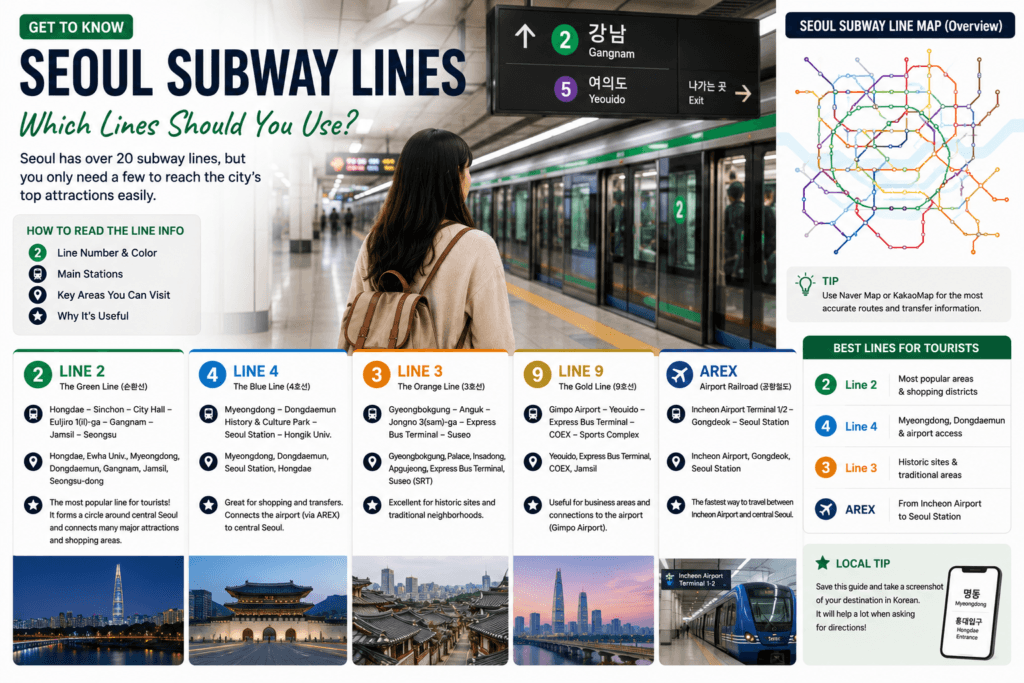
You do not need to memorize every subway line.
Most visitors use only a few lines regularly. Seoul’s subway map looks like a bowl of colorful noodles at first, but your actual route will usually be much simpler.
Line 2
Line 2 is one of the most useful subway lines for visitors.
It connects many major areas, including Hongdae, City Hall, Gangnam, Jamsil, Seongsu, and parts of central Seoul. If you are staying in Seoul for several days, there is a very good chance you will use Line 2 more than once.
Line 2 is especially helpful for nightlife, cafes, shopping, and major neighborhood hopping.
Useful guides:
- Hongdae Travel Guide 2026
- Seongsu-dong Travel Guide 2026
- Gangnam Travel Guide 2026
- Lotte World Guide 2026
Line 4
Line 4 is useful for Myeongdong, Dongdaemun, Seoul Station, and several central Seoul routes.
If you stay near Myeongdong or Dongdaemun, Line 4 may become one of your main lines. It also connects with Seoul Station, which is helpful for travelers arriving by airport train or planning a KTX trip.
Useful guides:
- Myeongdong Travel Guide 2026
- Dongdaemun Travel Guide 2026
- Seoul Shopping Guide 2026
- Korea KTX Guide 2026
Line 3
Line 3 is useful for several traditional and historic areas.
Many travelers use Line 3 when visiting Gyeongbokgung Palace, Anguk, Bukchon Hanok Village, Insadong, and other central cultural neighborhoods.
Useful guides:
- Gyeongbokgung Palace Guide 2026
- Bukchon Hanok Village Guide 2026
- Insadong Travel Guide 2026
- Ikseon-dong Travel Guide 2026
AREX Airport Railroad
AREX connects Incheon International Airport with Seoul.
It is one of the most common ways for travelers to reach the city after landing. Depending on your destination, you may use the AREX Express Train or the all-stop train.
If you are arriving at Incheon Airport, read How to Get from Incheon Airport to Seoul before choosing between AREX, airport bus, taxi, or private transfer.
Travelers arriving late, carrying large luggage, or staying far from a subway station may prefer an Incheon Airport transfer to Seoul instead.
How to Ride the Seoul Subway
Using the subway is straightforward once you understand the basic flow.
First, check your route on Naver Map or KakaoMap. Pay attention to the line color, direction, transfer station, and exit number.
At the station, tap your T-money card or transportation card at the gate. Follow the signs toward your platform. Board the train in the correct direction. When you arrive, follow signs to your exit and tap your card again when leaving.
That is the basic process.
The part that confuses travelers is usually not the train itself. It is choosing the right station exit.
Large stations can have many exits, and choosing the wrong one can add ten or fifteen minutes of walking. Always check the recommended exit number in your navigation app. Seoul has a special talent for making two exits from the same station feel like different neighborhoods.
Transferring Between Lines
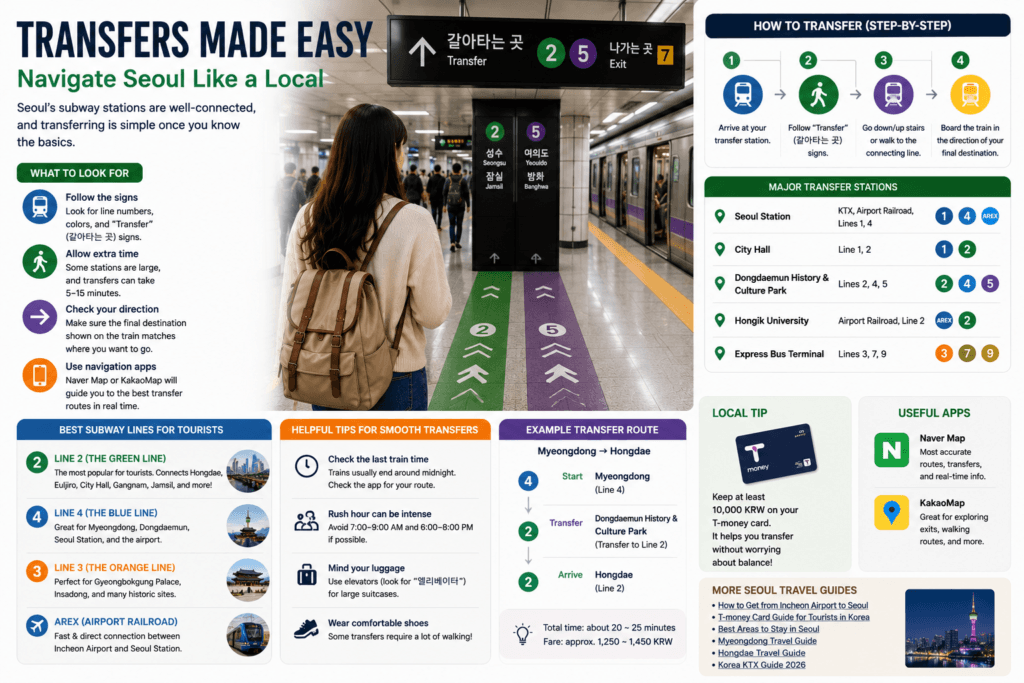
Transfers are one of the reasons Seoul’s subway is so useful.
Follow transfer signs inside the paid area rather than signs to the street exit. Some connections have an extra transfer gate: use the same card there and follow the displayed route. Changing platforms is not the same as ending one journey and starting another.
For eligible bus–subway transfers, tap the same transportation card on and off each service. Board within 30 minutes after tapping out, extended to 60 minutes between 9 PM and 7 AM. A discount does not mean every leg is free: distance and higher base fares can still add charges. See Seoul’s transfer rules; same-route bus reboarding is not a discounted transfer.
If you accidentally leave the gates, ask station staff before assuming re-entry will be free. A limited 15-minute re-entry arrangement exists on specified sections; it is not permission to leave any station for a quick shopping trip.
Popular transfer stations include Seoul Station, City Hall, Dongdaemun History & Culture Park, Hongik University, Express Bus Terminal, and Wangsimni.
Some transfers are quick. Others feel like you have accidentally entered an underground airport.
Do not worry if you need to walk for several minutes between platforms. This is normal in large Seoul stations. Follow the colored line signs and check your app if you are unsure.
If you are traveling with large luggage, avoid complicated transfers when possible. A route that is technically five minutes faster may become worse if it involves stairs, long corridors, and a suitcase with a grudge.
Plan a Day Without Crossing Seoul Repeatedly
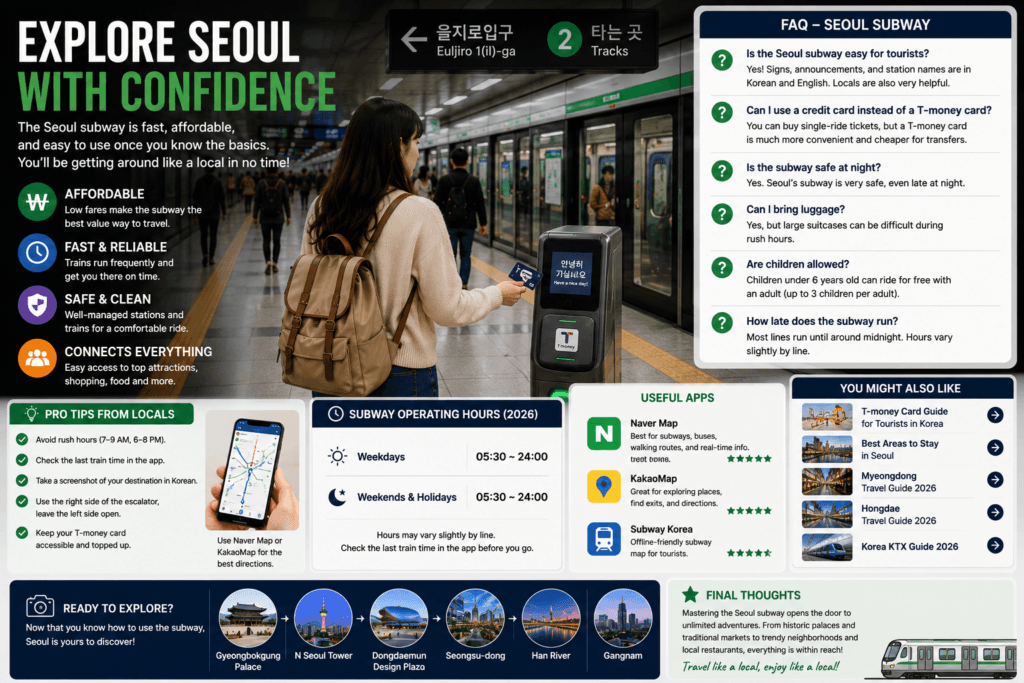
Group nearby stops before choosing trains. Gyeongbokgung and the Anguk area make a more coherent historic-neighborhood day than bouncing between Jamsil, Hongdae and Bukchon. The cheapest route is not much help if it spends half your afternoon undoing the previous journey.
For shopping, choose the actual store or market entrance as your app destination, not just the neighborhood name. For parks and riverside stops, check the final walking section and return station too. A station beside one corner of a large park may be nowhere near the cafe you saved.
Seoul Subway Etiquette
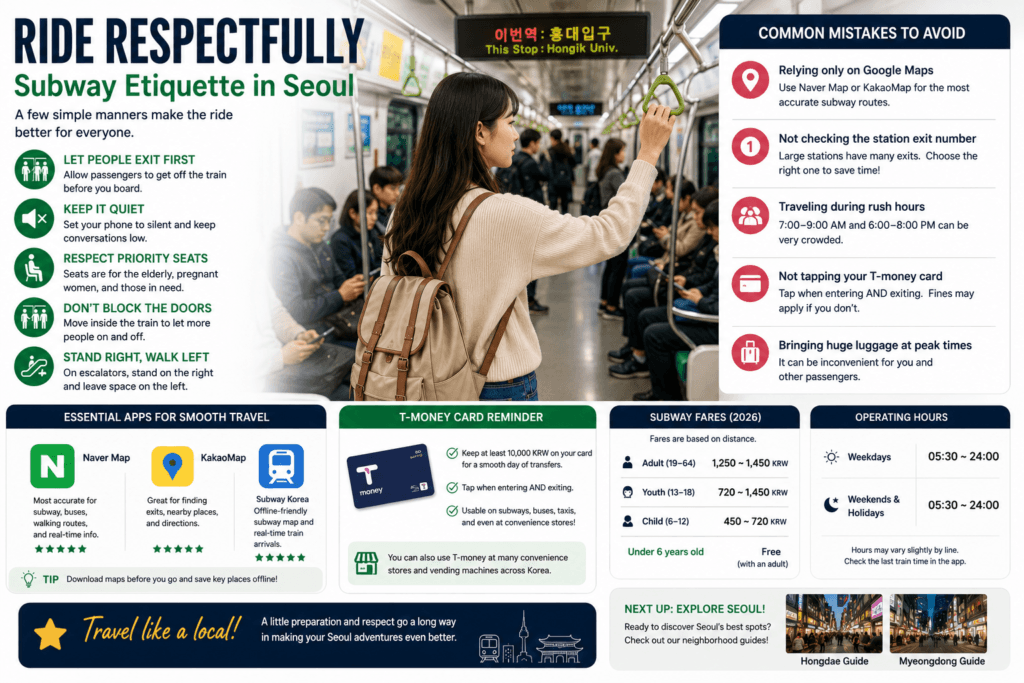
Seoul’s subway is efficient partly because most passengers follow a few simple habits.
Let passengers exit before boarding. Stand to the side of the doors, wait for people to get off, then board.
Keep your voice low. Talking is fine, but most passengers avoid loud conversations, speakerphone calls, or noisy videos.
Respect priority seats. Seats marked for elderly passengers, pregnant women, people with disabilities, and others who need them should be left available.
Do not block the doors. During busy times, move inside the train when possible so others can board and exit.
Be careful with backpacks. On crowded trains, wearing a large backpack can bump into other passengers. Hold it in front of you or place it low when the train is packed.
On escalators, hold the handrail, keep your suitcase secure and follow posted safety instructions. Do not feel pressured to walk just because someone else does.
These small habits make the ride smoother for everyone.
Rush Hour and Late-Night Travel
Rush hour can be intense in Seoul.
The busiest times are usually weekday mornings and early evenings, especially around major business districts and transfer stations. Trains can become very crowded, and getting on with large luggage can be uncomfortable.
If you have a suitcase, avoid rush hour when possible. Airport routes, Seoul Station, Gangnam, and major transfer stations can be especially difficult with luggage.
Late at night, the subway is generally safe, but it does not run all night. Most services operate from early morning until around midnight, but exact last train times vary by line, station, and direction.
Check the last usable connection for your whole route, including any transfer—not merely the last departure from the first platform. A late train may terminate before your destination. Missing the last train is not the end of the world, but it may turn your cheap subway night into a taxi bill with dramatic timing.
Can You Bring Luggage on the Seoul Subway?
Yes, you can bring luggage on the subway.
The better question is whether you want to.
Small suitcases are usually fine outside rush hour. Large suitcases can be difficult at crowded stations, especially if you need to transfer, use stairs, or ride during peak commuting times.
If your hotel is close to a subway station with elevators, the subway can be a good option. If your hotel is far from the station, your luggage is heavy, or you arrive late at night, an airport bus or private transfer may be easier.
For arrival planning, compare Korea Airport Bus Guide 2026, How to Get from Incheon Airport to Seoul, and Incheon Airport transfer to Seoul.
Common Mistakes First-Time Visitors Make
The most common mistake is relying only on Google Maps. Download Naver Map or KakaoMap before your trip. They are much more useful for subway routes, station exits, and public transportation planning in Korea.
Another mistake is ignoring exit numbers. Large Seoul stations can have many exits, and the wrong exit can leave you walking much farther than necessary.
Many travelers also forget to tap out when exiting. Always tap your transportation card at both entry and exit gates. The system calculates fares based on your trip.
Do not keep your T-money card buried deep inside your bag. You will use it often, especially if you transfer between subway and bus.
Avoid rush hour with luggage if possible. The subway may be efficient, but a large suitcase during peak commute time can make you feel like the villain in someone else’s morning.
Finally, do not assume taxis are always faster. For many central Seoul routes, the subway is quicker, cheaper, and less stressful than sitting in traffic.
Frequently Asked Questions
Is the Seoul subway easy for tourists?
Yes. The Seoul subway is very tourist-friendly, with English station names, clear signs, frequent trains, and useful navigation apps.
Do I need a T-money card?
A T-money card or similar transportation card is strongly recommended. It is easier than buying single-use tickets and can also be used on buses and many taxis.
Can I use a credit card instead of a T-money card?
Do not plan on tapping an ordinary overseas bank card directly at subway gates. Selected new vending machines accept overseas cards for short-term Climate Cards and single-journey tickets; you still use the resulting transit card or ticket to travel. Machine payment and gate payment are different things.
How much does the Seoul subway cost?
Adult starting fares are KRW 1,550 with a transportation card or KRW 1,650 with a single-journey ticket. The latter also requires a refundable KRW 500 deposit. Longer journeys and certain services can cost more.
Is the Seoul subway safe at night?
Yes. Seoul’s subway is generally safe, including in the evening. However, trains do not run all night, so check the last train time if you are staying out late.
Can I bring luggage on the subway?
Yes, but avoid rush hour if possible. Large suitcases can be inconvenient in crowded trains or stations with long transfers.
What is the most useful subway line for tourists?
Line 2 is one of the most useful lines for visitors because it connects areas such as Hongdae, Gangnam, City Hall, Jamsil, and Seongsu.
How late does the Seoul subway run?
Most services run from early morning until around midnight, but the exact last train depends on the line, station, and direction.
Which app should I use for the Seoul subway?
Naver Map or KakaoMap is recommended for subway routes, transfers, station exits, and travel time.
Recommended Travel Services
Optional booking links for arrival planning; these are not required to ride the subway. Check the product’s exact card type, pickup point, inclusions and any preloaded balance before paying:
- Korea eSIM for travelers
- Incheon Airport transfer to Seoul
- Seoul hotel deals near subway stations
- T-money card or Korea transport card options
Related Guides
Continue planning your Seoul trip with these guides:
- How to Get from Incheon Airport to Seoul
- T-money Card Guide for Tourists in Korea
- Best eSIM for Korea 2026
- Best Areas to Stay in Seoul
- Myeongdong Travel Guide 2026
- Hongdae Travel Guide 2026
- Gyeongbokgung Palace Guide 2026
- Korea Airport Bus Guide 2026
Final Thoughts
The Seoul subway may look intimidating on your first day.
By your third day, you will probably be using it like everyone else.
That is one of the reasons Seoul is such an easy city to explore. The subway is fast, affordable, safe, reliable, and surprisingly simple once you understand the basics.
Start with a T-money card, download Naver Map or KakaoMap, check your exit number, avoid rush hour with luggage, and do not be afraid of transfers. Some stations are huge, but the signs are usually clear enough to guide you through the underground maze.
Once you are comfortable with the subway, Seoul becomes much easier to enjoy.
Palaces, markets, cafes, shopping streets, river parks, food neighborhoods, and nightlife all begin to feel connected. And that is when the city stops feeling overwhelming and starts feeling wonderfully reachable.
Sources and Review Notes
Reviewed October 6, 2026 using Seoul’s official subway fare guide, single-journey ticket instructions, transfer rules, current short-term Climate Card coverage and 30-day card discontinuation notice. The newer Korean short-term guidance takes priority over older coverage details remaining on the English overview. This was a document review, not a test of an overseas card, kiosk or app. Check your actual travel date, route and final payment screen.