If you are planning to use public transportation in South Korea, getting a T-money card should be one of the first things on your travel checklist.
It is not the most exciting purchase of your trip. It will not photograph better than a palace, a bowl of tteokbokki, or a Jeju sunset. But once you start using subways and buses in Korea, a T-money card quickly becomes one of the most useful things in your pocket.
Instead of buying a ticket every time you ride the subway or bus, you simply tap your card and keep moving. For first-time visitors, that small convenience makes Korea’s public transportation system feel much easier.
Whether you are exploring Seoul, arriving from Incheon Airport, visiting Busan, or traveling through several Korean cities, a T-money card is one of the simplest ways to pay for local transportation.
This guide explains how to buy, recharge, use, and refund a T-money card in Korea in 2026, plus common mistakes tourists should avoid.
If this is your first trip to Seoul, read Seoul Subway Guide 2026 and How to Get from Incheon Airport to Seoul before arriving.
This article may contain affiliate links, which means we may earn a small commission if you book through them, at no extra cost to you.
Table of contents
What Is a T-money Card?
A T-money card is a rechargeable transportation card used in South Korea.
You load money onto the card, then tap it when using public transportation. It works on Seoul subways, city buses, many taxis, and public transportation systems in many Korean cities.
For most tourists, T-money is useful because it removes the need to buy single-use subway tickets or pay cash on buses. You can simply tap in, tap out, and continue your trip.
T-money can be used for:
- Seoul subway
- City buses
- Airport Railroad all-stop train
- Many taxis
- Public transportation in many Korean cities
- Some convenience stores and selected shops
Transportation is still the main reason to get one. Convenience store use is a bonus, not the main event.
Think of T-money as your small plastic permission slip to move around Korea without arguing with ticket machines every morning.
Why Tourists Should Use a T-money Card
A T-money card makes travel easier in several ways.
First, it saves time. You do not need to buy a subway ticket for every ride. This matters more than you expect, especially when you are moving between areas like Myeongdong, Hongdae, Gangnam, Dongdaemun, and Gyeongbokgung.
Second, it makes transfers easier. Seoul’s public transportation system is designed around subway and bus transfers, and using a transportation card helps the fare system calculate your trip properly.
Third, it can be cheaper than single-use tickets. In Seoul, transportation card fares are lower than single-use ticket fares for standard subway rides.
Fourth, it works beyond one neighborhood or one city. Many travelers use the same card across Seoul, Busan, Incheon, and other major areas.
For most visitors, the question is not really “Do I need T-money?”
It is “How soon should I get one?”
The answer is usually: before your first subway or bus ride.
Where to Buy a T-money Card
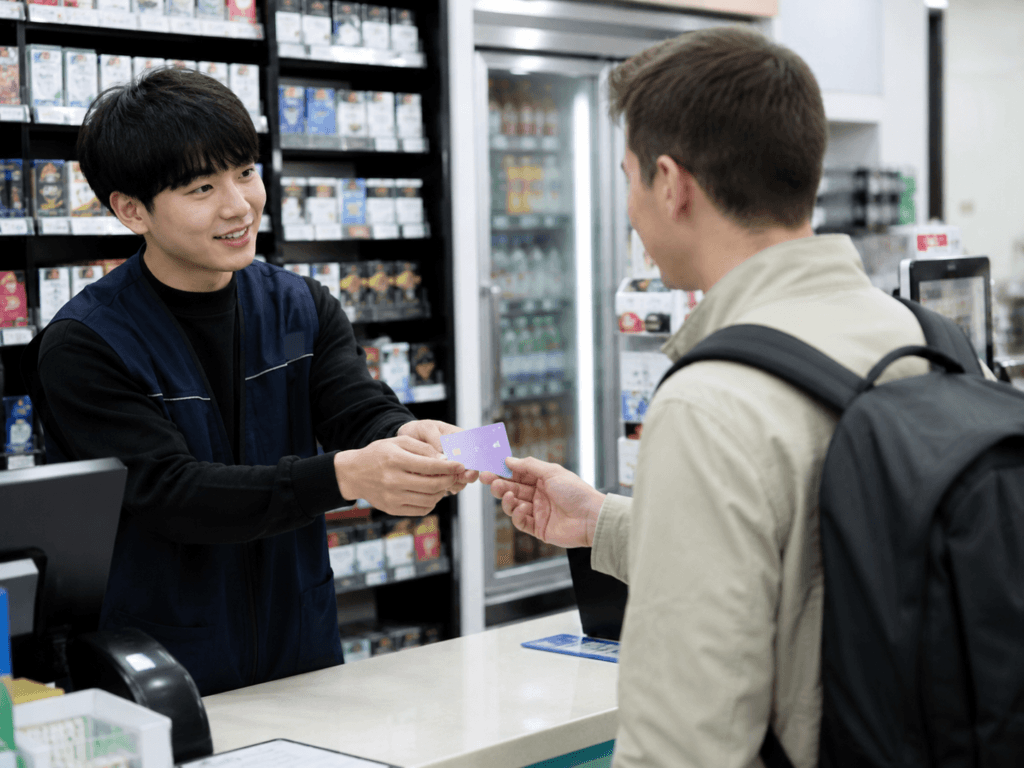
The most common places are convenience stores, including CU, GS25, 7-Eleven, emart24, and other major chains. You can also find T-money cards at some subway stations, transportation card vending machines, airport locations, and T-money sales points.
Incheon International Airport is a common place to buy one, especially if you plan to use public transportation immediately after landing.
Convenience stores are often the easiest option. Walk in, ask for a T-money card, choose a design if options are available, and pay for the card. Then add balance before using it.
Card designs vary. Some are plain, while others feature characters, K-pop designs, cute illustrations, or special editions. The cute version does not make the subway arrive faster, but it does make the wallet feel slightly happier.
If you prefer to arrange travel basics before arrival, you can also look for T-money card or Korea transport card options.
How Much Does a T-money Card Cost?
Basic cards are generally KRW 3,000–5,000 according to VISITKOREA’s transport-card overview. Designs and special editions can cost more, so check the shelf price.
This card purchase cost is separate from the balance you load onto it. For example, if you buy a card and add 20,000 KRW, the card price and the transport balance are not the same thing.
The card purchase cost is generally not refundable. Only the remaining balance can be refunded, usually with a small service fee.
For most short-term travelers, it is better not to overcharge the card. Add enough for your first few days, then top up when needed.
How Much Should You Recharge?
KRW 10,000–20,000 is a practical starting balance for many short Seoul visits, not a promise that it will cover your whole trip. Airport travel, longer distances and extra bus journeys can change the total.
If you are staying only a few days and using the subway casually, 10,000 KRW may be enough to begin. If you will use subways and buses several times a day, start with 20,000 KRW.
Treat these as starting deposits, not all-in transport budgets:
- 3-day Seoul trip: start with 10,000 to 15,000 KRW
- 5-day Seoul trip: start with 20,000 KRW
- 7-day Korea trip: start with 20,000 to 30,000 KRW
- Longer trip: recharge as needed
Do not load a huge amount on your first day. You can recharge easily, and leftover balance requires a refund process later.
T-money is useful, but it does not need to become your tiny prepaid savings account.
How to Recharge a T-money Card
You can recharge a T-money card at subway station machines, convenience stores, and official top-up locations.
At subway stations, look for ticket or recharge machines. Many machines support English, Japanese, Chinese, and Korean, which makes the process easier for visitors.
At convenience stores, hand your card to the cashier and say how much you want to add. You can also show the amount on your phone if you are nervous about pronunciation.
One important thing to know: cash is still useful for recharging T-money.
Korea is very card-friendly for shopping and restaurants, but transportation card top-ups may still require Korean won cash in many situations. Keep some small bills available so you are not trapped at a recharge machine with only a foreign credit card and rising regret.
The new overseas-card payment option is easy to misunderstand. Seoul’s March 17, 2026 announcement covers short-term Climate Cards and single-journey tickets at new machines on Lines 1–8, with a service fee averaging about 3.7%. It does not promise ordinary T-money top-ups with a foreign bank card at every machine. Buying a ticket by bank card is also different from tapping that bank card at a subway gate.
For money tips, read Korean Currency Guide 2026, Cash vs Card in Korea 2026, and Korea ATM Guide 2026.
How to Use T-money on the Subway
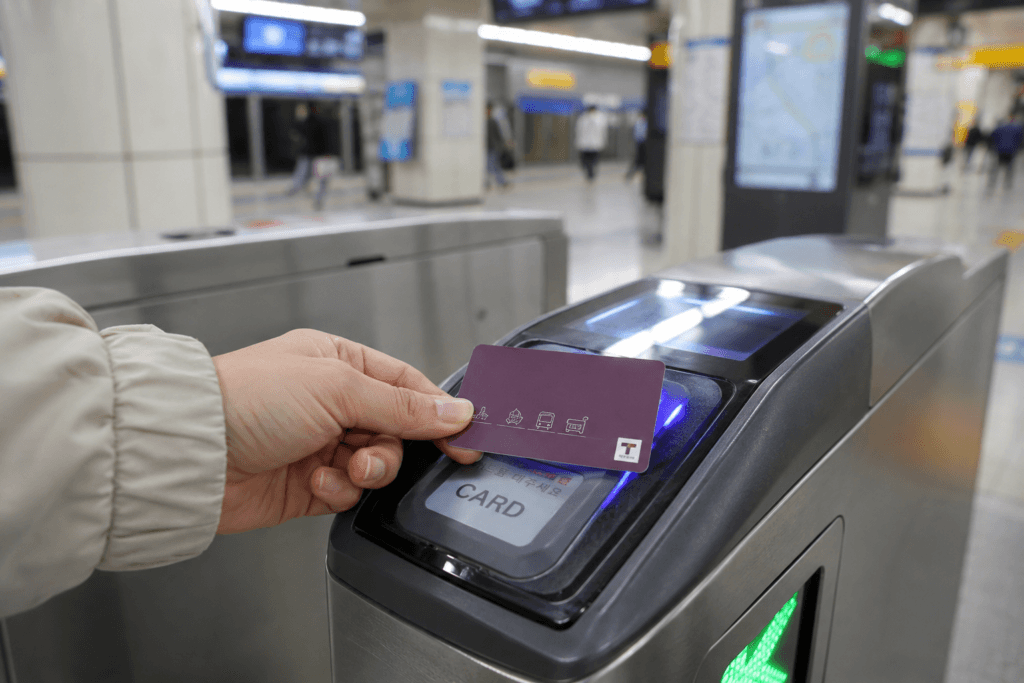
Using T-money on the subway is simple.
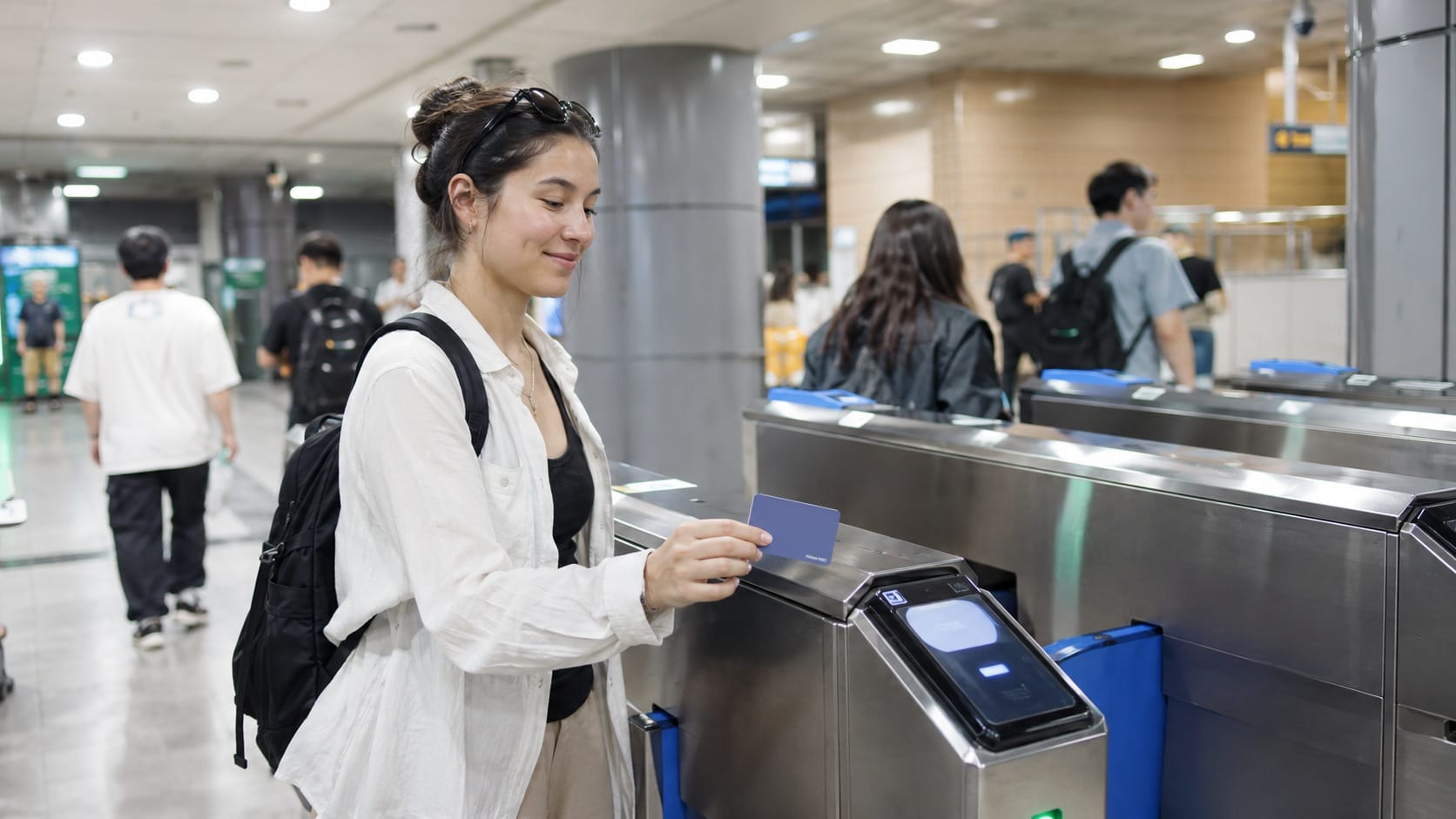
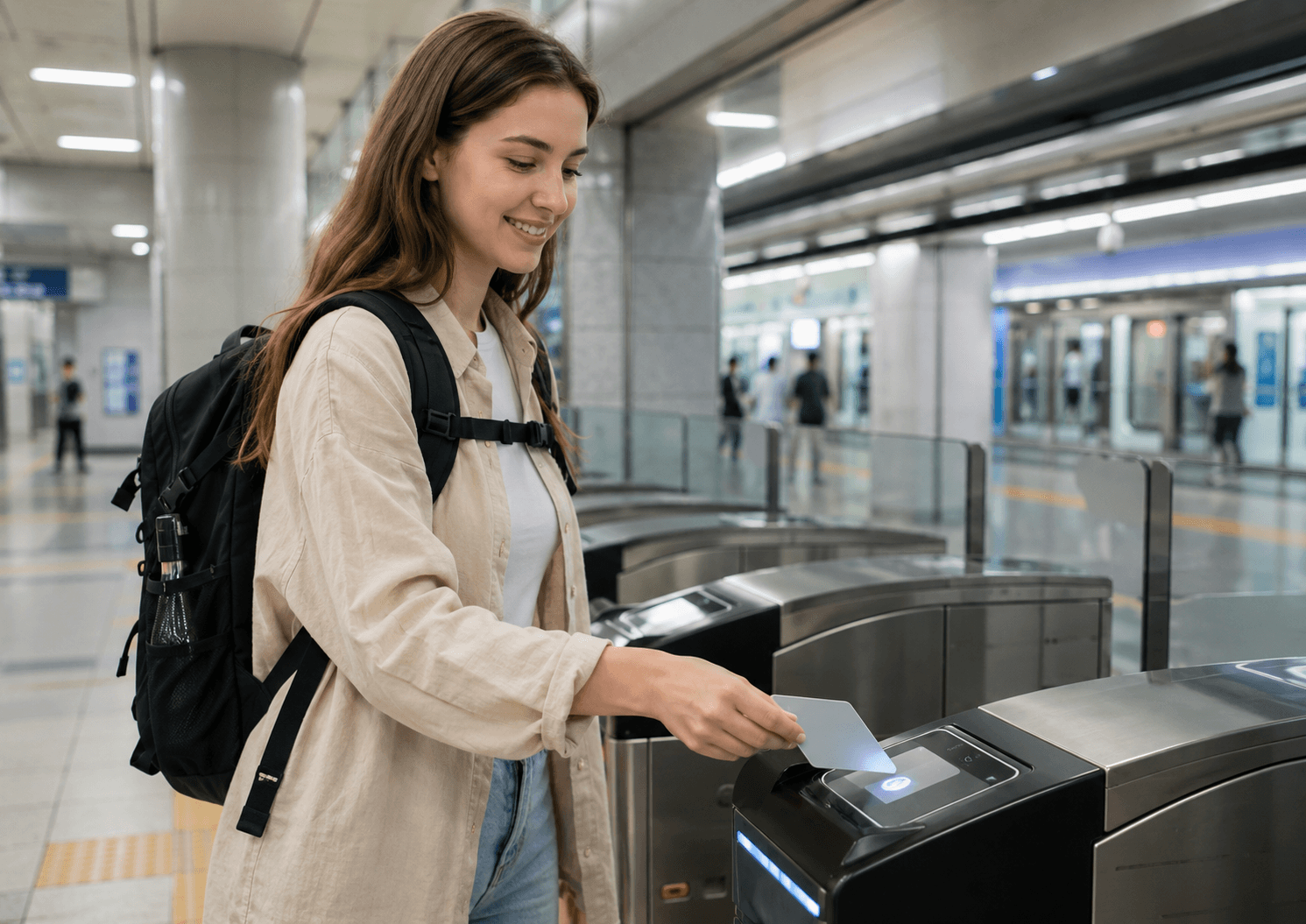
Tap your card at the gate when entering the station. When you arrive at your destination, tap again when exiting.
The system calculates your fare based on your route and distance. If your balance is too low, the gate may not open, so keep enough money on the card before entering.
Seoul’s adult starting subway fare is KRW 1,550 with a transportation card, compared with KRW 1,650 for a single-journey ticket, according to the official fare guide checked October 6, 2026. Distance charges and certain services’ surcharges can increase the total.
For subway routes, transfers, station exits, and tourist-friendly lines, read Seoul Subway Guide 2026.
How to Use T-money on Buses
Using T-money on buses is also easy, but there is one important habit:
Tap when you get on, and tap when you get off.
Many first-time visitors forget the second tap. Do not skip it. Tapping off helps the system calculate the correct fare and transfer discount. It is especially important if you are transferring between buses or between bus and subway.
When boarding, tap your card near the driver. Before getting off, tap the reader near the exit door.
If you are not sure what to do, watch local passengers. Korean buses are excellent teachers if you observe quietly for five seconds.
For eligible Seoul bus–subway transfers, use the same card and board within 30 minutes after tapping off, or within 60 minutes from 9 PM to 7 AM. Discounted does not mean every leg is free: distance and a higher base fare may still add charges. Reboarding the same bus route is not a discounted transfer. See Seoul’s transfer rules, and use one card per traveler for straightforward subway-and-bus journeys.
Can You Use T-money on Taxis?
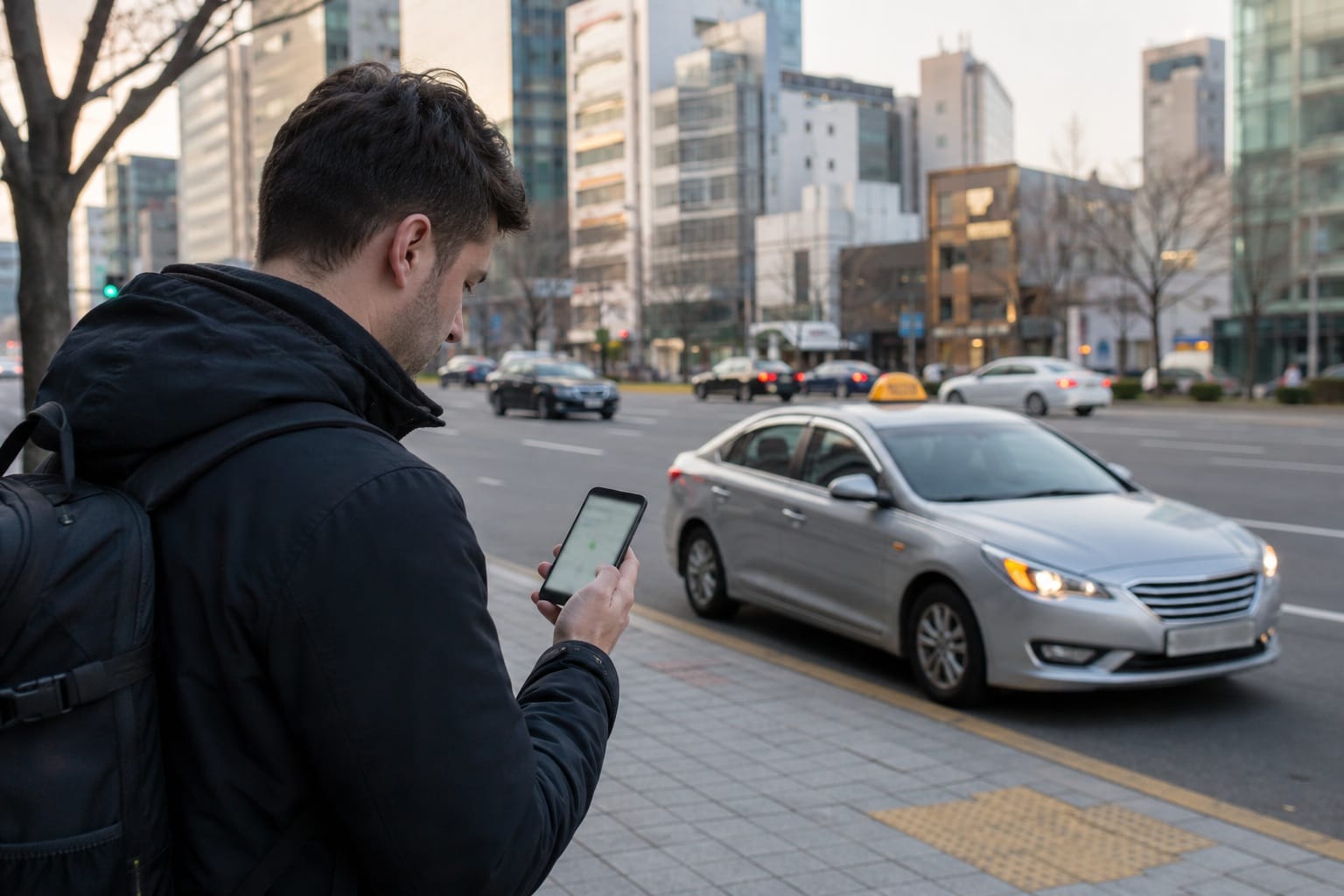
Yes, many taxis in Korea accept T-money.
However, tourists should not rely on T-money as their only taxi payment method. Some taxis may accept it, but credit cards, cash, or taxi app payments may be more practical depending on the situation.
If you want to pay by T-money, tell the driver before paying and look for the card reader.
For airport arrivals or late-night transportation, compare How to Get from Incheon Airport to Seoul, Korea Airport Bus Guide 2026, and Incheon Airport transfer to Seoul.
Can Tourists Use T-money Outside Seoul?
Yes. One of the best things about T-money is that it can be used in many parts of South Korea.
Travelers commonly use the same card in Seoul, Busan, Incheon, Daejeon, Daegu, Gwangju, and other major areas, depending on local transport acceptance.
This makes it useful if your Korea itinerary includes multiple cities. You can use the same card while exploring Seoul neighborhoods like Myeongdong, Hongdae, Dongdaemun, and Gangnam, then continue using it for local transportation in Busan.
If your trip includes other cities, read Korea KTX Guide 2026, Busan Travel Guide 2026, and Top 10 Places to Visit in South Korea.
T-money vs Single-Use Tickets
For most tourists, T-money is better than single-use subway tickets.
Single-use tickets require extra steps. You need to buy the ticket, choose the destination, pay the fare, and sometimes manage a deposit refund depending on the ticket system. It works, but it is slower.
T-money is simpler. Recharge once, then tap as you travel.
Choose T-money if:
- You will use public transportation more than once
- You are staying in Seoul for several days
- You plan to use buses
- You want easier transfers
- You are visiting more than one Korean city
Use single-use tickets only if:
- You are taking just one or two subway rides
- You forgot to buy a card
- You are leaving Korea very soon
- You prefer not to manage a rechargeable balance
For repeated rides across different cities, T-money is a practical default. For one or two subway journeys, buying individual tickets may be enough; for a busy Seoul-only stay, compare a short-term pass before deciding.
T-money vs Climate Card
Some travelers now wonder whether they should use T-money or the Climate Card.
The Climate Card offers unlimited travel on covered routes for short visits. Adult 1 / 2 / 3 / 5 / 7-day passes cost KRW 5,000 / 8,000 / 10,000 / 15,000 / 20,000, plus KRW 3,000 if you need the physical card. Validity begins on the day you recharge, so loading it just before bed is not a clever head start.
Coverage changed on October 1, 2026: follow Seoul’s current short-term pass guidance, not older broad Gyeonggi coverage maps. It covers Seoul subway routes and Seoul-licensed city/town buses, excluding services such as Sinbundang, GTX, intercity and airport buses. The specified AREX exception lets a covered journey finish at Incheon Airport T1/T2; you cannot board there with this pass.
Tourist short-term passes continue, but the former prepaid 30-day Climate Card stopped accepting reloads after August 31, 2026. The resident-oriented replacement Climate Pass is a different product. A card with “climate” in its name is not automatically the right pass for a visitor.
But it does not replace T-money for every traveler.
T-money is more flexible. It works for many city transportation systems beyond Seoul and is easy for subway, buses, and many taxis.
The Climate Card can be useful if:
- You are staying mostly in Seoul
- You will ride subways and buses many times a day
- You understand its coverage limits
- You are not relying on airport buses or intercity transportation
T-money is better if:
- You want the simplest option
- You are traveling outside Seoul
- You are using taxis sometimes
- You are visiting Busan, Jeju, or other regions
- You do not want to calculate whether a pass is worth it
For most first-time tourists, T-money is still the easiest starting choice. The Climate Card is worth considering only if your Seoul plan involves heavy public transportation use.
T-money vs WOWPASS vs NAMANE
T-money, WOWPASS, and NAMANE can be confusing because they all sound useful for travelers.
They are not exactly the same thing.
T-money is mainly a transportation card.
WOWPASS is more like a prepaid payment card for foreign travelers, often used for shopping and payments, with a transportation card function included depending on the product.
NAMANE is a customizable prepaid card that can also include transportation features depending on how it is set up.
For simple public transportation, T-money is usually enough.
If you want a payment card for shopping, cash exchange, or card payments, WOWPASS or NAMANE may be worth comparing. But do not overcomplicate your first day. If your main goal is to ride the subway and bus, a basic T-money card does the job.
Travel tools should make your trip easier, not turn your wallet into a small committee meeting.
Can You Get a Refund on a T-money Card?
For a working physical T-money card, you can normally request a refund of the remaining stored balance. The refund route depends on the amount and location; it is not a service every top-up counter offers.
For a modest balance, ask a participating convenience store whether your amount is within its refund limit. Do not assume every chain has the same cap. For larger amounts, arrange a suitable service counter before airport departure: VISITKOREA points visitors with more than KRW 50,000 to Tmoney Town near Seoul Station. Confirm its opening hours and requirements before making the trip. Ask for the applicable refund fee and the amount you will receive before agreeing. An ordinary balance refund does not return the card’s purchase price. Damaged or unreadable cards need a different process; do not count on a convenience store settling those before your flight.
Because of this, it is better to avoid loading too much money onto the card.
Many travelers use leftover balance for small purchases at convenience stores before leaving Korea, then refund only if a meaningful balance remains.
If the remaining amount is small, it may not be worth the time. Sometimes the most peaceful refund strategy is buying airport snacks and calling it a financial victory.
Common Mistakes Tourists Make
The most common mistake is waiting too long to buy a T-money card.
If you plan to use the subway or bus, get one early. It makes your first few days much smoother.
Another mistake is not carrying cash for recharge. Even if your credit card works almost everywhere else, transportation card top-up can still be cash-based in many places.
Many visitors also forget to tap off when leaving buses. Always tap when you board and when you get off.
Do not load too much money at once. You can top up easily, and refunds take extra effort.
Some travelers assume T-money works for everything. It is very useful, but it is not a replacement for all payment methods. You still need a credit card, debit card, or cash for many restaurants, shops, hotels, and attractions.
Finally, do not confuse T-money with intercity train tickets. T-money is not how you book KTX trains. For high-speed rail, read Korea KTX Guide 2026.
First-Time Visitor Tips
Buy your T-money card as soon as possible after arriving if you plan to use public transportation.
Keep it in an easy-to-reach place. You will tap it often, especially in Seoul.
Start with a modest balance, then recharge when needed. For most visitors, 10,000 to 20,000 KRW is a comfortable starting amount.
Use Naver Map or KakaoMap to plan routes before entering stations. These apps are better than relying only on Google Maps for public transportation in Korea.
If you are arriving at Incheon Airport and going directly to your hotel, decide first whether you are using AREX, airport bus, taxi, or private transfer. You may not need T-money immediately if you are taking a private transfer, but you will likely use it later in Seoul.
Set up mobile data before leaving the airport if possible. A Korea eSIM for travelers can make maps, subway routes, and app setup much easier from day one.
Frequently Asked Questions
Do tourists need a T-money card in Korea?
Most tourists who plan to use subways or buses should get a T-money card. It is convenient, easy to use, and works across many public transportation systems.
Where can I buy a T-money card?
You can buy T-money cards at convenience stores, some subway stations, Incheon Airport locations, and T-money sales points.
Can I recharge T-money with a credit card?
Keep Korean won for ordinary physical T-money top-ups. The overseas-card option at selected Seoul machines is officially announced for short-term Climate Cards and single-journey tickets; it is not a guarantee of foreign-card T-money recharging everywhere.
How much should I put on a T-money card?
For most short Seoul trips, 10,000 to 20,000 KRW is a good starting amount. You can recharge later if needed.
Can I use T-money on the Seoul subway?
Yes. T-money is one of the easiest ways to pay for the Seoul subway. Tap when entering and exiting the station.
Can I use T-money on buses?
Yes. Tap when boarding and tap again when getting off, especially if you want correct fares and transfer discounts.
Can I use T-money in Busan?
Yes, T-money can be used on public transportation in many Korean cities, including Busan, though local acceptance can vary by service.
Can I refund my T-money balance?
For a working physical card, ask a participating location about its balance limit and refund fee. Larger balances can require a separate service counter. The ordinary balance-refund process does not refund the card purchase price.
Is T-money better than the Climate Card?
For most first-time tourists, T-money is simpler and more flexible. The Climate Card can be better if you will ride public transportation many times within Seoul during a short stay.
Can I use T-money for KTX?
No. T-money is mainly for local transportation such as subway and buses. KTX tickets must be booked separately.
Related Guides
Continue planning your transportation setup with these guides:
- Seoul Subway Guide 2026
- How to Get from Incheon Airport to Seoul
- Best eSIM for Korea 2026
- Korea SIM Card Guide 2026
- Korea Internet Guide 2026
- Best Apps for Korea Travel 2026
- Korean Currency Guide 2026
- Cash vs Card in Korea 2026
- Korea ATM Guide 2026
- Korea KTX Guide 2026
Official Sources and Last Check
Last reviewed October 6, 2026. Transport-card rules, reload methods and refund limits can change. Before relying on a specific counter, kiosk or payment method, compare this guide with the Seoul Metropolitan Government public transportation guide and VISITKOREA’s official transportation-card overview.
This review compared official transport-card, fare and payment guidance; it was not a test of an overseas card, app or refund counter. For current Climate Card coverage, the October 1 Korean Seoul guidance takes priority over older maps. For overseas kiosk payment, use the dated March announcement rather than an older overview saying only Korean cards work.
The simple rule that causes the fewest surprises is still this: keep a small amount of cash available, check the machine or counter before committing to a reload, and tap when you leave as well as when you board.
Final Thoughts
A T-money card is one of the simplest and most useful things you can buy during a trip to South Korea.
It will not be the most glamorous part of your itinerary, but it will quietly make every subway ride, bus transfer, and neighborhood hop easier.
For most first-time visitors, the best approach is simple: buy a T-money card early, add a modest balance, keep some cash for recharging, tap when entering and exiting, and avoid loading more money than you expect to use.
Once you have mobile data, a navigation app, and a T-money card, Korea’s public transportation system becomes much easier to use.
That is when the city starts to feel less like a map full of lines and more like a place you can actually move through with confidence.