Affiliate disclosure: This guide may contain affiliate links. If you book through them, we may earn a small commission at no extra cost to you. Learn more.
Planning a trip to South Korea in 2026? Before you start choosing cafes in Seongsu, saving restaurant pins in Myeongdong, or trying to convince your suitcase that “just one more outfit” is reasonable, there is one less glamorous but very important thing to check first: entry requirements.
The good news is that for many travelers from the United States, the United Kingdom, Canada and Australia, visiting South Korea in 2026 is still fairly simple. In most short-term travel cases, you do not need a tourist visa. You may also be temporarily exempt from applying for K-ETA until December 31, 2026.
But there is one detail many travelers miss: K-ETA exemption does not automatically mean every arrival declaration requirement disappears.
This guide explains South Korea’s 2026 entry rules in plain English, including who needs a visa, whether K-ETA is required, how the e-Arrival Card works, what documents to prepare before flying, and common mistakes to avoid.
If this is your first time visiting Korea, you may also want to read our Incheon Airport to Seoul Guide after this, because getting through immigration is only step one. Step two is figuring out how to reach your hotel without turning your first hour in Korea into a luggage-dragging marathon.
Table of contents
Quick Answer: What Do Travelers Need to Enter South Korea in 2026?
For most short-term travelers from the United States, United Kingdom, Canada and Australia, the basic 2026 entry checklist looks like this:
- A valid passport
- No tourist visa for most normal short-term tourism visits
- No K-ETA required during the temporary exemption period, currently until December 31, 2026
- An arrival declaration, which may be completed through the official e-Arrival Card system if required
- Your first accommodation address in Korea
- A return or onward ticket, which may be requested
- Travel details that match your passport and flight information
For most visitors, the process is not difficult. The main problem is confusion. Some websites still make it sound like everyone must apply for K-ETA, while others skip the arrival declaration part completely. That is where people start opening 17 browser tabs and quietly questioning their life choices.
Here is the simple version: if your passport country is covered by the temporary K-ETA exemption, you usually do not need to pay for K-ETA before your Korea trip in 2026. However, you should still check whether you need to complete an arrival declaration, either online through the official e-Arrival Card system or by following the process provided at the airport or by your airline.
Do You Need a Visa to Visit South Korea in 2026?
Many travelers from visa-free countries can visit South Korea without a tourist visa for short stays. This usually includes travelers from the United States, United Kingdom, Canada and Australia when visiting for tourism, short business trips, family visits or similar non-working purposes.
That does not mean every traveler can enter for any reason. A visa may still be required if you are planning to work, study, teach, stay long-term, join certain paid activities, perform, receive payment, or move to Korea for family or residence reasons.
For a normal vacation, though, most travelers from these four countries can enter Korea without applying for a tourist visa in advance.
A simple way to think about it:
If you are coming to Korea for sightseeing, food, shopping, palaces, cafes, skincare, baseball games, mountain views, or to finally test whether Korean fried chicken is as powerful as the internet says, you probably fall under short-term tourism.
If you are coming to work, study, earn money, teach, or stay for a long period, do not rely on tourist entry rules. Check the correct visa category before booking your flight.
What Is K-ETA?
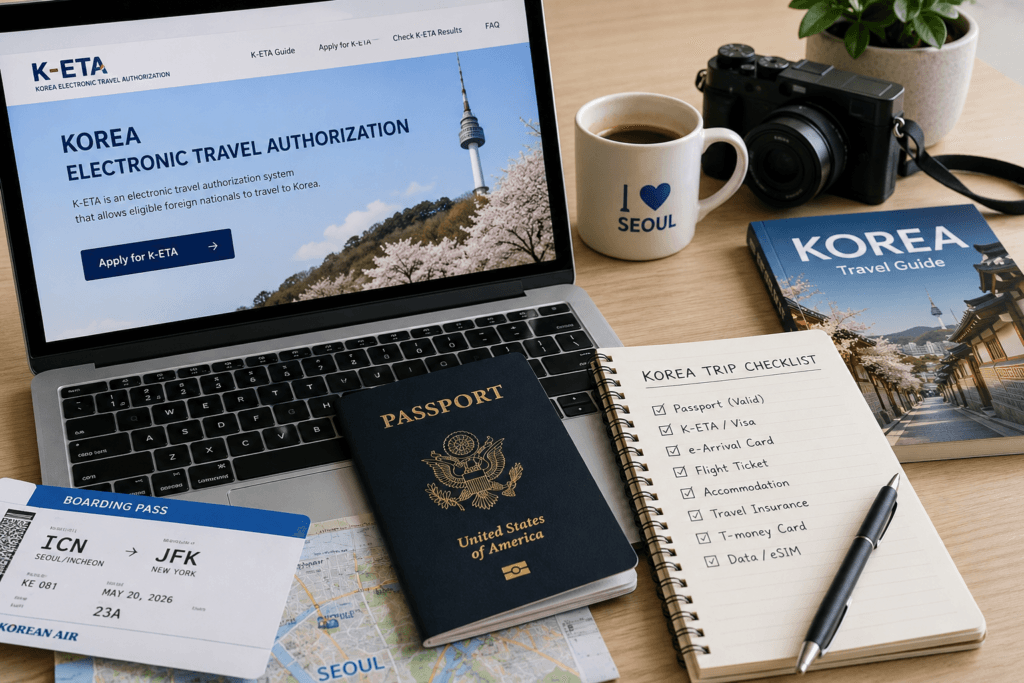
K-ETA stands for Korea Electronic Travel Authorization. It is an online travel authorization system for travelers who can enter South Korea without a visa.
Before the temporary exemption, many visa-free travelers had to apply for K-ETA before boarding their flight to Korea. The application required passport details, travel information, a photo and a fee.
In 2026, travelers from selected countries and regions are temporarily exempt from K-ETA until December 31, 2026. This includes many major tourist markets, including the United States, United Kingdom, Canada and Australia.
That means many travelers from these countries can visit Korea without applying for K-ETA during the exemption period.
Still, there is a small twist. Travelers who already have a valid K-ETA, or who choose to apply voluntarily, may be exempt from submitting an arrival card. So K-ETA is not always “needed,” but it can still have a practical benefit for some travelers.
For most first-time tourists in 2026, though, the key point is this:
You probably do not need to apply for K-ETA if your passport country is covered by the temporary exemption. But you still need to handle your arrival declaration properly.
K-ETA Rules for US, UK, Canadian and Australian Travelers
Here is how the 2026 K-ETA situation looks for the main traveler groups this guide focuses on.
United States Travelers
US passport holders visiting South Korea for short-term tourism or business generally do not need a visa for stays of 90 days or less.
In 2026, US travelers are included in the temporary K-ETA exemption. This means most US tourists do not need to apply for K-ETA before visiting Korea during the exemption period.
You should still make sure your passport information, flight details and accommodation address are ready before travel. Immigration is usually smooth when your documents match cleanly. It gets less charming when your hotel address is hiding somewhere in your email like a shy raccoon.
United Kingdom Travelers
British citizens traveling to Korea for short-term tourism or business can generally visit without a visa for up to 90 days.
British nationals traveling visa-free are temporarily exempt from K-ETA until December 31, 2026. This makes Korea easier to visit in 2026, especially for first-time travelers who are already juggling flights, hotels, transport cards and a suspiciously long food list.
UK travelers should still check official guidance before departure, especially if they hold a different type of British passport or are traveling for a purpose other than tourism.
Canadian Travelers
Canadian passport holders do not usually need a tourist visa for short visits to South Korea. Canadians are also temporarily exempt from the K-ETA requirement until December 31, 2026.
This is useful for travelers planning a first Korea trip, especially if Seoul is part of a bigger Asia itinerary. Even when the entry process is simple, keep your stay details organized. You may need your hotel address for the arrival declaration, so it helps to book at least your first accommodation before flying.
If you are still deciding where to stay, our Best Areas to Stay in Seoul guide can help you choose between places like Myeongdong, Hongdae, Gangnam and Insadong.
Australian Travelers
Australian passport holders can visit South Korea as tourists for short stays without applying for a visa. In 2026, Australian travelers are also temporarily exempt from applying for K-ETA until December 31, 2026.
This means many Australian tourists can enter Korea without a tourist visa and without K-ETA during the exemption period. However, the arrival declaration still matters. Do not skip it just because K-ETA is waived.
If you are landing at Incheon Airport after a long flight from Australia, it is also worth preparing your first-day transport in advance. After a long flight, nobody wants to learn airport train options while half-asleep and emotionally attached to a vending machine coffee.
Do You Still Need the e-Arrival Card?
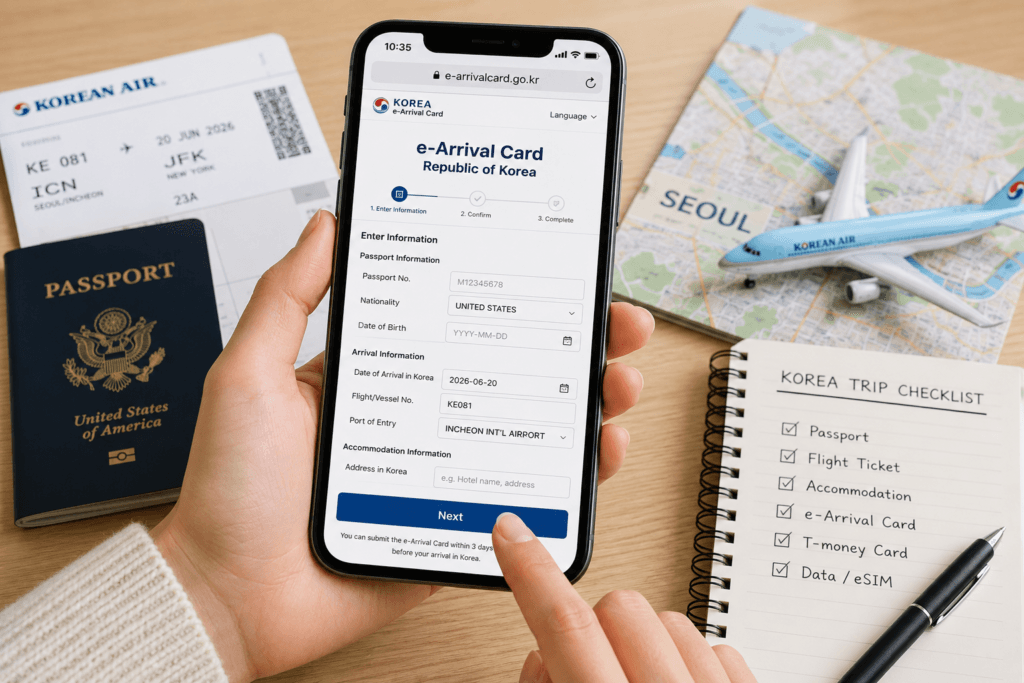
This is the part many travelers miss.
K-ETA exemption does not automatically remove every arrival declaration requirement. If you are required to submit an arrival declaration, you can usually complete it online through Korea’s official e-Arrival Card system within 3 days before arrival, or follow the arrival declaration process provided at the airport or by your airline.
The e-Arrival Card is a digital version of the arrival declaration. It asks for basic details such as your passport information, flight details, travel purpose and address in Korea.
The official e-Arrival Card system is free.
That last part is important: free.
If a website asks you to pay for an e-Arrival Card, be careful. It may be a fake or unofficial site. The official e-Arrival Card does not require a fee.
Who May Not Need to Submit an Arrival Card?
Some travelers may be exempt from submitting an arrival card. This can include travelers with a valid K-ETA, certain registered residents in Korea, and some other specific categories.
For normal short-term tourists, the easiest rule is this:
If you are entering Korea without K-ETA, check whether you need to complete the e-Arrival Card or follow the arrival declaration process provided for your flight.
This is especially important for travelers from K-ETA-exempt countries in 2026. Many people hear “K-ETA is waived” and assume all arrival paperwork is gone. That is not always true.
Think of K-ETA and the e-Arrival Card as two different doors in the same airport hallway. One may be open for you, but the other might still need a gentle knock.
When Should You Submit the e-Arrival Card?
You can submit the e-Arrival Card within 3 days before arriving in South Korea.
Do not submit it too early, because the system is designed around your upcoming arrival date. Also, do not leave it until the last second at the airport gate, because travel Wi-Fi has a talent for disappearing exactly when you need it most.
A good practical timing is:
- Submit it after your flight details are confirmed
- Submit it after your first hotel or accommodation address is ready
- Submit it within 72 hours before arrival
- Save your confirmation or issue number after submitting
- Keep your passport and flight information consistent
After submitting the e-Arrival Card, save your confirmation or issue number on your phone. You may not need to show it during every step of arrival, but keeping it available is a simple backup in case there is a question about your declaration.
For internet access after landing, you can prepare Korea eSIM options before your flight. It is not an entry requirement, but it makes your first hour in Korea much easier, especially if you need maps, hotel directions or translation apps.
What Information Do You Need for the e-Arrival Card?
Before filling out the e-Arrival Card, prepare the following:
- Passport details
- Flight information
- Arrival date
- Travel purpose
- Accommodation address in Korea
- Contact details
- Basic personal information
The accommodation address is where some travelers get stuck. If you are staying at a hotel, use the hotel’s English address. If you are staying at an Airbnb or guesthouse, copy the full address exactly as provided by the host.
This is one reason it helps to book your first hotel before submitting arrival information. You can always explore different areas later, but immigration paperwork prefers clear answers over “I will decide when I get there.”
If Seoul is your first stop, check our Best Areas to Stay in Seoul guide before booking. Choosing the right neighborhood can make your trip smoother from the first night.
Passport Validity for South Korea
Your passport should be valid for your stay in South Korea and preferably beyond your planned departure date.
Some official guidance varies by country, and airlines may also check passport validity before boarding, so avoid traveling with a passport that is close to expiring. Even if your passport technically meets the minimum requirement, a nearly expired passport can still create stress at check-in, during transit, or when plans unexpectedly change.
The safest practical rule is simple: travel with a passport that is valid beyond your planned departure date from Korea.
If your passport is close to expiring, renew it before booking major non-refundable travel plans.
Nothing ruins a Korea trip faster than being fully packed, fully caffeinated, and then stopped before the flight because your passport date looks risky.
Country-by-Country Entry Summary for 2026
Here is a simple overview for travelers from the United States, United Kingdom, Canada and Australia visiting South Korea in 2026 for normal short-term tourism.
| Passport Country | Tourist Visa Needed? | K-ETA Needed in 2026? | Typical Short-Term Stay |
|---|---|---|---|
| United States | No, for most tourism or business visits | Temporarily exempt until December 31, 2026 | Up to 90 days |
| United Kingdom | No, for most short-term visits | Temporarily exempt until December 31, 2026 | Up to 90 days for British Citizens |
| Canada | No, for most short-term visits | Temporarily exempt until December 31, 2026 | Up to 6 months |
| Australia | No, for most short-term tourism visits | Temporarily exempt until December 31, 2026 | Up to 90 days |
This table is for normal tourism and short-term travel. If you are planning to work, study, teach, perform, stay long-term, or receive payment in Korea, check the correct visa rules before you travel.
Stay limits can depend on passport type, travel purpose and official entry category, so always check the latest official guidance before departure. This is especially important for travelers who hold a passport type that is different from a standard tourist passport.
Also remember that visa-free entry does not guarantee entry. Immigration officers can still ask about your travel purpose, accommodation, return ticket, or onward travel plans.
What Should You Prepare Before Flying to Korea?
Before you leave for South Korea, prepare the following:
- Passport
- Flight ticket
- Return or onward ticket
- First accommodation address in Korea
- e-Arrival Card confirmation or issue number, if submitted
- Mobile data plan or eSIM
- Payment card and some backup cash
- Emergency contact information
- Copies or screenshots of important travel documents
Most travelers will not be asked for every single item, but it is better to have them ready. Think of it as your small airport survival folder. Not dramatic, just useful.
The accommodation address is especially important because you may need it for your e-Arrival Card or arrival declaration. If you are staying in Seoul, use the full English address of your hotel or guesthouse.
For first-time visitors, it is usually easier to book your first few nights before arrival. If you are unsure where to stay, read our Best Areas to Stay in Seoul guide before choosing a neighborhood.
Should You Print Your Documents?
You do not always need printed documents, but having both digital and offline copies is smart.
At minimum, save screenshots of:
- Passport photo page
- Flight booking
- Hotel booking
- e-Arrival Card confirmation or issue number
- Travel insurance policy, if you buy one
- Airport transfer or train booking
- eSIM QR code or activation details
Do not rely only on your email inbox. Airport Wi-Fi is usually fine, but travel days have their own sense of humor. The one document you need will often be hiding behind weak signal, low battery, or an app that suddenly decides it needs an update.
If you are arriving late at night, screenshots become even more useful. After a long-haul flight, nobody wants to search through 74 emails while standing near baggage claim with one shoe slightly untied.
Do You Need Travel Insurance to Enter Korea?
Travel insurance is not usually a standard entry requirement for short-term tourists from the United States, United Kingdom, Canada or Australia, but it is still worth preparing before your trip.
Medical care in Korea is generally modern and efficient, but foreign visitors may need to pay upfront depending on the clinic, hospital, insurance coverage and situation. Travel insurance can also help with flight delays, lost luggage, cancellations and unexpected medical issues.
This is especially useful if you are visiting during winter, hiking in places like Bukhansan or Hallasan, traveling during typhoon season, or planning a busy multi-city trip.
You can compare Korea travel insurance options before departure as part of your general travel preparation, not as an immigration requirement. It is not the most exciting part of planning, but it is one of those things you will be glad to have if the trip decides to throw a tiny plot twist.
Do You Need Q-Code in 2026?
Most ordinary tourists do not need to focus on Q-Code for a standard Korea trip unless special health or quarantine measures apply at the time of travel.
Q-Code is related to Korea’s quarantine and health declaration process. It may apply if you are entering from or have recently visited a quarantine inspection required area, or if specific health measures are in place at the time of travel.
For most tourists arriving from the United States, United Kingdom, Canada or Australia, the main entry paperwork to focus on is usually your passport, visa-free eligibility, K-ETA exemption status and arrival declaration.
Before flying, check your airline notice and official Korean guidance if you are entering from a quarantine inspection area, if you have symptoms, or if health rules change.
Arriving at Incheon Airport: What Happens Next?
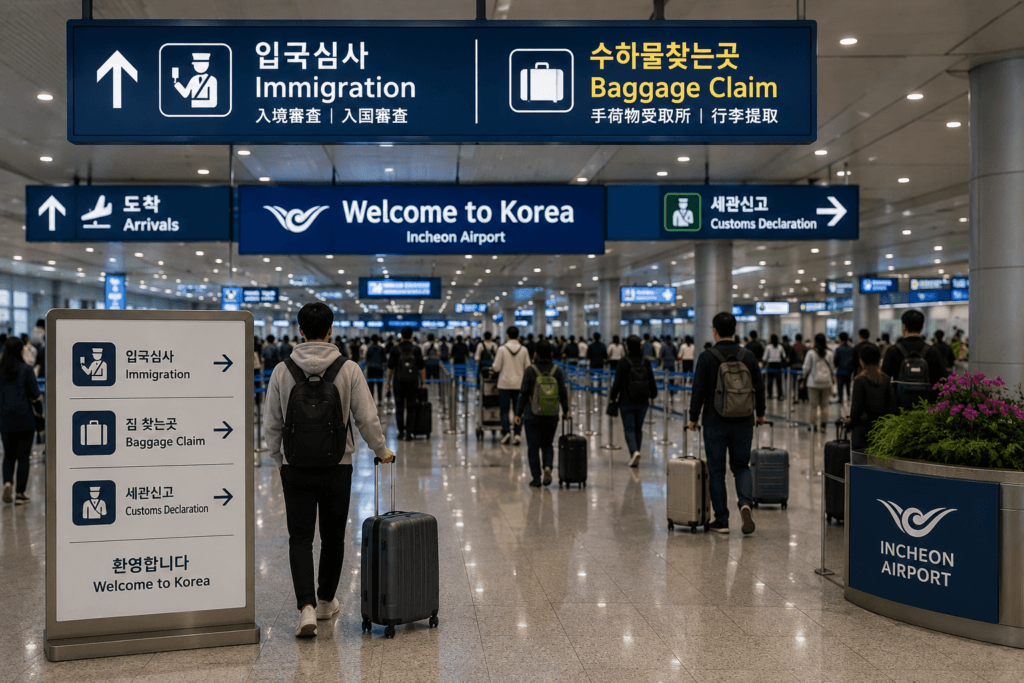
Most international travelers arrive at Incheon International Airport. The arrival process is usually straightforward:
- Get off the plane
- Follow signs for immigration
- Present your passport
- Complete arrival checks
- Collect your baggage
- Pass customs
- Enter the arrivals hall
If you submitted your e-Arrival Card online, keep your confirmation or issue number available on your phone. If you need to fill out an arrival declaration at the airport, do it before reaching immigration if forms or instructions are provided.
After immigration, the next question is transport. Incheon Airport is not in central Seoul, so you need to choose between the AREX train, airport limousine bus, taxi, private transfer or domestic connection.
For most first-time travelers, the airport railroad is efficient if you are heading toward Seoul Station. Airport buses can be easier if they stop near your hotel. Taxis and private transfers are convenient if you arrive late, travel with family, or have too much luggage to pretend you are “packing light.”
You can read our Incheon Airport to Seoul Guide for a full comparison of trains, buses, taxis and private transfers.
If you arrive late or want a smoother first night, checking airport transfer options from Incheon Airport before flying can be helpful.
Customs Rules: What Can You Bring Into Korea?
For most tourists, Korean customs is simple. You should declare restricted or taxable items when required, and avoid bringing prohibited goods.
Common things to be careful with include:
- Large amounts of cash
- Commercial quantities of goods
- Certain foods, meat products, plants or agricultural items
- Prescription medication without proper documentation
- Weapons or restricted items
- Goods exceeding duty-free limits
If you are bringing prescription medication, keep it in its original packaging and carry a copy of your prescription or doctor’s note if possible. Some medications that are common in one country can be restricted in another, so check before traveling if you take controlled medicine.
Do not pack random food items “just in case” unless you know they are allowed. Korea has excellent convenience stores, supermarkets and pharmacies, so you probably do not need to bring half your kitchen with you. Your suitcase deserves peace.
Common Entry Mistakes Travelers Make
1. Thinking K-ETA exemption means no arrival declaration
This is probably the biggest mistake in 2026.
K-ETA exemption means you may not need to apply for K-ETA before traveling. It does not automatically mean all arrival declaration requirements disappear.
If you are entering Korea without K-ETA, check whether you need to submit the e-Arrival Card or complete the arrival declaration process provided for your trip.
2. Using unofficial paid websites
The official e-Arrival Card is free. Be careful with websites that charge unnecessary fees or look like official government pages but are not.
For K-ETA, use the official K-ETA website if you decide to apply voluntarily or if your nationality requires it. Avoid random agency websites unless you clearly understand what service they are charging for.
3. Not having a Korean address ready
Many travelers forget that arrival forms usually ask where you will stay in Korea.
Book at least your first accommodation before departure and save the English address. If your hotel has both Korean and English addresses, keep both just in case.
4. Waiting until the airport to sort out everything
You can do many things at the airport, but your travel day will be calmer if you prepare earlier.
Submit your e-Arrival Card within the allowed period if required, save your hotel address, prepare your transport plan and install important apps before departure.
This is especially useful if your first stop is Seoul. Once you arrive, our Seoul Subway Guide can help you understand T-money cards, subway transfers and basic station etiquette.
5. Assuming old Korea travel advice is still correct
Entry rules changed several times in recent years. Some older blog posts, videos and forum comments may still mention old K-ETA rules, COVID-era procedures or outdated arrival forms.
Always check the latest official information before flying. Travel blogs are helpful for explanation, but official government pages are the final boss door.
6. Forgetting that visa-free entry is not the same as guaranteed entry
Even if you do not need a visa, immigration officers can still ask why you are visiting, where you are staying and when you plan to leave.
Most travelers pass through without any issue, but having clear answers and saved documents makes the process smoother.
Practical Korea Arrival Checklist
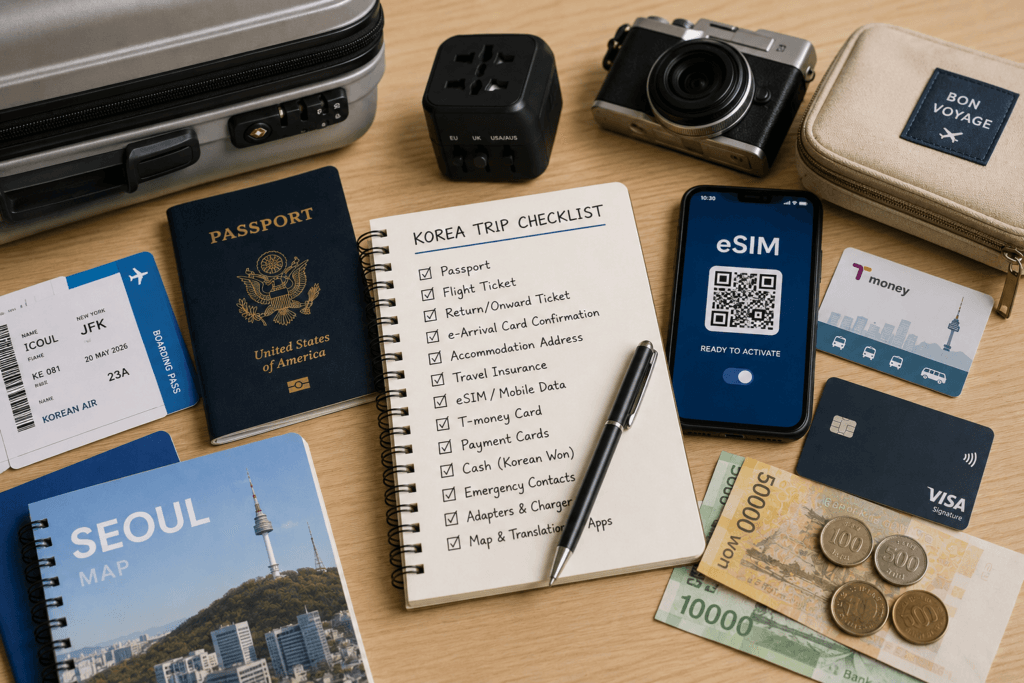
Use this quick checklist before your flight.
1 Week Before Departure
- Check your passport validity
- Confirm whether your nationality is K-ETA exempt
- Check whether your travel purpose is covered by visa-free entry
- Book your first accommodation
- Save the English address of your hotel or guesthouse
- Review travel insurance options
- Check airline notices
3 Days Before Arrival
- Submit your e-Arrival Card, if required
- Save your confirmation or issue number
- Confirm your flight details
- Prepare airport transport
- Download map and translation apps
- Activate or prepare your eSIM
For mobile data, arranging Korea eSIM options before departure is one of the easiest ways to make arrival smoother. You can use it for maps, hotel directions, subway routes and messaging as soon as you land.
On Arrival Day
- Keep your passport ready
- Have your accommodation address available
- Keep your e-Arrival Card confirmation or issue number accessible, if submitted
- Follow immigration signs
- Collect baggage
- Pass customs
- Choose your airport transport
Once you are through arrivals, the real trip begins. This is where Korea changes from “documents and airport signs” into convenience stores, subway jingles, hot soup, late-night streets and the sudden realization that your itinerary may already be too ambitious.
FAQ: South Korea Entry Requirements 2026
Do US citizens need a visa for South Korea in 2026?
Most US citizens do not need a visa for short-term tourism or business visits of 90 days or less. However, a visa may be required for work, study, long-term stay or other special purposes.
Do UK citizens need K-ETA for Korea in 2026?
British citizens traveling visa-free are temporarily exempt from K-ETA until December 31, 2026. Travelers should still check current rules before flying and complete arrival declaration requirements when needed.
Do Canadian travelers need K-ETA for South Korea?
Canadian travelers are included in the temporary K-ETA exemption until December 31, 2026. For normal short-term travel, most Canadian tourists do not need to apply for K-ETA during the exemption period.
Do Australian travelers need K-ETA for Korea in 2026?
Australian passport holders are temporarily exempt from K-ETA until December 31, 2026. Most Australian tourists visiting Korea for short stays do not need a tourist visa or K-ETA during the exemption period.
Is the Korea e-Arrival Card free?
Yes. The official Korea e-Arrival Card is free. Be careful with unofficial websites that ask for payment.
When can I submit the e-Arrival Card?
You can submit the e-Arrival Card online within 3 days before arriving in South Korea. Prepare your passport, flight information and accommodation address before filling it out.
Do I need both K-ETA and e-Arrival Card?
Not always. During the temporary K-ETA exemption period, many travelers from selected countries do not need K-ETA. However, if you enter Korea without a valid K-ETA, you may still need to complete the e-Arrival Card or arrival declaration process.
Can I be refused entry even if I do not need a visa?
Yes. Visa-free entry does not guarantee entry. Immigration officers may ask about your travel purpose, accommodation, return ticket or other details.
Do I need proof of hotel booking to enter Korea?
It is useful to have your first accommodation booked and ready to show if asked. You may also need the address for your e-Arrival Card or arrival declaration.
Should I apply for K-ETA anyway?
Most travelers from K-ETA-exempt countries do not need to apply during the exemption period. However, some travelers may still choose to apply voluntarily because a valid K-ETA can simplify arrival declaration requirements. For many normal tourists, completing the e-Arrival Card or following the arrival declaration process is enough.
Is Q-Code required for Korea in 2026?
Most ordinary tourists do not need to focus on Q-Code for a standard Korea trip unless special health or quarantine measures apply. Check airline and official guidance before departure if you are entering from a quarantine inspection area or if health rules change.
Final Thoughts
South Korea’s 2026 entry rules are not too difficult once you separate the main pieces: visa, K-ETA and arrival declaration.
For most travelers from the United States, United Kingdom, Canada and Australia, the process is simple. You usually do not need a tourist visa, and you are temporarily exempt from K-ETA until December 31, 2026. The part you should not forget is the e-Arrival Card or arrival declaration.
Before your trip, check your passport, prepare your hotel address, submit the e-Arrival Card if required and save your confirmations. Once that is done, you can move on to the more enjoyable questions, like where to stay, what to eat first and whether your Korea itinerary has accidentally become a full-time job.
If this is your first visit, start with our Incheon Airport to Seoul Guide, then read our Seoul Subway Guide and Best Areas to Stay in Seoul to make your first few days easier.