Will your phone charger work in Korea?
Do you need a plug adapter, a voltage converter, or both?
And what happens if your phone battery reaches 2% somewhere between immigration and the airport train?
For most travelers, the answer is pleasantly simple: bring a plug adapter, check the voltage label on your charger, and leave the heavy converter at home.
South Korea uses 220V electricity at 60Hz, with round two-pin wall sockets. Most modern phones, laptops, tablets, cameras, power banks, and earbud chargers support international voltage, so they only need the correct plug shape.
The devices most likely to cause trouble are older hair dryers, curling irons, straighteners, shavers, and other heat-producing appliances designed only for 110V or 120V.
Here is how to check everything before your trip.
Table of contents
Korea Plug and Voltage at a Glance
| Item | South Korea Standard |
|---|---|
| Voltage | 220V |
| Frequency | 60Hz |
| Main socket type | Type F |
| Common compatible plug | Type C |
| Pin shape | Two round pins |
| Adapter needed for US plugs | Yes |
| Adapter needed for UK plugs | Yes |
| Adapter needed for Australian plugs | Yes |
| Converter needed for dual-voltage chargers | No |
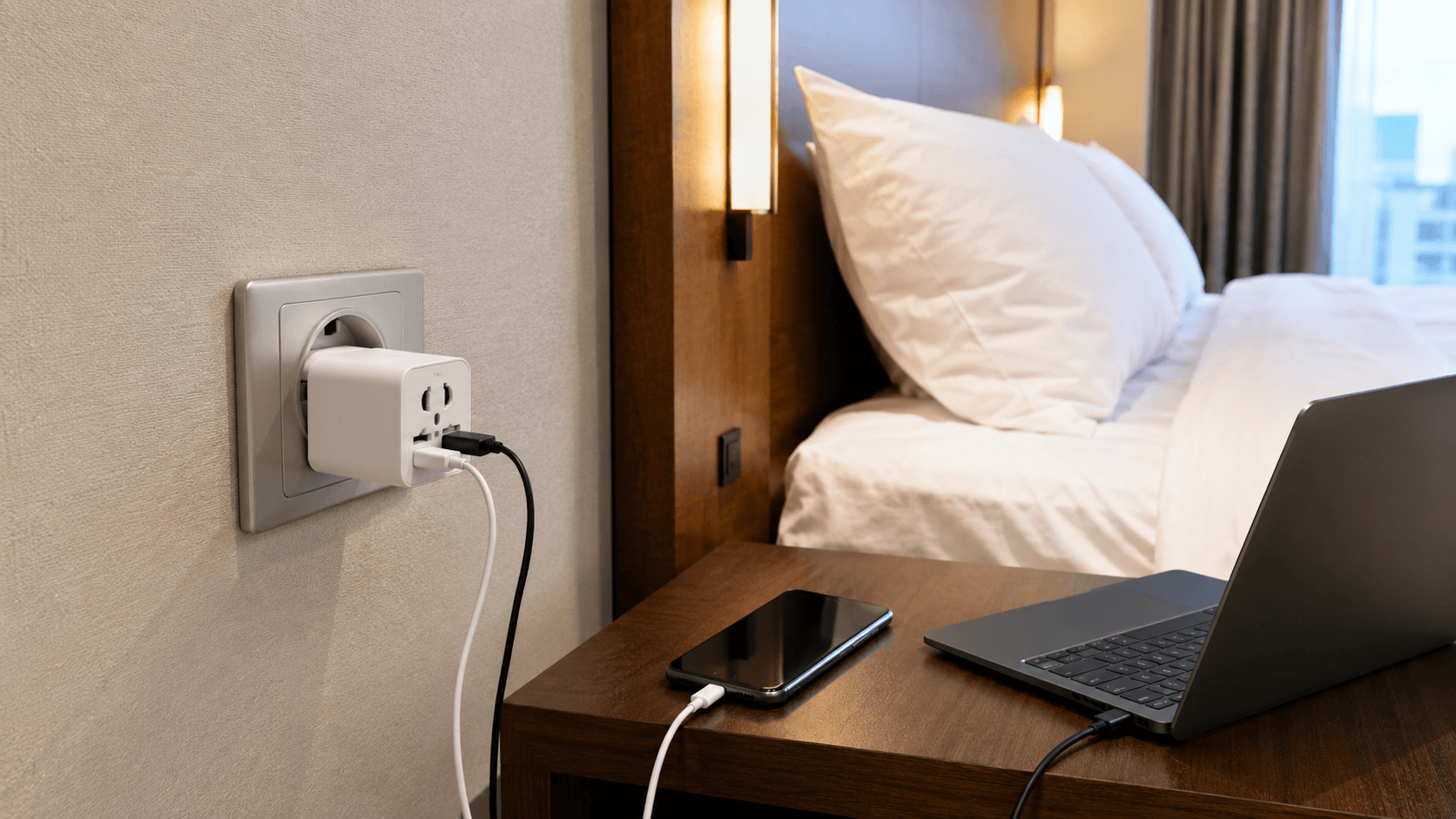
Korean sockets are generally the recessed, round-pin Type F style. Slim Type C Europlugs also fit many Korean outlets because they use the same basic two-round-pin arrangement.
Travelers from most of continental Europe may already have compatible plugs. Travelers from the United States, Canada, Japan, the United Kingdom, Australia, and New Zealand normally need an adapter.
What Plug Type Does South Korea Use?
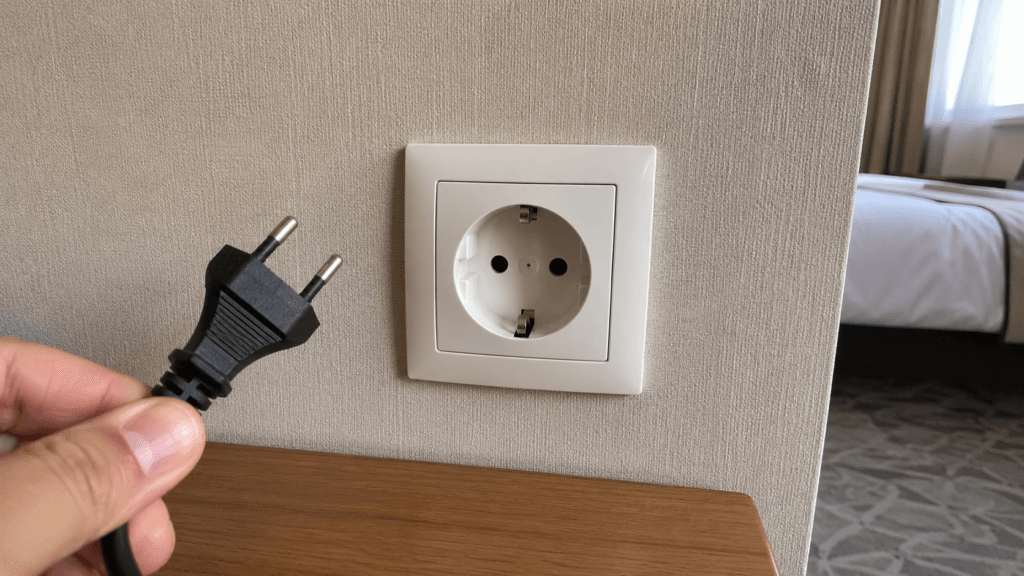
South Korea primarily uses Type F wall sockets.
Type F sockets have two round holes and grounding contacts along the sides. They are often associated with Germany and several other European countries.
The smaller Type C Europlug, which also has two round pins, generally fits Korean sockets. That is why travelers from many European countries can charge their devices without buying another adapter.
However, not every European plug is identical.
Large grounded plugs, unusually thick pins, and adapters with wide bodies may fit differently depending on the outlet. If you are unsure, a compact Korea-compatible or universal travel adapter removes the guesswork.
Travelers Who Usually Need an Adapter
You will normally need a plug adapter if you are traveling from:
- United States
- Canada
- Japan
- United Kingdom
- Ireland
- Australia
- New Zealand
- Singapore
- Hong Kong
- Countries using Type A, B, G, or I plugs
Travelers Who May Not Need an Adapter
You may not need one if your charger already has a slim Type C plug or a compatible Type F plug.
This often includes travelers from countries such as:
- Germany
- France
- Spain
- Portugal
- Netherlands
- Belgium
- Austria
- Poland
- Greece
- Several other continental European countries
Check the actual charger rather than relying only on your nationality. Phones and laptops have a habit of collecting chargers from several continents over their working lives.
Korea Uses 220V, 60Hz Electricity
South Korea’s standard electricity supply is:
Voltage: 220V
Frequency: 60Hz
Voltage determines how much electrical pressure reaches the device. Frequency describes how often the alternating current cycles each second.
For most modern electronic chargers, neither causes a problem because the charger automatically adjusts within a wide input range.
The important information is printed on the power brick, adapter, or device label.
Look for wording such as:
Input: 100–240V, 50/60Hz
If you see that range, the charger is designed for international use.
You need a plug adapter, but you do not need a voltage converter.
Plug Adapter vs Voltage Converter
These two items are often confused, but they do completely different jobs.
Plug Adapter
A plug adapter changes the physical shape of the plug so it fits the wall socket.
It does not change 220V electricity into 110V.
A travel adapter is enough when your device already supports 220V.
Voltage Converter
A voltage converter changes the electrical voltage supplied to the device.
You may need one when a 110V or 120V-only appliance must be used with Korea’s 220V electricity.
Converters are heavier, more expensive, and limited by wattage. A converter designed for a small electric shaver may not safely handle a powerful hair dryer.
This is the part where the tiny label matters more than the confident appearance of the appliance.
How to Check Whether Your Charger Works in Korea
Find the line marked Input on the charger.
Safe with a Simple Adapter
These labels normally mean the device can be used in Korea:
Input: 100–240V, 50/60Hz
Input: 110–240V
Input: 100–240V AC
Most modern chargers for the following devices support this range:
- Smartphones
- Tablets
- Laptops
- Cameras
- Power banks
- Smartwatches
- Wireless earbuds
- Portable game consoles
- USB charging hubs
The charger converts the incoming power to the lower voltage the device actually needs.
Do Not Plug It in Directly
Be careful when the label shows only:
Input: 110V
Input: 120V
Input: 100–120V
These appliances are not designed to receive Korea’s 220V supply directly.
Using only a plug adapter could damage the device, trip a breaker, overheat the appliance, or create a safety risk.
An adapter changes the plug shape. It does not perform electrical wizardry behind the wall.
Devices Most Likely to Need Extra Attention
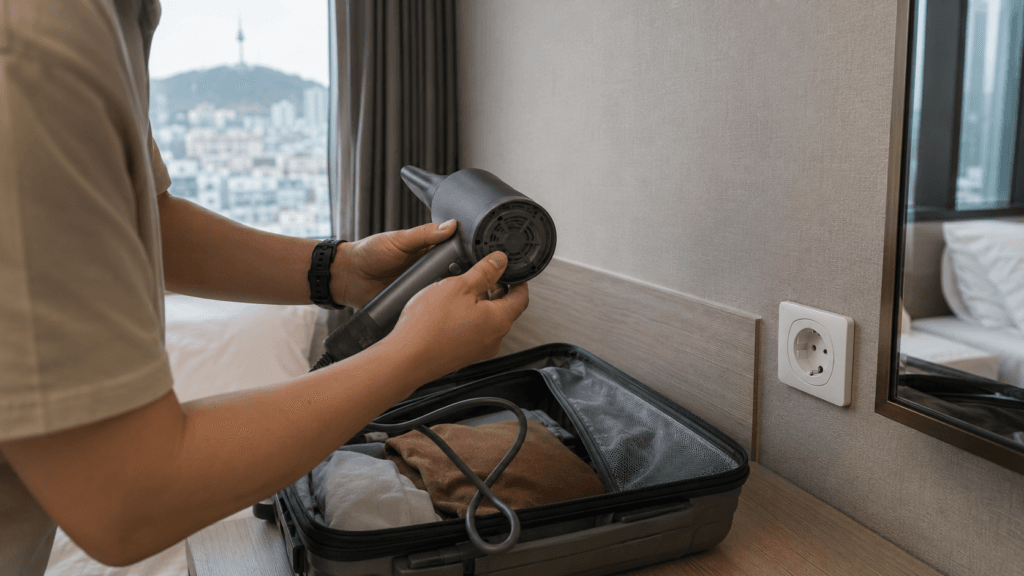
Hair Dryers
Hair dryers use a large amount of power and are among the worst devices to connect to the wrong voltage.
A 120V-only hair dryer should not be plugged directly into a Korean socket.
Even with a converter, the converter must support the dryer’s wattage. Small travel converters often cannot handle powerful heating appliances.
The easiest solution is usually to use the dryer provided by your hotel or guesthouse.
Hair Straighteners and Curling Irons
Some modern straighteners and curling irons are dual voltage. Others are not.
Check the input label or product manual carefully.
A device marked 100–240V only needs an adapter. A device marked 120V needs a properly rated converter or should remain at home.
Electric Shavers
Many newer electric shavers support international voltage, but older models may not.
Check both the shaver and its charging unit.
Electric Toothbrushes
Electric toothbrush chargers are surprisingly inconsistent.
Some support 100–240V. Others are designed for one regional voltage. A toothbrush that costs more than dinner deserves ten seconds of label inspection.
CPAP Machines and Medical Devices
Many medical-device power supplies support international voltage, but do not assume.
Check the manufacturer’s specifications and bring any required adapter, converter, backup battery, or extension equipment.
Travelers relying on medical equipment should also confirm the outlet situation with their accommodation before arrival.
Do You Need a Grounded Adapter?
Phones and small USB chargers often use ungrounded two-pin plugs, so a simple adapter is usually enough.
Laptops, larger electronics, and appliances may use grounded plugs.
For those devices, choose an adapter that preserves grounding rather than using the smallest ungrounded plastic adapter available.
This matters especially for:
- Large laptop power supplies
- Monitors
- Medical devices
- High-powered electronics
- Equipment with a three-pin home-country plug
A universal adapter that accepts grounded plugs can be more useful than carrying several tiny adapters, but check its safety certification and maximum wattage before buying.
Can You Buy a Power Adapter in Korea?
Yes.
Forgetting an adapter is inconvenient, not catastrophic.
Adapters are commonly available at:
- Incheon International Airport
- Airport convenience stores
- Duty-free shops
- Electronics stores
- Large supermarkets
- Shopping centers
- Some tourist-area convenience stores
- Daiso locations
- Hotel front desks
Some hotels lend adapters to guests, although the number available may be limited. Ask the front desk before purchasing another one.
Airport adapters are convenient but may cost more than options in the city. If your phone still has enough battery to reach the hotel, you may find a wider selection after arriving in Seoul.
Store availability varies, so bringing one from home remains the safer plan.
What If You Forget Your Adapter at Incheon Airport?
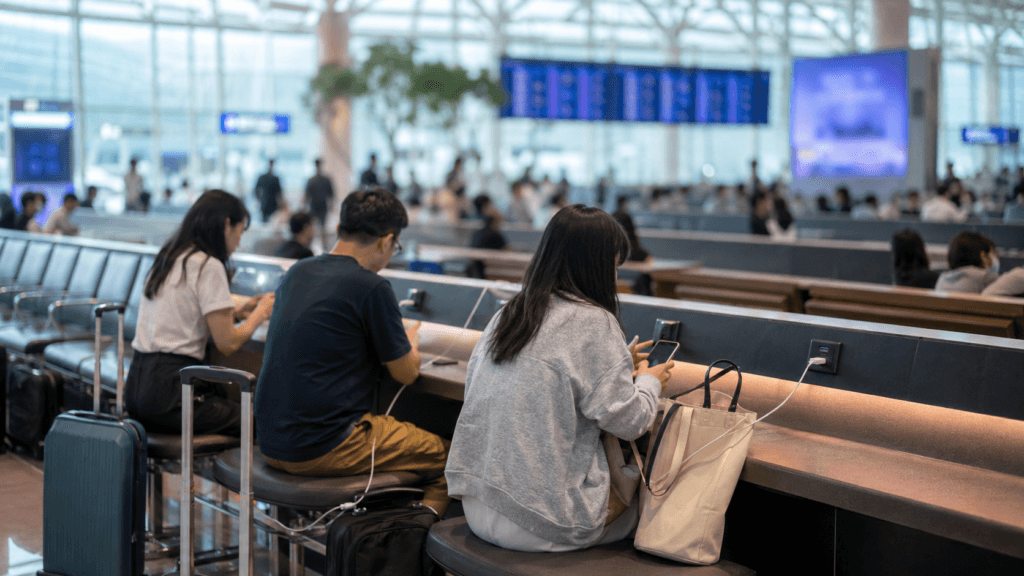
You can still charge your phone.
Incheon International Airport provides charging facilities using 110V, 220V, and USB connections for phones, laptops, and other mobile devices.
Charging areas can be found in both public and secured parts of the airport, including departure halls, arrival areas, charging towers, charging chairs, and relaxation zones.
Some areas also provide wireless charging, which can help when you have a compatible phone but no cable.
The airport’s official information lists charging facilities across Terminal 1, Terminal 2, and the concourse. Exact equipment and availability can vary by location, so look for charging symbols or ask an information desk.
This is especially useful after arrival when you need your phone for:
- Immigration documents
- Hotel directions
- AREX or airport bus information
- eSIM activation
- Translation
- Messaging your accommodation
- Checking the last train
A nearly dead phone makes every airport sign feel more dramatic than necessary.
For arrival procedures and transportation options, read Incheon Airport Guide.
Do Korean Hotels Have USB Ports?
Some do, but do not rely on them.
Newer hotels may provide:
- USB-A charging ports
- USB-C ports
- Bedside charging panels
- Universal sockets
- Wireless charging pads
Older hotels, guesthouses, hostels, and traditional accommodations may provide only standard Korean wall outlets.
Even when a USB port is available, it may charge slowly or fail to support fast charging. Hotel USB ports also vary in condition and output quality.
Bring your normal charger and adapter rather than planning the trip around a mysterious bedside USB slot.
How Many Adapters Should You Bring?
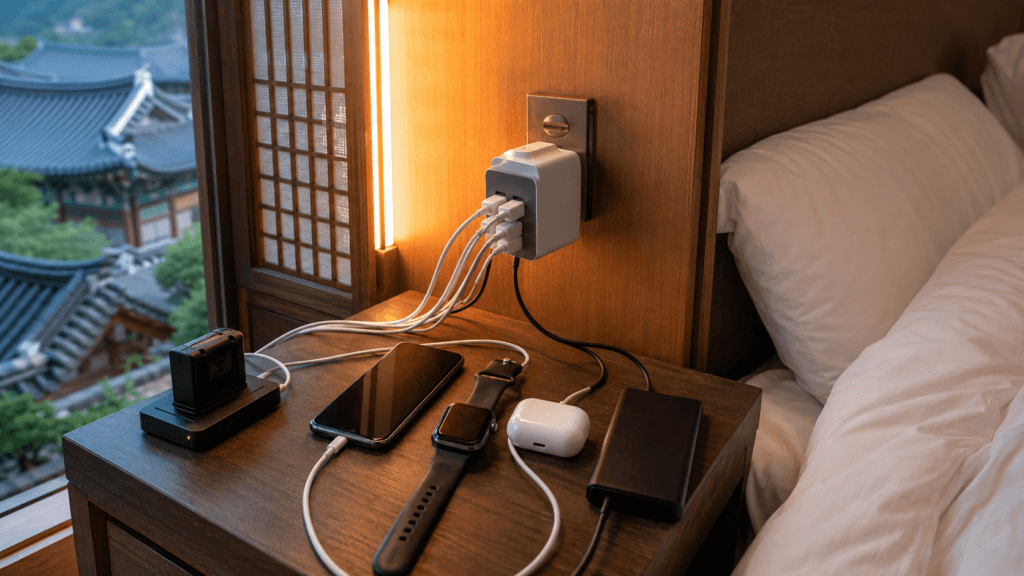
One adapter is enough for a solo traveler carrying only a phone.
For a traveler with a phone, watch, camera, laptop, and power bank, one wall adapter quickly becomes a nightly charging committee.
A practical setup is:
- One Korea-compatible travel adapter
- One multi-port USB or USB-C charger
- Your normal charging cables
- One power bank
- An optional short extension lead
A multi-port charger is usually more useful than carrying four separate plug adapters. Check that the charger supports 100–240V and has enough output for all connected devices.
Couples or families should consider bringing at least two adapters in case the hotel room has outlets on opposite sides of the room.
Are Korean Outlets Loose?
Sometimes Type C plugs can feel slightly loose in older or heavily used outlets.
This is more likely with lightweight two-pin adapters than with thicker Type F plugs.
If the adapter slips out:
- Try another outlet
- Support the charger rather than letting a heavy cable pull downward
- Use a better-fitting adapter
- Avoid stacking several heavy adapters together
- Do not force bent or damaged pins into the socket
The outlet behind the bed may look like the perfect solution until the charger drops out at 2 AM and your phone wakes up with 7%.
Can You Charge Devices in Cafés and Public Places?
Many Korean cafés provide wall outlets, especially near shared tables or seating along walls.
However, outlets are not guaranteed, and some businesses limit laptop use or charging during busy hours.
You may also find charging facilities at:
- Airports
- Some train stations
- Libraries
- Co-working spaces
- Shopping malls
- Airport lounges
- Certain hotel lobbies
Use public outlets respectfully. Charging one phone while buying a drink is normal. Constructing a mobile electronics laboratory across four café seats is less charming.
Power Banks in Korea
A power bank is useful for long sightseeing days, especially when using maps, translation apps, mobile tickets, and photography.
Charge the power bank with a dual-voltage USB charger just as you would charge a phone.
For flights, power banks normally belong in carry-on baggage rather than checked luggage. Airline limits and labeling requirements can change, so check your airline’s current battery rules before departure.
Make sure the capacity marking remains visible on the device. Airlines may inspect the watt-hour rating when applying battery limits.
Common Power Adapter Mistakes
Assuming an Adapter Converts Voltage
It does not.
An adapter changes the plug shape. Always check the appliance’s supported voltage.
Packing a 120V Hair Dryer
This is one of the most common avoidable problems.
Use the hotel dryer or bring a dual-voltage model.
Buying a Converter Without Checking Wattage
Converters have maximum power limits.
A converter suitable for a small charger may fail with a heating appliance.
Relying Only on Hotel USB Ports
The room may not have them, and the charging speed may be poor.
Bringing One Adapter for Too Many Devices
One outlet and six devices create an evening schedule nobody requested.
A multi-port USB charger solves the problem more neatly.
Waiting Until the Airport to Check
You can buy an adapter after landing, but checking your devices at home takes less time and usually costs less.
What to Pack
For most travelers, this is enough:
- One Type F or Korea-compatible travel adapter
- One dual-voltage USB or USB-C charger
- Charging cables
- Power bank
- Spare cable
- Optional multi-port charger
- Optional grounded adapter for laptops
You probably do not need a voltage converter unless you are bringing a device that only supports 100V, 110V, or 120V.
Check every high-powered appliance individually.
This small task belongs near the top of your Korea Packing List, somewhere between passport checks and wondering whether three pairs of shoes count as packing light.
FAQ
What plug adapter do I need for South Korea?
South Korea uses Type F wall sockets with two round openings. A Type C Europlug usually fits, while travelers using Type A, B, G, or I plugs normally need an adapter.
Does Korea use 110V or 220V?
South Korea uses 220V electricity at 60Hz.
Can I use my US phone charger in Korea?
Usually yes. Check the charger label. If it says 100–240V and 50/60Hz, you only need a plug adapter.
Do I need a voltage converter for my laptop?
Most laptop chargers support 100–240V, so they only need a plug adapter. Confirm the input range printed on the power brick.
Can I use an American hair dryer in Korea?
Not if it supports only 110V or 120V. Use a dual-voltage dryer, a correctly rated converter, or the dryer provided by your accommodation.
Can I buy an adapter at Incheon Airport?
Yes. Adapters may be available at airport convenience stores, duty-free shops, and other retailers. The airport also provides free charging facilities if you need power immediately.
Do Korean hotels provide adapters?
Some hotels lend adapters, but availability is not guaranteed. Contact the property or ask the front desk after check-in.
Final Thoughts
Most travelers do not need a voltage converter for Korea.
They need a plug adapter and ten seconds to read the input label on each charger.
Phones, laptops, cameras, tablets, power banks, watches, and earbuds are usually designed for international voltage. Older heating appliances and single-voltage devices require more attention because Korea supplies 220V electricity.
Bring a Korea-compatible adapter, use a multi-port charger if you have several devices, and check hair tools before packing them.
If the adapter still disappears somewhere between your suitcase and the airport, Korea is not a charging wilderness. You can buy another one, ask your hotel, or use the charging facilities at Incheon Airport.
The trip will survive.
Your phone battery may even survive with it.