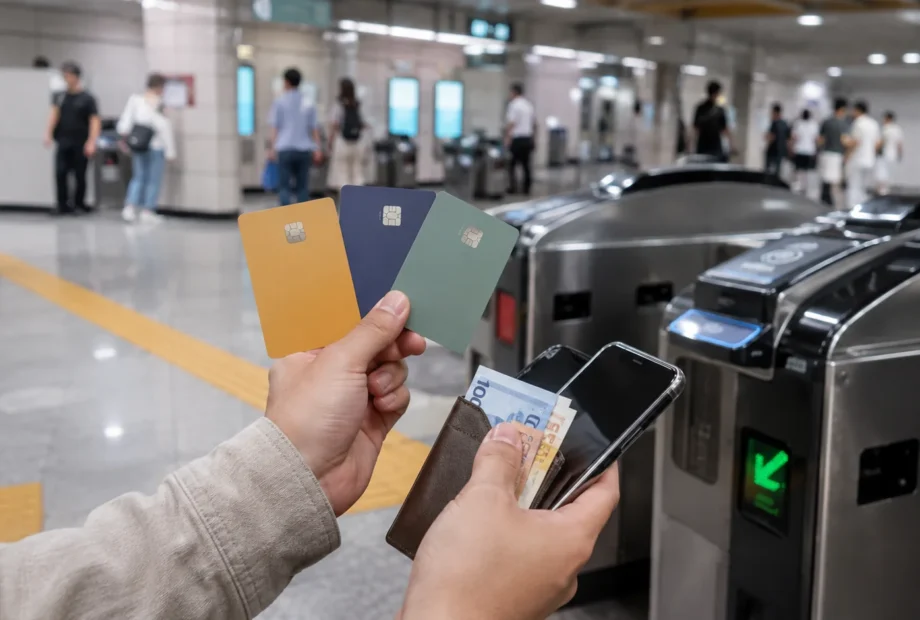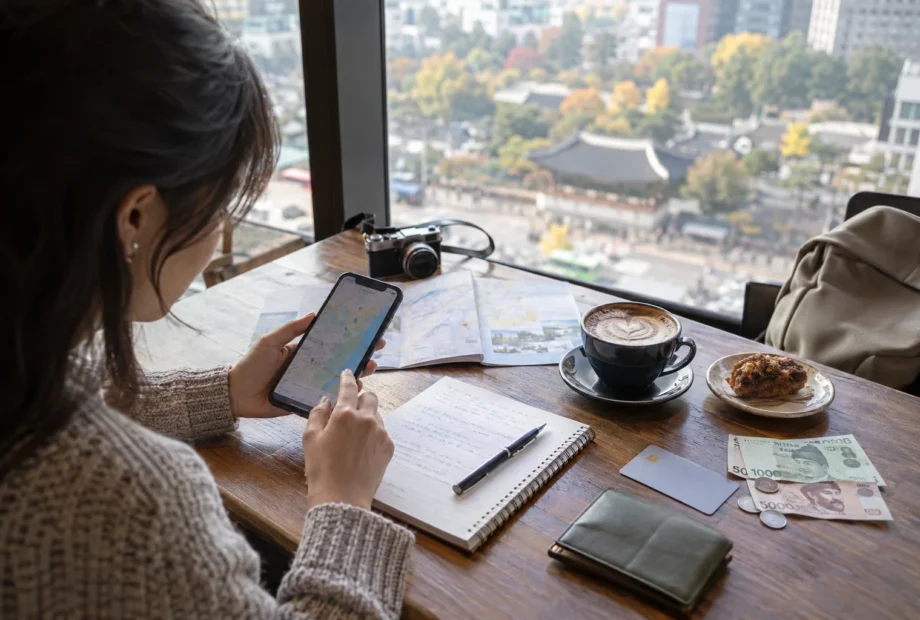
You may see it while buying street food, topping up a transportation card, paying for coffee, using an ATM, or staring at a 50,000 won bill and wondering whether it is a lot, a little, or secretly both.
The good news is that Korean currency is easy to understand once you get used to the numbers.
South Korea is also very card-friendly, so most travelers do not need to carry large amounts of cash. Still, understanding Korean won helps you avoid confusion, exchange too much money, struggle with small vendors, or panic when a machine asks for cash.
This Korean currency guide explains what money Korea uses, which banknotes and coins tourists should know, how much cash to carry, where to exchange money, how ATMs work, and how Korean won fits into your overall travel budget.
If you are planning your payment setup, read Cash vs Card in Korea 2026, Korea ATM Guide 2026, and Korea Travel Costs Guide 2026 before departure.
This article may contain affiliate links, which means we may earn a small commission if you book through them, at no extra cost to you.
Table of contents
What Currency Does South Korea Use?
South Korea uses the Korean won.
The currency code is:
KRW
The currency symbol is:
₩
You will see prices written like this:
₩1,000
₩5,000
₩10,000
₩50,000
In English travel writing, you may also see prices written as 1,000 KRW, 5,000 KRW, 10,000 KRW, or 50,000 KRW.
Both mean the same thing.
The numbers may feel large at first, especially if your home currency has smaller everyday amounts. But after a few days, most travelers quickly get used to it.
A 10,000 won bill will stop looking dramatic once you realize it often covers a simple meal, a cafe visit, or a few market snacks.
Korean Banknotes Explained
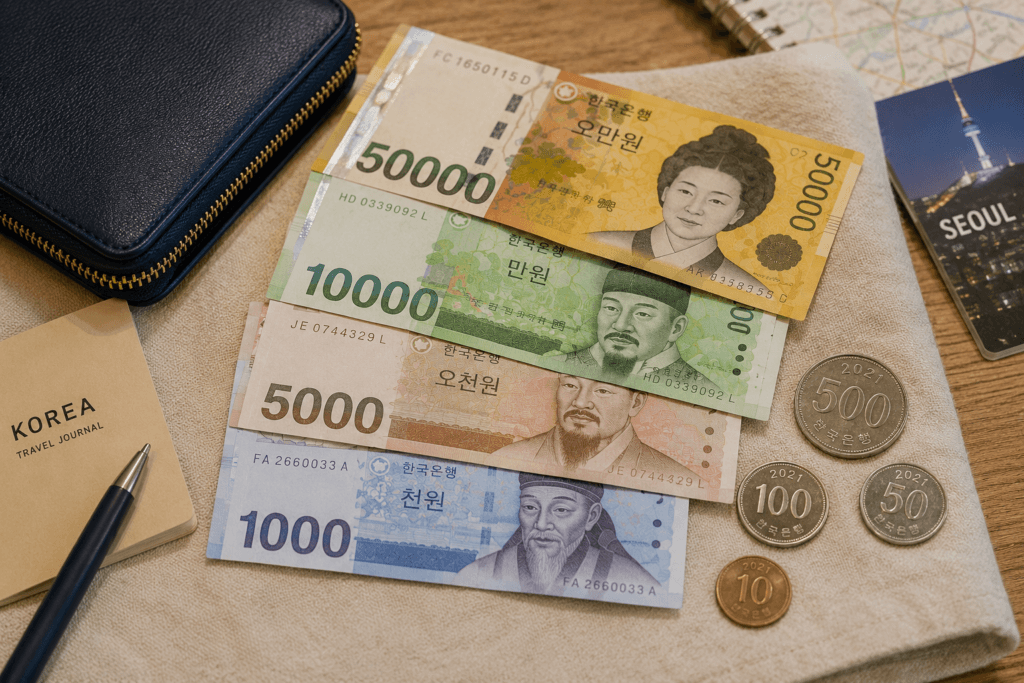
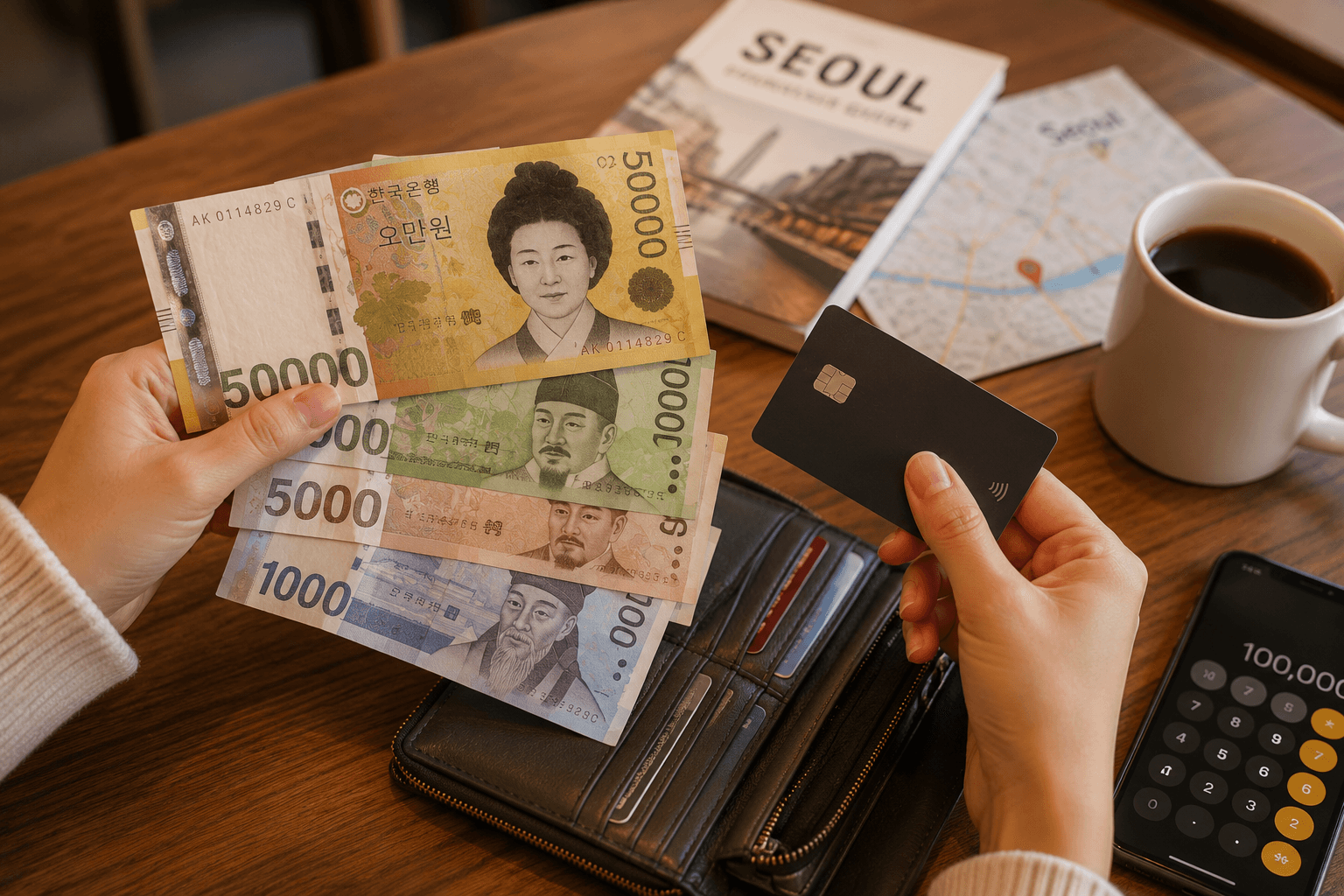
Korea commonly uses four banknotes in daily life:
- 1,000 won
- 5,000 won
- 10,000 won
- 50,000 won
These are the bills travelers should recognize.
1,000 Won
The 1,000 won note is the smallest common banknote.
It is useful for:
- Small snacks
- Convenience store items
- Market purchases
- T-money recharge
- Vending machines
- Small cash payments
It is a handy bill to keep in your wallet, especially if you plan to visit markets or street food stalls.
5,000 Won
The 5,000 won note is useful for everyday spending.
You may use it for:
- Coffee
- Street food
- Small meals
- Convenience store purchases
- Local snacks
- Small souvenirs
This bill is one of the most practical notes for tourists because it is large enough to be useful but small enough that vendors can usually give change easily.
10,000 Won
The 10,000 won note is one of the most useful bills for travelers.
It is commonly used for:
- Restaurant meals
- Cafe visits
- Market shopping
- Taxi backup cash
- Attraction snacks
- Everyday purchases
If you are carrying cash in Korea, 10,000 won bills are often the most convenient.
They are the wallet’s reliable middle child.
50,000 Won
The 50,000 won note is the highest-value banknote commonly used in Korea.
It is convenient for larger payments, but it is not always ideal for small purchases.
Use 50,000 won notes for:
- Larger restaurant bills
- Bigger shopping purchases
- Hotel or tour backup cash
- Emergency money
Avoid relying only on 50,000 won notes for small markets, street food, or tiny local shops. Some vendors may not have enough change.
For daily travel, it is usually better to carry several 10,000 won notes rather than only large bills.
Korean Coins Explained
Korean coins include:
- 10 won
- 50 won
- 100 won
- 500 won
Very small 1 won and 5 won coins technically exist, but most travelers will almost never see them in normal travel situations.
The coins tourists most often notice are 100 won and 500 won coins.
You may receive coins at convenience stores, vending machines, small shops, or markets. Coins are also useful for small purchases, though many travelers end up using cards or T-money instead.
If your wallet starts collecting coins, use them at convenience stores before leaving Korea. Korean coins make terrible souvenirs unless your hobby is making your luggage slightly more suspicious at airport security.
How to Read Korean Prices
Korean prices are usually straightforward once you understand the zeros.
Here are simple examples:
- ₩1,000 = one thousand won
- ₩5,000 = five thousand won
- ₩10,000 = ten thousand won
- ₩50,000 = fifty thousand won
- ₩100,000 = one hundred thousand won
Many travelers mentally group Korean prices into rough travel categories:
- 1,000 to 3,000 KRW: small snack or drink
- 4,000 to 7,000 KRW: coffee, dessert, small food item
- 8,000 to 15,000 KRW: casual meal
- 20,000 to 40,000 KRW: nicer meal, activity, or shopping
- 50,000 KRW and up: larger purchase or travel expense
Do not convert every tiny purchase back into your home currency all day. That habit turns coffee into math homework.
Instead, learn the local price rhythm after a few meals and purchases.
What Can You Buy with Korean Won?
Prices vary by area, season, restaurant, and inflation, but these rough examples can help first-time visitors understand Korean won.
You might see:
- Bottled water: around 1,000 to 2,000 KRW
- Convenience store snack: around 1,000 to 4,000 KRW
- Street food: around 3,000 to 8,000 KRW
- Coffee: around 4,000 to 7,000 KRW
- Casual local meal: around 8,000 to 15,000 KRW
- Korean BBQ meal: often higher depending on restaurant and meat
- Subway ride: usually around the low-thousand-won range
- Airport transportation: higher, depending on AREX, bus, taxi, or transfer
For food planning, read What to Eat in Korea, Korean Street Food Guide 2026, Korean BBQ Guide 2026, and Korean Fried Chicken Guide 2026.
For transportation, read Seoul Subway Guide 2026, T-money Card Guide for Tourists in Korea, and How to Get from Incheon Airport to Seoul.
Do Tourists Need Cash in Korea?
Yes, but usually not much.
Korea is very card-friendly. Many travelers use cards for most of their trip, especially in Seoul, Busan, Jeju, and other popular destinations.
Cards usually work well at:
- Hotels
- Cafes
- Restaurants
- Convenience stores
- Shopping malls
- Department stores
- Attractions
- KTX stations
- Beauty shops
- Pharmacies
- Major tourist businesses
Cash is still useful for:
- Traditional markets
- Street food stalls
- Small local shops
- Some older restaurants
- Emergency backup
- T-money recharge
- Rural areas
- Small vendors
The best strategy is not cash only or card only.
It is card mainly, cash backup.
For the full payment strategy, read Cash vs Card in Korea 2026.
How Much Cash Should You Carry in Korea?
Most tourists can start with around 50,000 to 100,000 KRW in cash.
This is usually enough for:
- Market snacks
- Street food
- Small local purchases
- Transportation card recharge
- Emergency taxi backup
- Cash-only situations
If you are staying mainly in Seoul and using cards, 50,000 KRW may be enough to begin.
If you love markets, street food, or small local shops, 100,000 KRW feels safer.
If you are staying longer or traveling outside major cities, withdraw more as needed.
Avoid exchanging or carrying too much cash at once. Korea is card-friendly, and you can usually access ATMs if you need more.
Your wallet should feel prepared, not like it is carrying a tiny paper brick.
Should You Exchange Money Before Arriving?
You do not need to exchange a large amount before arriving in Korea.
Many travelers either:
- Bring a small amount of Korean won before departure
- Exchange a little at the airport
- Withdraw cash from a Global ATM after arrival
- Use cards for most purchases
If your flight lands late at night, having some Korean won before arrival can be helpful. It gives you backup money for small expenses before you figure out ATMs, transport cards, or airport services.
But exchanging several hundred dollars before departure is often unnecessary for short trips.
A small starting amount plus a reliable card is usually enough.
Where to Exchange Money in Korea
You can exchange money at several places in Korea.
Common options include:
- Airport exchange counters
- Banks
- Exchange booths in tourist areas
- Some hotel desks
- Money exchange shops in shopping districts
Airport exchange counters are convenient, especially on arrival day, but rates may not always be the best.
Tourist areas such as Myeongdong often have many exchange booths, but rates can vary. Always compare before exchanging large amounts.
Banks are reliable, though opening hours and language support may vary.
For most tourists, the easiest strategy is simple:
Bring a small amount of cash, use your card, and withdraw or exchange more only if needed.
Using ATMs in Korea
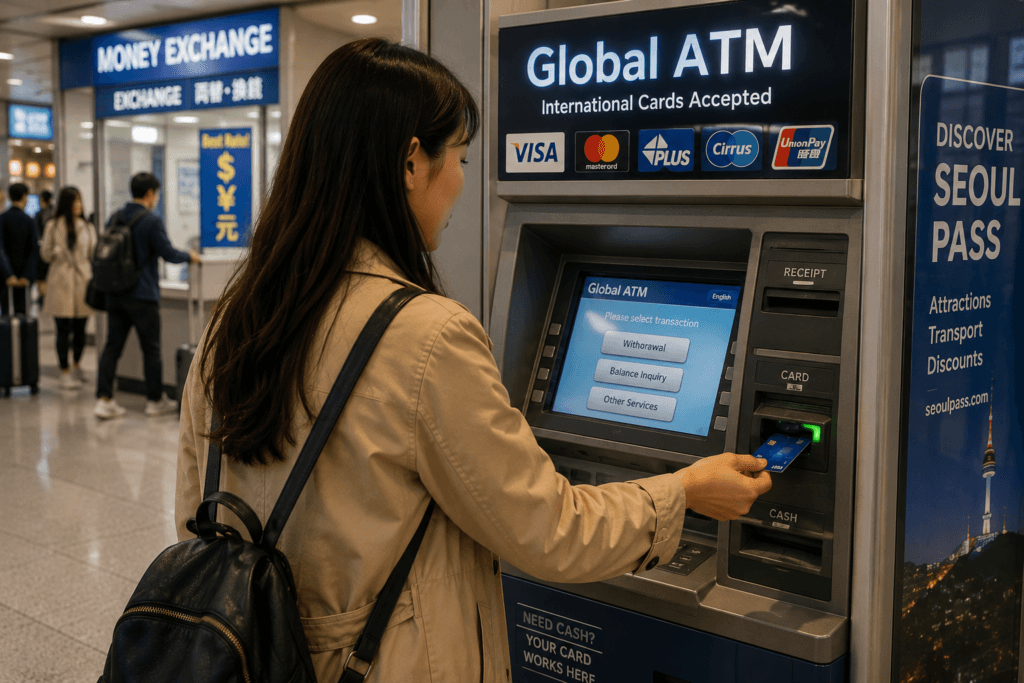
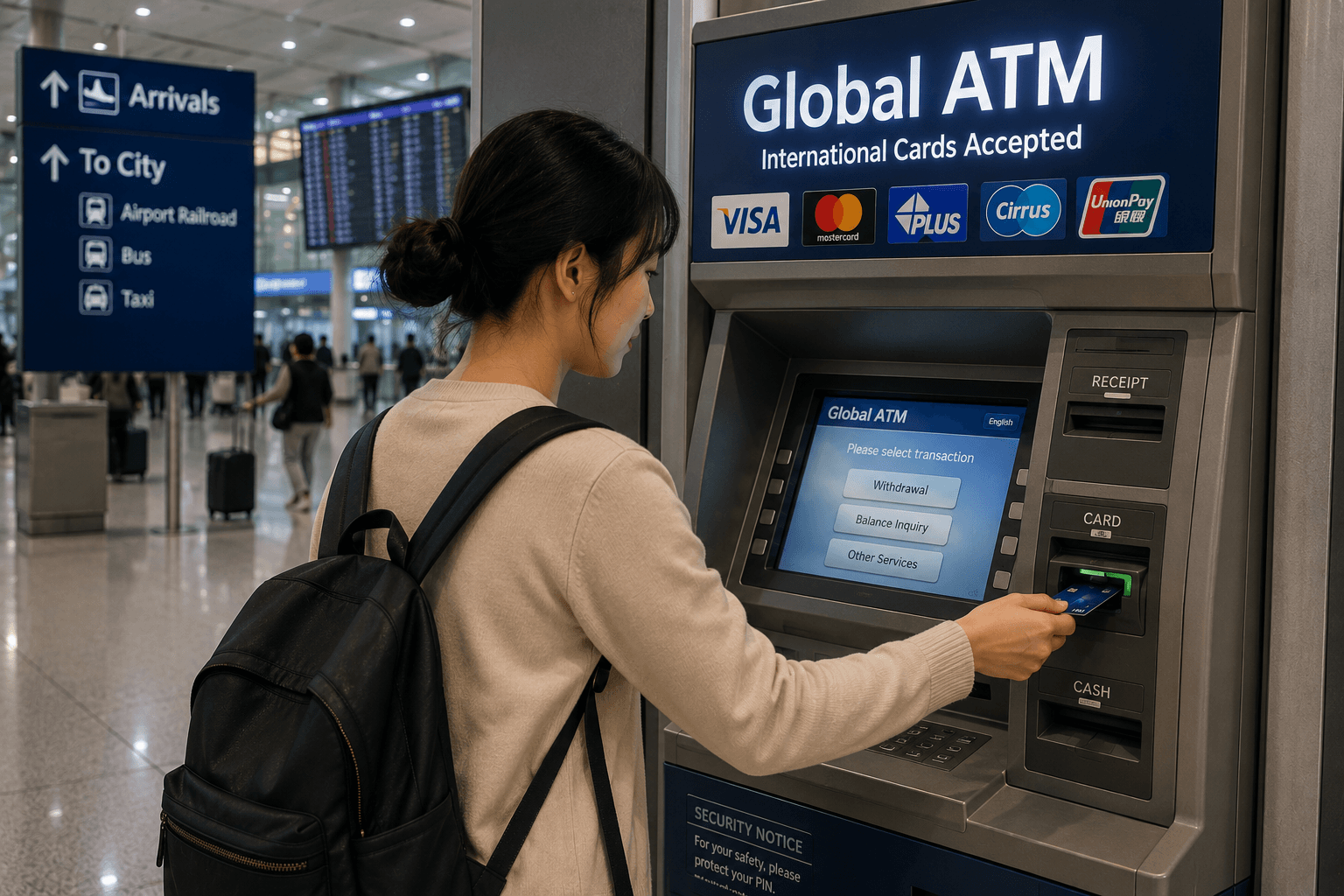
ATMs are common in Korea, but not every machine accepts foreign cards.
Look for machines marked:
- Global ATM
- International ATM
- Visa
- Mastercard
- Cirrus
- Plus
International ATMs can often be found at:
- Airports
- Banks
- Shopping districts
- Subway stations
- Convenience stores
- Tourist areas
Most machines in tourist-friendly locations offer English menus.
Before using an ATM, check:
- International withdrawal fee
- Your home bank fee
- Exchange rate
- Daily withdrawal limit
- Whether your card is enabled for overseas use
If the ATM offers dynamic currency conversion, it may ask whether to charge you in your home currency or Korean won. In many travel situations, choosing the local currency, KRW, is often better, but check your card terms and fees.
For a full guide, read Korea ATM Guide 2026.
Korean Won and T-money
T-money is a transportation card used for subways, buses, and some small payments.
It is not the same as cash, but cash is still useful for recharging it in many common tourist situations.
You may need Korean won to:
- Buy a T-money card
- Recharge T-money at some machines
- Top up at convenience stores
- Handle small transport-related expenses
Seoul has expanded international card support for some subway ticket machines and short-term Climate Card purchases, which is helpful for tourists. But many visitors still prefer T-money because it is simple for repeated daily subway and bus rides.
If you plan to use public transportation, read T-money Card Guide for Tourists in Korea and Seoul Subway Guide 2026.
Korean Won and Shopping
For most shopping in Korea, cards are easier than cash.
Use cards at:
- Olive Young
- Department stores
- Shopping malls
- Duty-free shops
- Fashion stores
- Electronics stores
- Beauty shops
- Tourist souvenir stores
Cards create a purchase record, which can be useful for budgeting and tax refund claims.
If you plan to shop heavily, read Olive Young Guide 2026, Best K-Beauty Shopping in Seoul, Seoul Shopping Guide 2026, and Korea Tax Refund Guide 2026.
Cash is still useful in markets, small souvenir stalls, and local shops.
Korean Won at Markets and Street Food Stalls
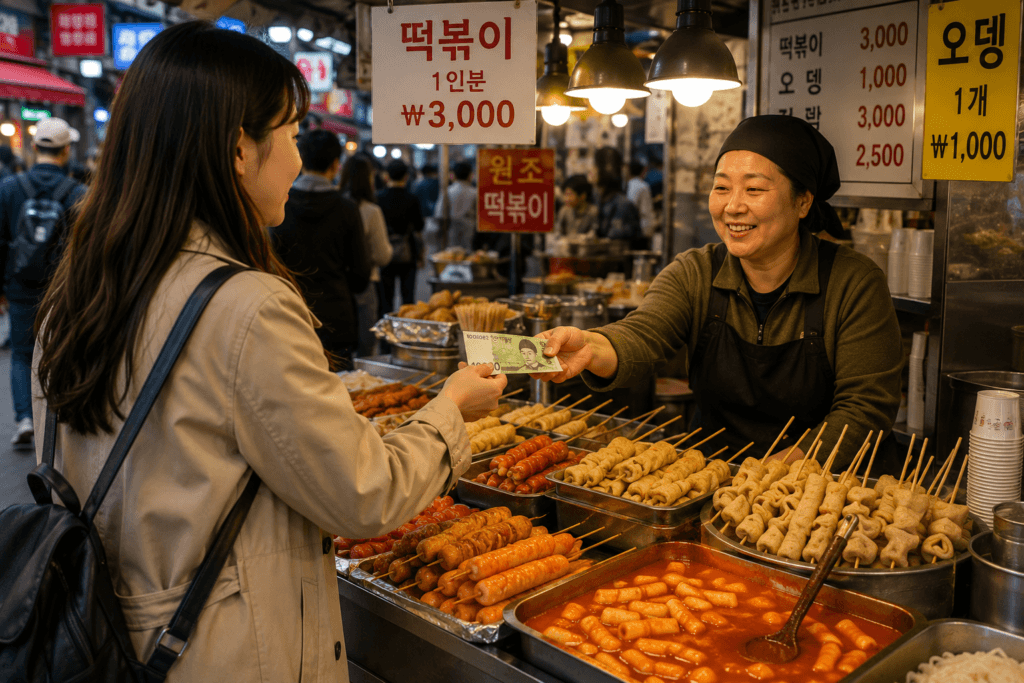
Markets and street food are where Korean cash still shines.
Bring small bills when visiting:
- Gwangjang Market
- Namdaemun Market
- Local neighborhood markets
- Street food alleys
- Night market-style food stalls
- Small snack vendors
Some vendors accept cards, but cash is often easier and faster.
Small bills such as 1,000, 5,000, and 10,000 won notes are especially useful.
If you hand a 50,000 won bill to a small vendor for a tiny snack, you may receive a look that says, “We are now solving a problem together.”
Can You Use Foreign Currency in Korea?
No, not for normal daily purchases.
Most businesses in Korea only accept Korean won or card payments.
You generally cannot pay with:
- US dollars
- Euros
- Japanese yen
- Chinese yuan
- Other foreign cash
Some duty-free shops, hotels, or exchange services may handle foreign currency in specific situations, but normal restaurants, cafes, shops, taxis, markets, and convenience stores expect Korean won or card payment.
Exchange or withdraw Korean won before you need cash.
Common Currency Mistakes Tourists Make
The first mistake is exchanging too much cash.
Many travelers arrive with a large stack of won, then realize they use cards for most purchases.
The second mistake is carrying only 50,000 won notes.
Large bills are convenient for bigger payments but annoying for small vendors.
The third mistake is carrying no cash at all.
Korea is card-friendly, but cash is still useful at markets, street food stalls, and for some T-money recharges.
The fourth mistake is not checking ATM fees.
International ATM fees, home bank fees, and exchange rates can quietly nibble your budget.
The fifth mistake is confusing price zeros.
Take a moment to read prices carefully. 5,000 won and 50,000 won are very different beasts.
Finally, do not keep all your cash, cards, and passport in the same place. A lost wallet should not become a full travel opera.
Frequently Asked Questions
What currency does South Korea use?
South Korea uses the Korean won. The currency code is KRW, and the symbol is ₩.
What Korean banknotes should tourists know?
The main banknotes are 1,000 won, 5,000 won, 10,000 won, and 50,000 won.
What Korean coins are common?
Tourists most commonly encounter 10 won, 50 won, 100 won, and 500 won coins. Very small 1 won and 5 won coins exist but are rarely seen by visitors.
How much cash should I bring to Korea?
Most travelers can start with around 50,000 to 100,000 KRW in cash and rely on cards for most purchases.
Can I use US dollars in Korea?
No. Normal businesses in Korea expect Korean won or card payments. US dollars are not accepted for everyday purchases.
Should I exchange money before arriving in Korea?
You can exchange a small amount before departure, but exchanging a large amount is usually unnecessary. Many travelers use cards and withdraw more cash from Global ATMs if needed.
Are credit cards accepted in Korea?
Yes. Credit cards are widely accepted in hotels, restaurants, cafes, shops, attractions, and convenience stores. Visa and Mastercard are usually the safest options.
Do I need cash for street food in Korea?
Yes, cash is still useful for street food stalls and traditional markets. Some vendors accept cards, but cash is often easier.
Can I withdraw Korean won from ATMs?
Yes, but use Global ATMs or machines that accept international cards. Check your bank fees and withdrawal limits before traveling.
Is Korea cashless?
Korea is very card-friendly, but not fully cashless. Tourists should still carry a small amount of Korean won.
Recommended Travel Services
These can help with money, transportation, and travel setup:
- Korea eSIM plans for travelers
- Korea SIM card options
- Korea travel activities and tickets
- Private Incheon Airport transfer to Seoul
- Seoul hotel deals for first-time visitors
Related Guides
Continue planning your Korea money setup with these guides:
- Cash vs Card in Korea 2026
- Korea ATM Guide 2026
- Korea Tax Refund Guide 2026
- Korea Travel Costs Guide 2026
- T-money Card Guide for Tourists in Korea
- Seoul Subway Guide 2026
- Korea Airport Bus Guide 2026
- How to Get from Incheon Airport to Seoul
- Olive Young Guide 2026
- Seoul Shopping Guide 2026
- Gwangjang Market Travel Guide 2026
- Namdaemun Market Travel Guide 2026
Final Thoughts
Korean currency is easy to use once you understand the basics.
South Korea uses the Korean won, with 1,000, 5,000, 10,000, and 50,000 won banknotes being the main bills travelers will handle. Cards work almost everywhere, but a small amount of cash is still useful for markets, street food, small vendors, T-money recharge, and emergencies.
For most tourists, the best strategy is simple:
Use cards for most spending, carry 50,000 to 100,000 KRW as backup, keep smaller bills when possible, and withdraw more only if needed.
You do not need a wallet full of cash to travel Korea smoothly.
You just need enough Korean won to handle the small moments where cards, apps, and machines decide to be dramatic.