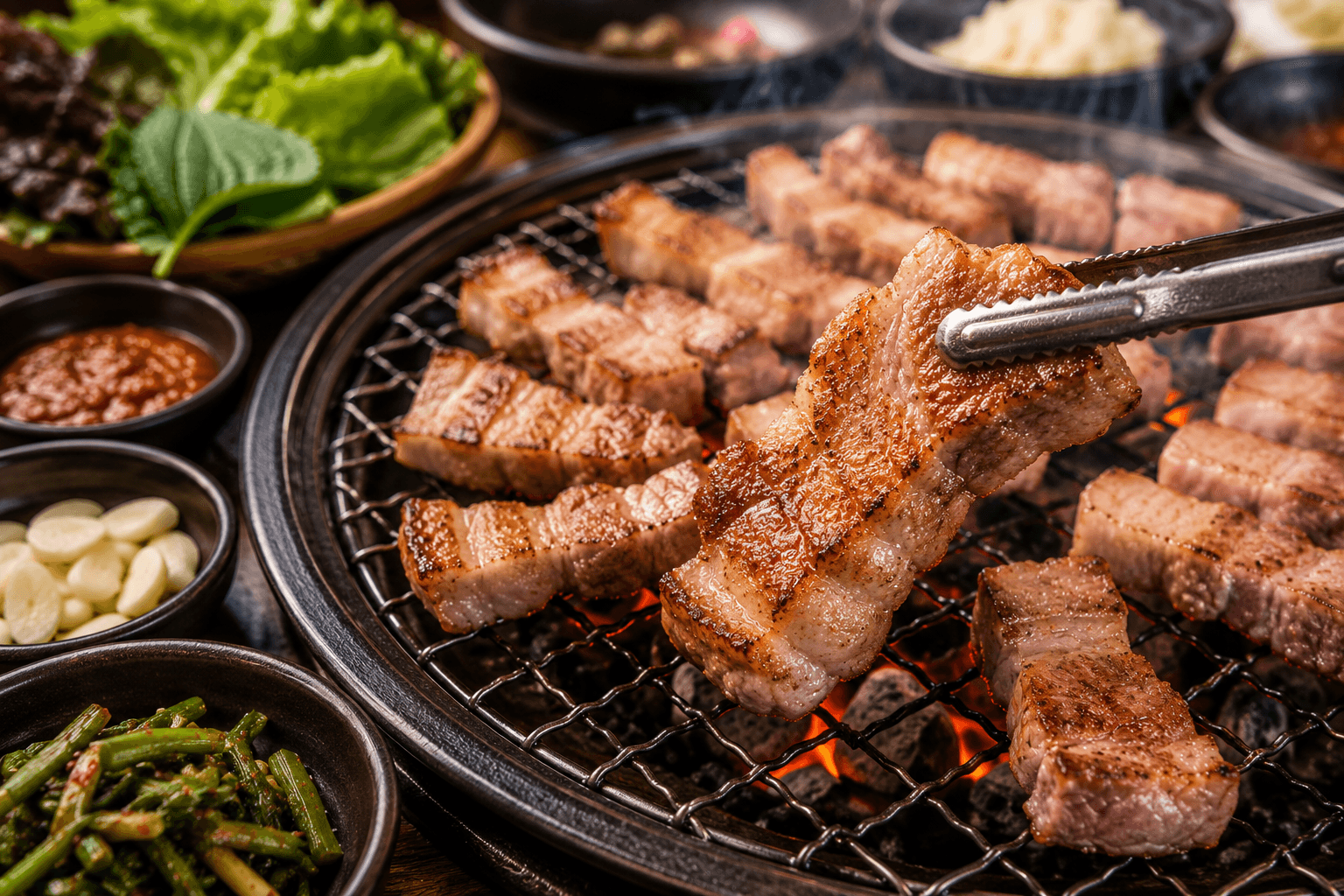
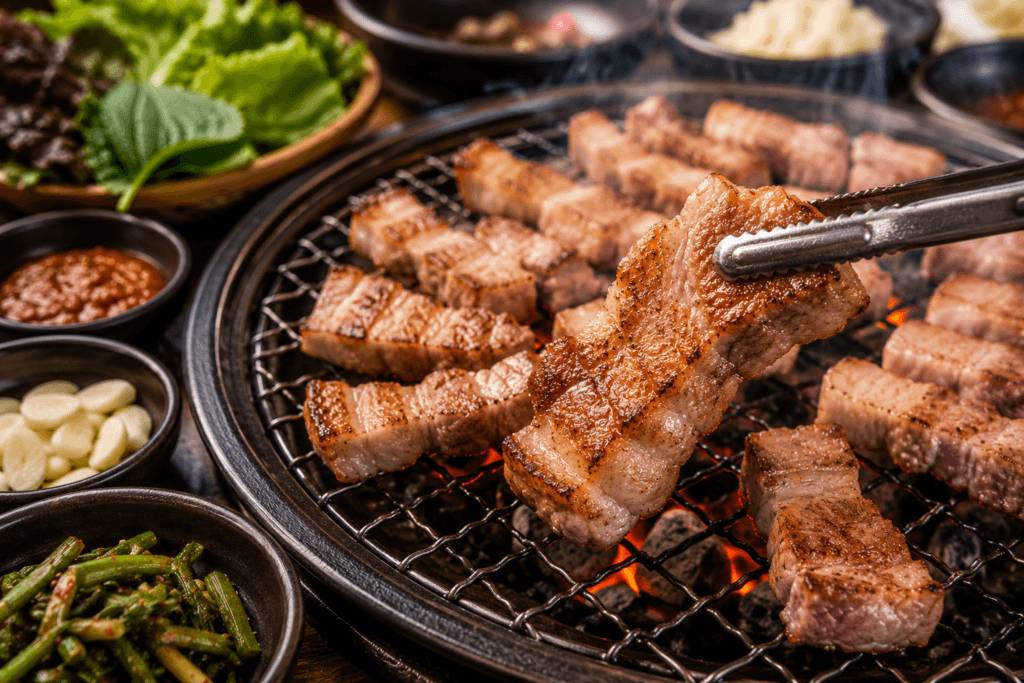
The meat is important, of course. But the real magic comes from everything happening around the grill: pork belly sizzling at the table, scissors cutting meat into bite-sized pieces, side dishes filling every empty space, garlic roasting quietly in the corner, and everyone building lettuce wraps with the seriousness of tiny edible architecture.
Many first-time visitors arrive expecting a simple barbecue meal. Then they sit down, the grill turns on, banchan starts arriving, someone asks if they should flip the meat, and suddenly dinner feels like a full cultural event.
That is what makes Korean BBQ so memorable.
It is not just grilled meat. It is a social meal built around sharing, cooking, wrapping, dipping, drinking if you want to, talking, waiting, and eating slowly. Whether you are visiting Seoul, Busan, Gyeongju, or Jeju Island, Korean BBQ should be near the top of your Korea food list.
If this is your first trip to Korea, you may also want to read What to Eat in Korea, which covers the country’s most famous dishes beyond barbecue.
This article may contain affiliate links, which means we may earn a small commission if you book through them, at no extra cost to you.
Table of contents
Why Korean BBQ Feels Different in Korea
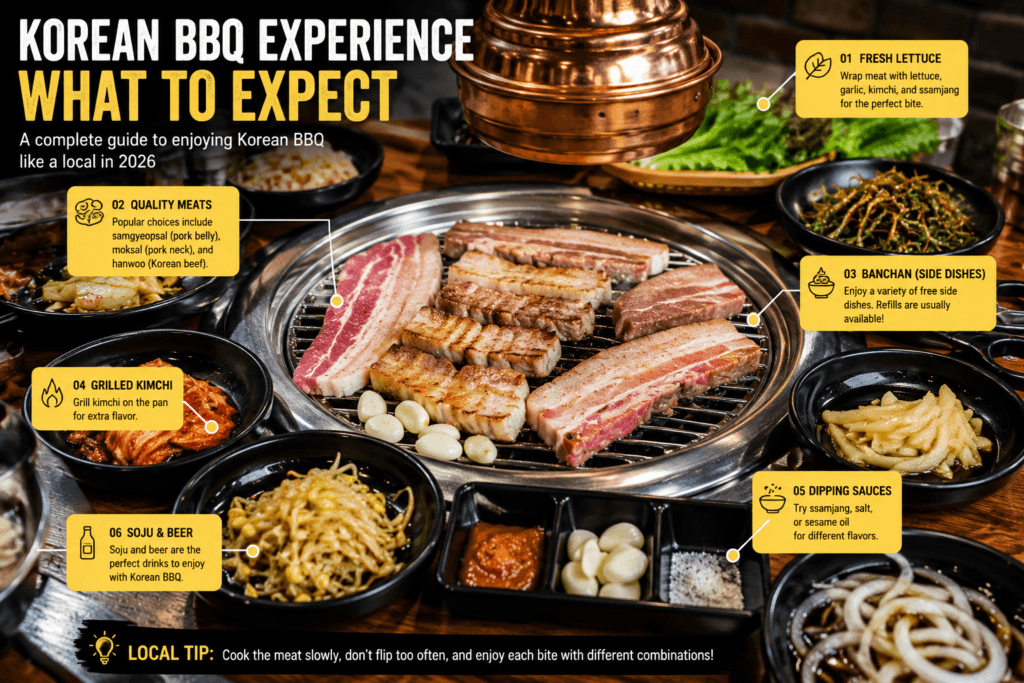
Korean BBQ feels different because the cooking happens right at your table.
Instead of receiving a finished plate from the kitchen, you take part in the meal. In some restaurants, the staff cook the meat for you. In others, you cook it yourself. Either way, the grill becomes the center of the table.
The other big difference is the side dishes.
A typical Korean BBQ meal may come with kimchi, pickled vegetables, garlic, lettuce, perilla leaves, green chili peppers, dipping sauces, seasoned onions, bean sprouts, and other banchan. These side dishes are usually included with the meal, and many can be refilled for free.
The point is not to eat meat by itself until everyone becomes slightly sleepy and philosophical. Korean BBQ is about balance. A single bite might include grilled pork, garlic, kimchi, ssamjang, lettuce, rice, and a little sauce. Every wrap can taste slightly different.
That is why the meal feels more interactive than many other types of barbecue. You are not just eating. You are building each bite.
The Most Popular Korean BBQ Meats
Samgyeopsal
Samgyeopsal, or pork belly, is the classic first Korean BBQ order.
It is rich, fatty, juicy, and easy to enjoy. Thick slices of pork belly are grilled at the table until the edges become golden and slightly crispy. Most people eat it with salt, ssamjang, garlic, grilled kimchi, and lettuce wraps.
For many travelers, samgyeopsal is the first “real” Korean BBQ experience. It is casual, affordable compared with premium beef, and widely available across Korea.
If you are nervous about ordering, samgyeopsal is the safest place to start. It is popular for a reason, and that reason is usually sizzling directly in front of you.
Moksal
Moksal, or pork neck, is often underrated by first-time visitors.
It has less fat than pork belly but still stays juicy when grilled well. Many Koreans like moksal because it has a firmer texture and a balanced flavor. It can feel less heavy than pork belly, especially if you are planning to eat more than one round of meat.
A good Korean BBQ order for beginners is pork belly plus moksal. Pork belly gives you richness. Moksal gives you balance. Together, they make the table feel more complete.
If you only order samgyeopsal, you are not doing anything wrong. But adding moksal is one of the easiest upgrades.
Galbi
Galbi refers to ribs, often beef ribs, and it is one of Korea’s most famous BBQ dishes.
Many galbi restaurants serve the meat marinated in a sweet and savory sauce before grilling. The flavor is easier for many first-time visitors because it is slightly sweeter and more familiar than plain grilled pork or beef.
Galbi can be more expensive than pork BBQ, depending on the restaurant and cut. It is a good choice if you want something flavorful, tender, and a little more special than a casual pork belly dinner.
Just be careful with marinated meat on the grill. The sauce can burn more easily, so do not abandon it like a suitcase at the airport.
Hanwoo Beef
Hanwoo is Korea’s premium native beef.
It is often compared with Japanese Wagyu, although the flavor and texture are not exactly the same. Hanwoo is prized for its tenderness, marbling, and deep beef flavor. It is usually much more expensive than pork BBQ, so many travelers save it for a special meal.
If your budget allows, Hanwoo can be worth trying once in Korea. It is especially good if you care about high-quality beef and want a more premium BBQ experience.
That said, you do not need Hanwoo to enjoy Korean BBQ. A simple pork belly dinner at a good local restaurant can be just as memorable, sometimes more so.
Jeju Black Pork
If you are visiting Jeju Island, Jeju black pork is one of the most famous regional BBQ experiences in Korea.
It is known for its rich flavor, firm texture, and strong local identity. Many travelers try it with meljeot, a salty Jeju anchovy dipping sauce that pairs surprisingly well with grilled pork.
Jeju black pork is usually more expensive than standard pork, but it is worth considering if food is a big part of your trip. For details on what to order and where to eat it, read the Jeju Black Pork Guide 2026.
How to Order Korean BBQ
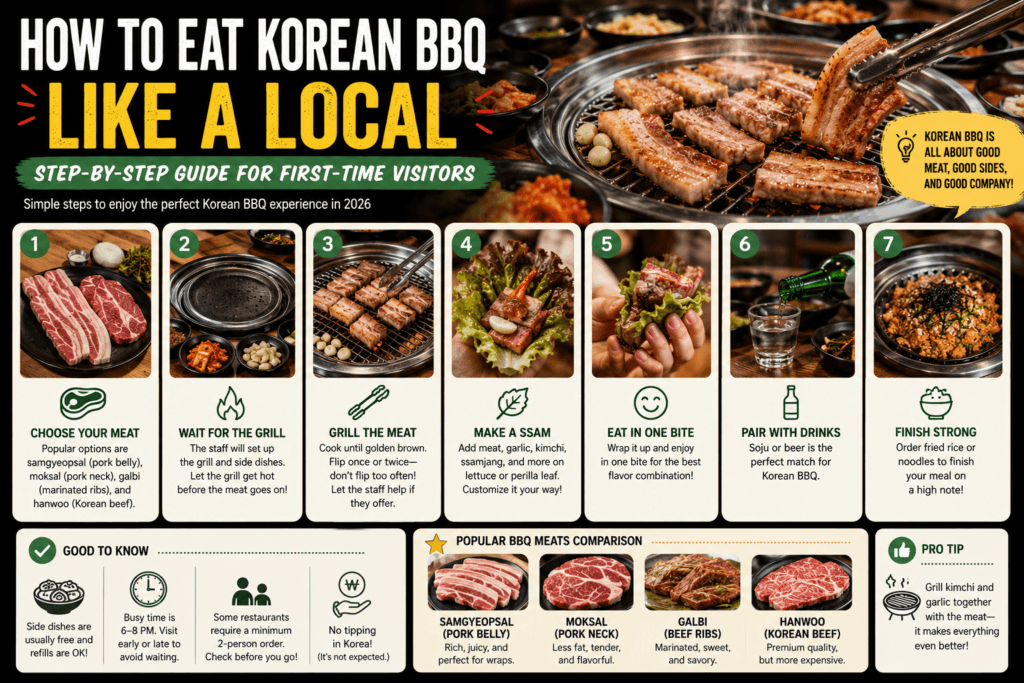
Ordering Korean BBQ can feel intimidating the first time, but the process is simpler than it looks.
Most restaurants have menus with photos, and many tourist-friendly areas offer English or translated menus. In general, you choose the type of meat, decide how many portions to order, add drinks or side dishes if needed, and wait for the grill to be prepared.
One thing that surprises many visitors is the minimum order rule. Some BBQ restaurants require at least two portions of meat, even if you are dining alone. This is common because Korean BBQ is usually designed as a shared meal.
If you are with two people, a good first order might be two portions of meat, such as samgyeopsal and moksal, plus rice, stew, or noodles if you are hungry. You can always order more later. It is better to start with a reasonable amount than cover the table with meat and realize your appetite has left the chat.
In many restaurants, staff will help grill the meat. If they do, let them. They know the timing, the grill temperature, and when to cut the meat. Your job is to enjoy the meal and avoid looking too heroic with the tongs.
Travelers who feel nervous about ordering or want a smoother first experience can consider a Korean BBQ dining experience in Seoul or a Seoul food tour with Korean BBQ.
How Much Does Korean BBQ Cost?
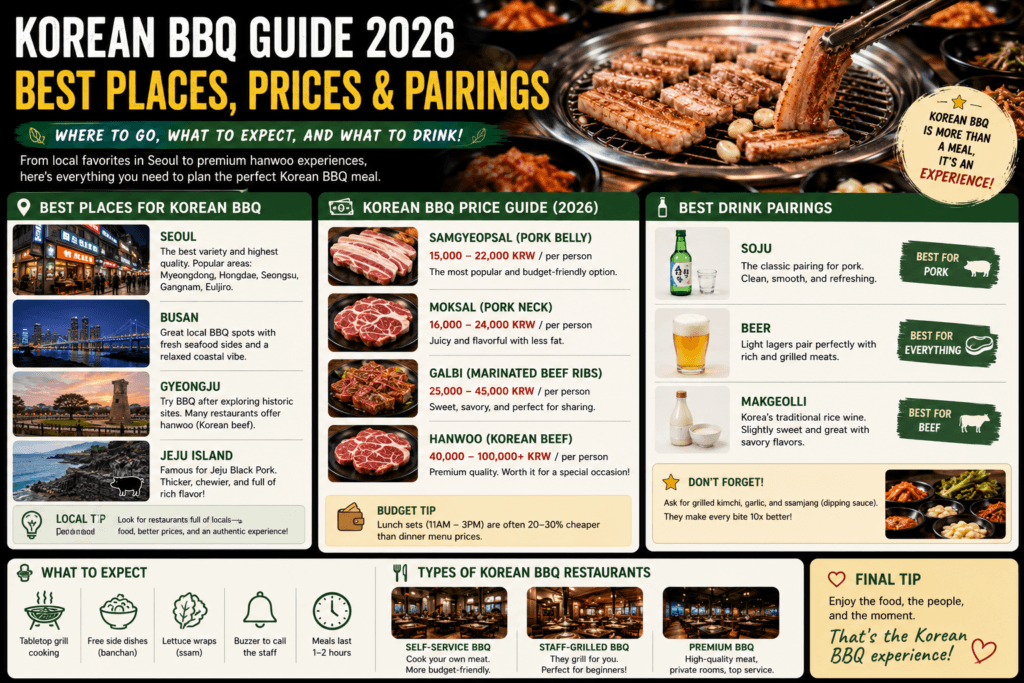
Korean BBQ prices vary depending on the city, neighborhood, restaurant style, and meat quality.
As a rough guide, pork BBQ is usually the most affordable option, while galbi and Hanwoo are more expensive. Tourist-heavy neighborhoods, premium restaurants, and famous restaurants with long lines may cost more.
Typical price ranges can look like this:
- Samgyeopsal: often around 15,000 to 22,000 KRW per serving
- Moksal: often around 16,000 to 24,000 KRW per serving
- Galbi: often around 25,000 to 45,000 KRW per serving
- Hanwoo: often around 40,000 KRW and much higher per serving
A normal Korean BBQ dinner for two people often costs around 40,000 to 80,000 KRW, depending on what you order. Premium Hanwoo restaurants can cost significantly more.
If you are watching your budget, pork BBQ is usually the best value. Samgyeopsal and moksal give you the full Korean BBQ experience without entering luxury beef territory.
For broader trip planning, check the Seoul Budget Travel Guide 2026 and How to Visit Seoul on $50 a Day.
Can You Eat Korean BBQ Alone?
Yes, you can eat Korean BBQ alone in Korea, but there are limits.
Some restaurants welcome solo diners, especially in tourist areas or casual neighborhoods. Others still require a minimum two-person order, which can make solo BBQ more expensive or awkward.
Solo-friendly BBQ restaurants are easier to find in areas such as Myeongdong, Hongdae, Seongsu, Gangnam, and other busy parts of Seoul. Some places are specifically designed for one-person barbecue, with individual grills or set menus.
If you are traveling alone, check reviews before going. Search for solo dining comments, minimum order information, or photos of single-person seating. You can also visit earlier than peak dinner time, when restaurants may be more flexible.
Travelers exploring Seoul can pair this with the Myeongdong Travel Guide 2026, Hongdae Travel Guide 2026, or Seongsu-dong Travel Guide 2026 to choose a neighborhood that fits dinner plans.
And if a restaurant says two portions minimum, that does not always mean two people minimum. Sometimes solo diners can order two portions and eat alone. This is not a failure. This is dinner with ambition.
How Koreans Actually Eat BBQ
Korean BBQ is usually a slower, more social meal than many visitors expect.
Most Korean groups do not rush through the meat. They grill in rounds, eat small combinations, refill side dishes, talk, drink if they want to, and often stay for one to two hours.
A typical bite might start with a lettuce or perilla leaf. Then comes a piece of meat, a little ssamjang, garlic, maybe grilled kimchi, and sometimes rice or green chili. The whole wrap is usually eaten in one bite.
Yes, one bite.
This surprises many visitors, especially when the wrap looks like it has architectural problems. But eating it in one bite keeps the flavors together and avoids the slow collapse of lettuce, sauce, and dignity.
You do not need to copy every local habit perfectly. But understanding the rhythm helps. Korean BBQ is not about eating the meat as fast as possible. It is about enjoying the grill, the side dishes, and the combinations.
Tips for Eating Korean BBQ Like a Local
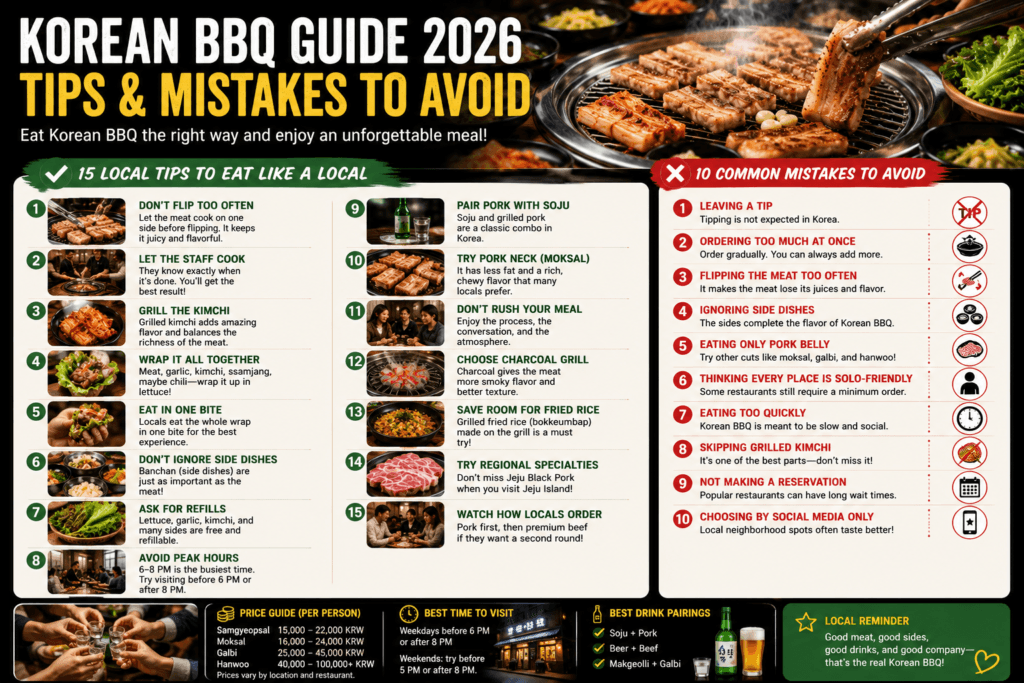
Do not flip the meat every few seconds. Let one side cook properly before turning it. Constant flipping can stop the meat from developing good color and texture.
If the staff offer to cook, let them. This is especially helpful with thick cuts, premium meat, or busy restaurants where the staff are used to managing the grill quickly.
Try grilled kimchi, especially with pork belly. Kimchi becomes softer, smokier, and richer on the grill. For many visitors, grilled kimchi becomes one of the surprise highlights of the meal.
Do not ignore the banchan. Side dishes are not decoration. They are part of how Korean BBQ works. Lettuce, garlic, sauces, pickled vegetables, onions, and kimchi all change the flavor of each bite.
Ask for refills if you need them. In many restaurants, common side dishes can be refilled for free. Just ask politely or point to what you want more of.
Order gradually. It is better to start with a few portions and add more later than to order too much meat at once. Freshly grilled meat tastes better than meat sitting on the side getting cold and sad.
Save room for the ending. Some restaurants offer fried rice, stew, cold noodles, or ramyeon after the meat. These can be excellent, especially if the grill or broth has picked up flavor from the meal.
Finally, do not rush. Korean BBQ is meant to be enjoyed slowly. Give the meal time to do its smoky little dance.
Common Mistakes First-Time Visitors Make
One of the easiest mistakes is tipping.
Tipping is not expected in Korea, including at Korean BBQ restaurants. Good service is part of the meal, and you do not need to leave extra money unless a specific service charge is clearly stated.
Another common mistake is ordering too much meat at once. First-time visitors often panic-order because everything looks good. Start with a manageable amount and add more if needed.
Many visitors also flip the meat too often. Letting the meat cook properly on one side creates better texture and flavor. If the staff are cooking, resist the urge to help unless they ask. The tongs are not always a democracy.
Some travelers focus only on pork belly and miss other cuts such as moksal, galbi, or Hanwoo. Pork belly is great, but Korean BBQ becomes more interesting when you try different textures and flavors.
Do not choose restaurants only because they are famous on social media. Popular places can be good, but local neighborhood BBQ restaurants often offer better value, fewer lines, and a more relaxed meal.
Skipping side dishes is another mistake. The banchan, sauces, wraps, and grilled kimchi are what make Korean BBQ feel Korean. Meat alone is only half the conversation.
Finally, do not treat Korean BBQ like fast food. The meal is supposed to take time. If you rush it, you miss the best part.
Best Areas for Korean BBQ in Seoul
Seoul has Korean BBQ restaurants almost everywhere, but some areas are especially convenient for travelers.
Myeongdong is easy for first-time visitors because it is central, tourist-friendly, and close to shopping, hotels, and street food. It can be more touristy, but it is convenient. Use the Myeongdong Travel Guide 2026 if you are planning dinner in the area.
Hongdae is great for a casual and energetic BBQ night. The area has many restaurants, bars, cafes, and late-night options. It works well for travelers who want dinner followed by a lively evening. Use the Hongdae Travel Guide 2026 to plan the neighborhood.
Gangnam offers many mid-range and premium BBQ options, including beef and Hanwoo restaurants. It is a good area if you want a more polished dinner.
Seongsu is better for travelers who want a trendy cafe-and-dinner route. Spend the afternoon exploring cafes and shops, then finish with BBQ nearby. The Seongsu-dong Travel Guide 2026 can help with that route.
For traditional atmosphere before dinner, you can also spend the day around Insadong, Bukchon, or Gyeongbokgung, then head to a nearby BBQ restaurant in central Seoul. The Insadong Travel Guide 2026, Bukchon Hanok Village Guide 2026, and Gyeongbokgung Palace Guide 2026 pair naturally with a Korean food evening.
What to Drink with Korean BBQ
Soju and beer are the most common drinks with Korean BBQ.
Many Koreans enjoy pork BBQ with soju, beer, or somaek, which is a mix of soju and beer. These drinks pair well with rich grilled meat, salty sauces, and spicy side dishes.
That said, alcohol is completely optional. You can enjoy Korean BBQ with water, soda, tea, or soft drinks. Do not feel pressured to drink just because it appears in Korean dramas every 12 seconds.
If you do drink, pace yourself. Korean BBQ is already a long meal, and soju can feel gentle until it suddenly starts making executive decisions.
Frequently Asked Questions
Is Korean BBQ expensive in Korea?
Korean BBQ does not have to be expensive. A normal pork BBQ meal is often reasonably priced, while premium beef, galbi, and Hanwoo cost more. Budget depends on the restaurant, neighborhood, and meat quality.
What is the best Korean BBQ meat for first-time visitors?
Samgyeopsal, or pork belly, is the best starting point for many first-time visitors. It is popular, easy to enjoy, and widely available. If possible, order moksal as well for a more balanced meal.
Can I eat Korean BBQ alone?
Yes, but some restaurants require a minimum order of two portions. Solo-friendly BBQ restaurants are easier to find in tourist areas such as Myeongdong, Hongdae, Seongsu, and Gangnam.
Do I need to tip at Korean BBQ restaurants?
No. Tipping is not expected in Korea. You can simply pay the bill and leave normally.
Is Korean BBQ different in Korea compared with overseas?
Yes. The table grilling, side dishes, restaurant atmosphere, staff cooking style, meat cuts, sauces, and social rhythm often feel very different from Korean BBQ restaurants overseas.
Are Korean BBQ side dishes free?
Usually, yes. Most Korean BBQ restaurants include banchan with the meal, and many side dishes can be refilled for free. Premium or special menu items may cost extra.
What drink goes best with Korean BBQ?
Soju and beer are the most common alcoholic drinks with Korean BBQ. Soft drinks, water, and tea are also completely fine.
Is Hanwoo worth trying?
Hanwoo is worth trying if your budget allows and you enjoy premium beef. However, you do not need Hanwoo to have a great Korean BBQ experience. Pork belly or moksal at a good local restaurant can be excellent.
How long does a Korean BBQ meal take?
Most Korean BBQ meals last around one to two hours. The meal is meant to be shared slowly rather than rushed.
Which city is best for Korean BBQ?
Seoul offers the largest variety of Korean BBQ restaurants. Jeju is famous for black pork, while Busan, Gyeongju, and other cities also have excellent local BBQ options.
Related Guides
Planning more food adventures in Korea? Continue with these guides:
- What to Eat in Korea
- Jeju Black Pork Guide 2026
- Myeongdong Travel Guide 2026
- Hongdae Travel Guide 2026
- Seongsu-dong Travel Guide 2026
- Seoul Budget Travel Guide 2026
- Best Areas to Stay in Seoul
Recommended Travel Services
These can be useful if you want an easier food experience or smoother trip planning:
- Korean BBQ dining experience in Seoul
- Seoul food tour with Korean BBQ
- Korea eSIM for travelers
- Airport transfer services in Korea
Final Thoughts
Korean BBQ is much more than grilled meat.
It is one of the best ways to experience Korean food culture, whether you are sharing pork belly in Seoul, trying premium Hanwoo, eating galbi with friends, or enjoying Jeju black pork on the island.
The best Korean BBQ meals are not always the fanciest ones. Sometimes the most memorable dinner is a simple evening around a hot grill with good meat, fresh side dishes, grilled kimchi, and enough time to enjoy the whole thing properly.
Start with samgyeopsal, try moksal if you can, let the staff cook when they offer, build a proper lettuce wrap, and do not ignore the side dishes.
If you are visiting South Korea for the first time, Korean BBQ should absolutely be on your must-try list. It is smoky, social, satisfying, and just chaotic enough to be unforgettable in the best way.