Affiliate disclosure: This guide may contain affiliate links. If you book through them, we may earn a small commission at no extra cost to you. Learn more.
Choosing where to stay in Jeju can feel harder than choosing whether to visit. The island looks compact until a pretty hotel on the wrong coast turns every breakfast into the start of a road expedition.
The useful question is not “Which hotel is best?” but “Which area removes the most friction from my route?” Jeju City wins for airport access and no-car trips, Seogwipo for a balanced longer stay, Jungmun for resort comfort, Aewol for cafe evenings, Hyeopjae for beach time and Seongsan for Udo and early starts.
This guide compares those bases by transport, atmosphere, nearby sights and hidden trade-offs. Pick the region first and the room second; a photogenic bathtub has never shortened a cross-island drive.
For a full island overview before choosing your base, start with our Jeju Travel Guide 2026.
Table of contents
Quick Answer: Where Should You Stay in Jeju?
If you are visiting Jeju for the first time, here is the simple version.
| Trip priority | Best base | Main trade-off |
|---|---|---|
| Late arrival, early flight or 1–2 nights | Jeju City | Convenient, but less island atmosphere |
| No rental car | Jeju City or central Seogwipo | Plan around bus corridors and tours |
| Balanced 3–5 day trip | Seogwipo | Longer airport and far-east transfers |
| Resort, family or easy vacation | Jungmun | Higher prices and less local texture |
| Cafes, couples and sunsets | Aewol | A car helps; sights are spread out |
| Beach-focused warmer-weather trip | Hyeopjae or Hallim | Long drives to eastern Jeju |
| Udo, sunrise and eastern nature | Seongsan | Far from the airport and west coast |
For most travelers, the safest choices are Jeju City for convenience, Seogwipo for balance, and Jungmun for comfort.
Let Arrival and Departure Times Choose the First Night
Your flight number matters less to this decision than the time you actually leave the airport. A late arrival, an early departure or a separate rental-car shuttle makes Jeju City the sensible first or final base. Practical is attractive when the alarm is set before sunrise.
With an earlier arrival and a car already booked, you can continue to Seogwipo, Jungmun or Aewol. Without a car, check the live airport bus route against the exact hotel—not just the town name—because the last walk can be the least charming part of a long travel day.
If Jeju is part of a wider Korea route, the Jeju 5-Day Itinerary shows where a one-time hotel move saves time and where it merely introduces your suitcase to another lobby.
How to Choose the Best Area to Stay in Jeju
Before booking a hotel in Jeju, think about three things: trip length, transportation, and your main reason for visiting.
Jeju is not like Seoul, where you can usually fix a bad location with the subway. Public transportation exists, but buses can take time, taxis can add up, and many scenic places are easier with a rental car or organized tour.
If you are staying only one or two nights, convenience matters more than atmosphere. In that case, Jeju City is usually the most practical base.
If you are staying three to five nights, Seogwipo often gives you a better island experience because it puts you closer to waterfalls, local markets, coastal roads, and many southern attractions.
If you are traveling with kids, older parents, or someone who believes vacation should not require logistics gymnastics, Jungmun is a strong choice. It has large hotels, resort facilities, and easy access to family-friendly attractions.
If your trip is more about cafes, coastal views, and slow travel, Aewol or Hyeopjae may feel more memorable. Just remember that beautiful locations are not always the easiest locations.
A good Jeju hotel is not only about the room. It is about how many hours it saves you each day.
Jeju City: Best for First-Time Visitors, Short Trips and No-Car Travel
Jeju City is the most practical area to stay in Jeju.
It is where Jeju International Airport is located, and it has the widest range of hotels, restaurants, shops, markets, cafes, bus connections, and everyday travel services. If this is your first trip to Jeju, Jeju City may not feel like the most dramatic choice, but it is often the easiest one.
This is especially true if you are arriving late, leaving early, staying only one or two nights, or traveling without a rental car. You can get from the airport to many Jeju City hotels quickly, and it is easier to find food, convenience stores, pharmacies, and taxis compared with quieter parts of the island.
Jeju City is also useful at the beginning or end of a longer island trip. Many travelers stay here on the first night, then move to Seogwipo, Jungmun, Aewol, or the east side once they are ready to explore more deeply.
The main downside is that Jeju City does not always feel like the dreamy island version of Jeju that people imagine. You will find city streets, traffic, hotels, markets, and restaurants rather than quiet beaches outside your window. It is practical, not poetic.
Still, practical can be beautiful when your flight leaves at 8 a.m.
Jeju City is best for first-time visitors, short trips, late arrivals, early departures, travelers without a rental car, and people who want more food and hotel options.
Nearby places to visit include Dongmun Market, Yongduam Rock, Iho Tewoo Beach, and local shopping streets. If food is part of your plan, you can also connect this area naturally with our Jeju Black Pork Guide 2026.
If this base fits your arrival or no-car plan, compare Jeju City hotels near the airport by walking distance to food and the bus stop—not by “near the airport” in the listing title alone.
Why Stay in Jeju City?
The reason travelers choose Jeju City is simple: it makes the island easier.
You are close to the airport, which makes arrivals and departures much less stressful. There are more hotels at different price points, from budget stays to larger business-style hotels. Restaurants are easier to find late in the evening, and public transportation is generally more convenient than in rural areas.
Jeju City is also a good base if your itinerary includes different parts of the island but you do not want to change hotels. You can take day trips east, west, or south, although travel times will vary.
For travelers who are nervous about driving in Korea, Jeju City gives you more options. You can use buses, taxis, day tours, or private transfers more easily from here than from smaller coastal villages.
It is also useful during bad weather. If rain changes your plans, you still have cafes, markets, shops, restaurants, and indoor options nearby. In remote beach areas, rainy days can feel more limiting.
The trade-off is atmosphere. If you want resort pools, coastal trails, quiet beaches, or a room that feels deeply connected to Jeju’s nature, other areas may suit you better.
This is the classic Jeju travel trap: people see “Jeju Island” and assume everything is nearby. Then the map quietly laughs.
Seogwipo City: Best for Scenic Longer Trips
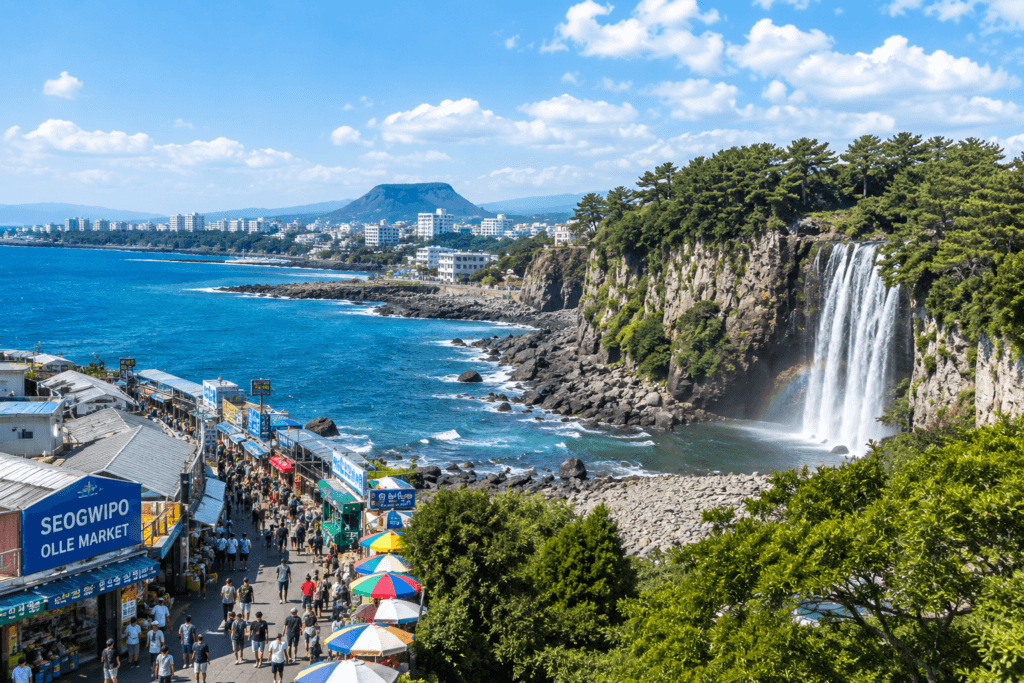
Seogwipo City is one of the best areas to stay in Jeju for travelers who want a more scenic, balanced island trip.
Located on the southern side of Jeju, Seogwipo has a more relaxed feel than Jeju City but still offers restaurants, markets, hotels, cafes, and useful travel services. It is not as remote as small coastal villages, but it feels closer to the Jeju many travelers come to see.
This area works especially well for trips of three to five days. From Seogwipo, you can visit waterfalls, coastal viewpoints, local markets, southern beaches, and parts of central Jeju more easily than if you stayed only in Jeju City.
Seogwipo is also a good base if your trip includes nature but you do not want to sleep somewhere too isolated. It gives you a comfortable middle ground: enough convenience to avoid travel stress, but enough scenery to feel like you actually came to an island.
For many first-time visitors with a longer itinerary, Seogwipo may be the best overall choice.
Seogwipo is best for three to five-day Jeju trips, couples, friends, travelers who want nature and convenience, visitors planning to explore southern Jeju, and people who want a more local feel than Jungmun.
Nearby attractions include Jeongbang Waterfall, Cheonjiyeon Waterfall, Seogwipo Maeil Olle Market, Oedolgae Rock, and southern coastal viewpoints. It also connects well with our Hallasan National Park Guide 2026 if you are planning a nature-focused trip.
Compare Seogwipo hotels and guesthouses by market, harbor or coastal location. “Seogwipo” covers more ground than the booking card may suggest.
Why Stay in Seogwipo?
Seogwipo gives you a good balance.
It feels more relaxed than Jeju City, but it is not so quiet that you feel stranded after dinner. You can still find markets, restaurants, cafes, convenience stores, and hotels, while staying closer to many of Jeju’s natural attractions.
It is also a good area for travelers who want to experience Jeju beyond airport convenience. Walking around Seogwipo in the evening, visiting the local market, eating seafood or black pork, and taking short trips to waterfalls gives the stay more texture.
For visitors following our Jeju 5-Day Itinerary 2026, Seogwipo often works well as a middle base, especially if you plan to explore southern and western Jeju.
The main drawback is distance from the airport. If your flight arrives late at night or leaves early in the morning, staying in Seogwipo on your first or last night can be inconvenient.
Public transportation is also not as simple as staying in central Jeju City. You can still travel by bus or taxi, but a rental car or planned day tour will make things much easier.
Seogwipo is a strong choice for a real Jeju trip, but it works best when you give it enough time.
Jungmun: Best for Resorts, Families and Easy Vacations
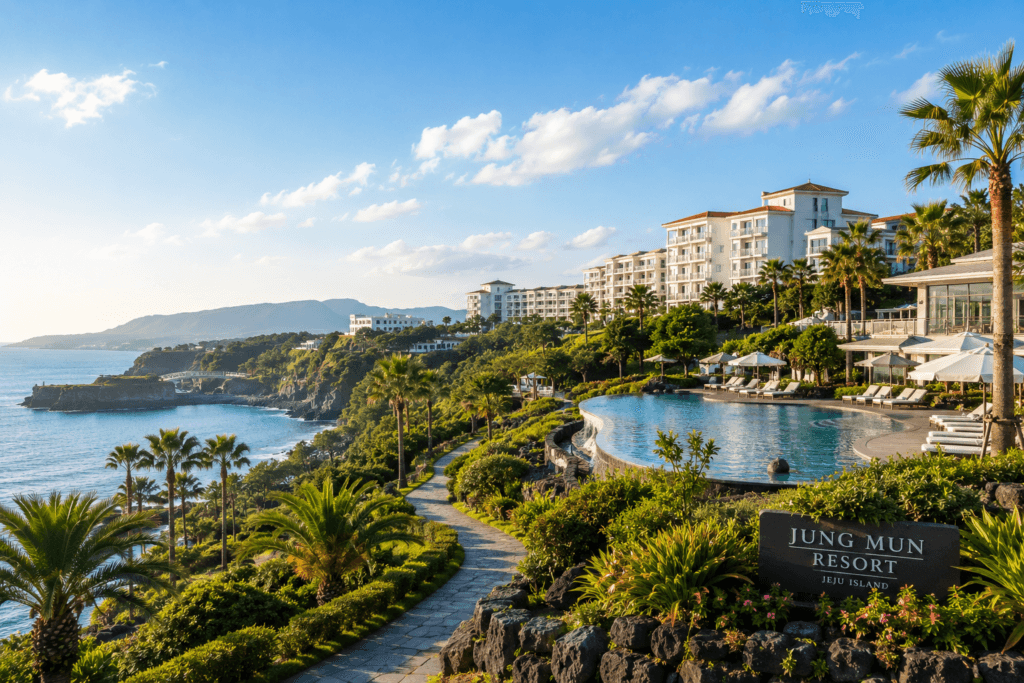
Jungmun is the best area to stay in Jeju if you want a resort-style vacation.
Located in the southwest part of Seogwipo, Jungmun Tourist Complex is one of Jeju’s most established resort areas. It has large hotels, family-friendly attractions, beaches, museums, gardens, restaurants, and scenic coastal spots nearby.
This is where Jeju feels more polished. The hotels are often larger, the facilities are easier to understand, and the area is comfortable for travelers who do not want to plan every tiny detail themselves. It is a good fit for families, couples, honeymooners, and visitors who want a softer landing.
Jungmun is also useful if you want to enjoy Jeju without constantly moving around. You can stay in a resort, visit nearby attractions, take a coastal walk, spend time at the beach, and keep your schedule relaxed.
It is not the cheapest area in Jeju, but it can be worth it if comfort matters more than shaving every won off the budget. Sometimes the best travel hack is simply not making your vacation harder than it needs to be.
Jungmun is best for families, couples, honeymoon-style trips, resort stays, travelers who want comfort, and visitors who prefer an easier vacation base.
Nearby places include Jungmun Saekdal Beach, Jusangjeolli Cliff, Cheonjeyeon Waterfall, museums, gardens, and resort dining options.
When comparing Jungmun resort hotels, check whether the pool, breakfast and family facilities you want are included in the selected room rate rather than shown only in the most persuasive photograph.
Why Stay in Jungmun?
Jungmun is comfortable. That is its biggest strength.
Hotels are often well-equipped, and the area is designed for visitors. Families may find it easier than staying in a smaller village, especially if they want pools, larger rooms, hotel restaurants, parking, or nearby attractions.
The area also has a vacation feeling that Jeju City does not always provide. If your image of Jeju includes resort mornings, coastal walks, and a slower schedule, Jungmun fits that mood better.
It also works well for travelers who want to avoid changing hotels too often. You can use Jungmun as a comfortable base for southern Jeju and parts of the west.
The biggest downside is price. Jungmun can be more expensive than Jeju City or central Seogwipo, especially during peak travel periods. Budget travelers may find better value elsewhere.
It can also feel less local. If you want markets, small restaurants, and everyday Jeju life, Seogwipo City or Jeju City may feel more interesting. Jungmun is convenient and pretty, but it is also a tourist complex.
Travelers without a car should check the exact hotel location before booking. Some hotels are easy enough to manage by taxi or bus, while others feel much more comfortable with a rental car or private transfer.
Aewol: Best for Cafes, Sunsets and Couples
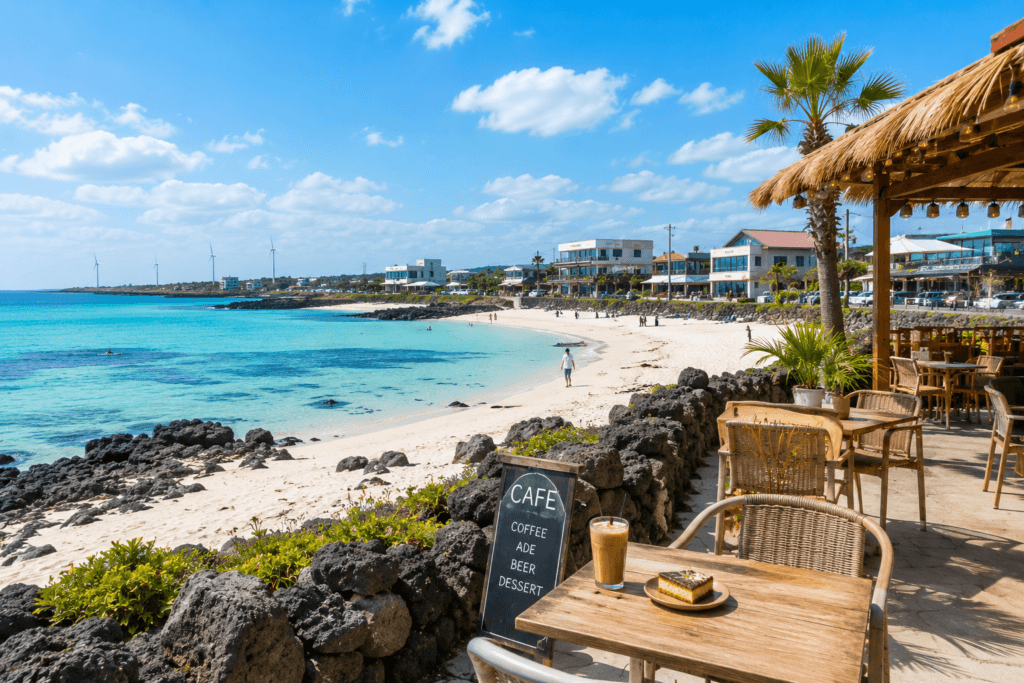
Aewol is where many visitors go when they want Jeju to feel slower: ocean-view cafes, coastal roads, sunset stops, small stays, and a softer island mood.
Located on the northwest side of the island, Aewol is close enough to Jeju City and the airport to feel convenient, but it has a much more scenic atmosphere. This is the Jeju many travelers imagine before they arrive: blue water, winding coastal roads, stylish cafes, guesthouses, pensions, and evening light that makes your camera roll feel slightly smug.
Aewol is especially good for couples, friends, cafe lovers, and travelers who want a scenic first impression of Jeju without going too far from the airport. It is also a good choice for visitors who plan to explore western Jeju, including Hyeopjae, Hallim, and nearby coastal villages.
If you want an Aewol afternoon, choose a stay near the Handam coast rather than assuming every address in Aewol is a short stroll from the cafés. The Aewol travel guide maps the Handam-to-Gwakji walk, while our Jeju café guide helps you pick a stop near the route you are already taking. One good sea-view break is plenty; a long drive for a second coffee is rarely the highlight of the day.
The trade-off is the exact address. A Handam-area stay can work without a car for a slow café-and-coastal-walk day, but the wider Aewol district is spread out. Visit Jeju describes the Handam trail toward Gwakji as a one-way coastal walk, not a loop back to your hotel. Before booking, check the walk to the bus stop, your return connection, and whether your lodging is genuinely near Handam—not merely labelled “Aewol.” Taxis help, but repeated rides add up.
Aewol is also less convenient than Jeju City for late-night food, shopping, and transportation. If you like having many restaurants within walking distance, central Jeju City may be easier.
During rainy or windy weather, Aewol can feel quieter than expected. The cafes are still there, but the ocean-view magic can become more of a gray postcard. Beautiful, yes. Slightly damp, also yes.
Choose Aewol when your Jeju trip is more about cafes, coastal roads, and slow sunsets than checking off every famous attraction.
Hyeopjae and Hallim: Best for Beaches and Summer Trips
If your Jeju trip is built around beach time, Hyeopjae and Hallim deserve a serious look.
This area is located on the western side of Jeju and is known for bright water, soft sand, views of Biyangdo Island, and a relaxed coastal mood. If you are visiting in late spring, summer, or early autumn, Hyeopjae can be one of the most satisfying places to stay.
Hyeopjae works especially well for families, beach lovers, slower travelers, and anyone who wants to spend more time near the water than inside a car. It also pairs nicely with nearby cafes, Hallim Park, coastal drives, and western Jeju sightseeing.
If beaches are a major part of your trip, read our Hyeopjae Beach Guide 2026 before booking your stay. The shore is worth a walk outside summer, but Jeju’s 2026 managed swimming season ended on September 6; do not book an autumn beach stay expecting lifeguarded swimming. Next season’s operating dates need a fresh official check.
Hyeopjae and Hallim are beautiful, but they are not central. If you plan to visit Seongsan Ilchulbong, Udo Island, or the far eastern side of Jeju, staying in Hyeopjae for the entire trip may create long travel days.
Public transportation can also be slower here. Travelers without a car should check bus routes carefully before booking. If your hotel is not near a main road or town center, you may need taxis more often than expected.
Hyeopjae is excellent when your trip is designed around the west. It is less ideal when you are trying to turn Jeju into a daily island marathon.
Seongsan and East Jeju: Best for Sunrise, Udo and Nature
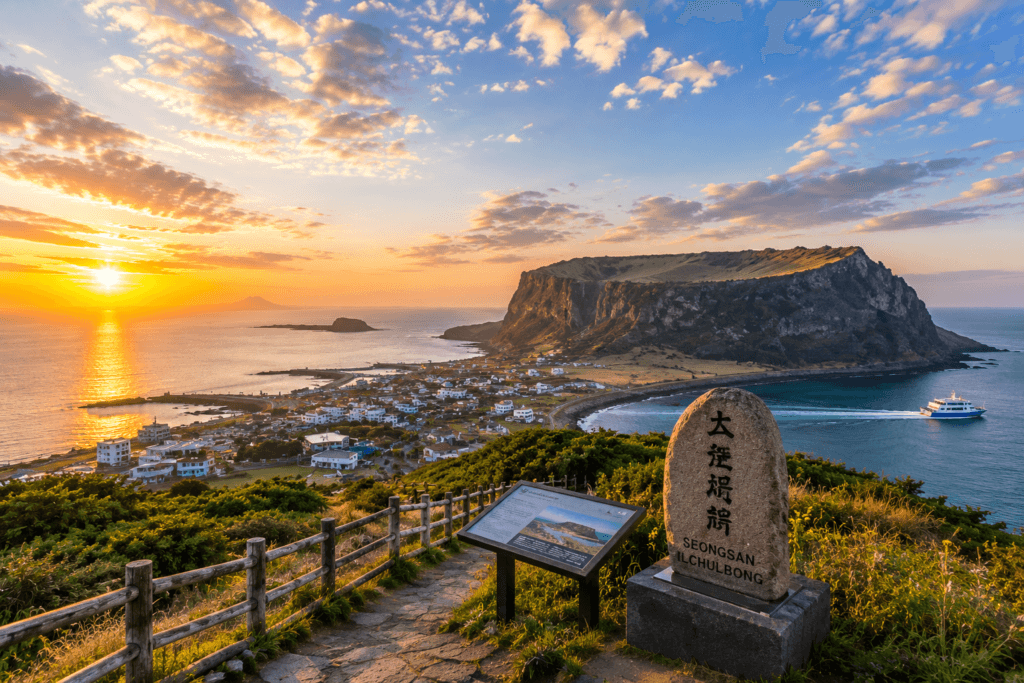
Seongsan and East Jeju suit travelers who are willing to trade convenience for quieter mornings, sunrise views, and easier access to Udo Island.
This area is famous for Seongsan Ilchulbong, one of Jeju’s most iconic natural landmarks. It is also the main gateway to Udo Island, making it a strong base if your itinerary focuses on eastern Jeju.
Staying in the east can make early mornings much easier. If you want to watch sunrise at Seongsan Ilchulbong, catch the ferry to Udo, visit Seopjikoji, or explore quieter coastal roads, staying nearby can save a lot of time.
This area is especially good for photographers, nature lovers, repeat visitors, and travelers who prefer quiet evenings over busy nightlife. It feels more remote than Jeju City, Seogwipo, or Jungmun, which can be either peaceful or inconvenient depending on your travel style.
For more planning, connect this section with our Seongsan Ilchulbong Guide 2026 and Udo Island Guide 2026.
The main drawback is distance. East Jeju is far from Jeju City, the airport, Hyeopjae, Aewol, Jungmun, and many southern attractions. If you stay here for your entire trip, you may create long travel days unless your itinerary is mostly focused on the east.
Evening options can also be quieter. You will find restaurants and local stays, but do not expect the same variety as Jeju City or Seogwipo.
This area is best when you have a clear reason to stay here. If you simply want “somewhere in Jeju,” Jeju City, Seogwipo, or Jungmun may be easier.
Your alarm will still be rude if you wake up for sunrise, but at least your commute will not join the attack.
Best Area to Stay in Jeju Without a Car
If you are visiting Jeju without a car, the safest area to stay is Jeju City.
Jeju City gives you the best access to the airport, buses, taxis, restaurants, markets, hotels, and day tour pickup points. It is not the most scenic base, but it is the easiest one to manage without driving.
Seogwipo can also work without a car, especially if you choose a central location near the market or main bus routes. However, you will need to plan more carefully than you would in Jeju City.
Jungmun is possible without a car if you plan to stay mostly around your resort area or use taxis and tours. It can be comfortable, but not always cheap.
Aewol, Hyeopjae and Seongsan require more precise location checks than Jeju City. A stay close to Handam can support an Aewol café-and-walk day by bus, and a Hyeopjae stay near the beach and bus corridor can suit a deliberately slow western trip. Neither makes the entire island easy without a car. Check the lodging-to-stop walk and the last practical return before booking.
For no-car travelers, the best strategy is usually simple: stay in Jeju City for convenience, then use organized day tours or private taxi tours for harder-to-reach attractions.
If you want to avoid driving but still reach dispersed sights, compare Jeju private taxi tour options. Confirm pickup area, total hours, overtime and which admission fees are excluded before booking.
You may also want to read our Best Apps for Korea Travel 2026 before your trip, because navigation, translation, taxi, and map apps can make Jeju much easier.
Best Area to Stay in Jeju With a Rental Car
If you have a rental car, you have much more freedom.
With a car, Seogwipo becomes one of the best overall bases for a longer Jeju trip. It gives you access to southern attractions, coastal roads, local food, and scenic viewpoints while still offering enough restaurants and hotels.
Jungmun is also excellent with a car, especially for families and resort travelers. You can enjoy a comfortable hotel base while driving to nearby beaches, museums, waterfalls, and cafes.
Aewol is much easier with a car, too. Many of the best cafes, coastal roads, and small stays are spread out, so driving makes the area feel relaxed instead of inconvenient.
For travelers planning a beach-focused trip, Hyeopjae and Hallim are much more practical with a car. The same is true for Seongsan and East Jeju if your goal is Udo, sunrise, and eastern nature.
If you plan to rent a car, compare your route before booking your hotel. A beautiful stay on the wrong side of the island can still become a daily test of patience.
Compare Jeju car rental options only after checking driver-document rules, insurance, luggage space, pickup shuttle and the return deadline for your flight.
Should You Split Your Stay in Jeju?
For trips of four nights or longer, splitting your stay can be a smart idea.
Instead of choosing one base for the entire island, you can stay in two different areas. This reduces driving time and lets you experience more than one side of Jeju.
A simple split-stay plan could look like this:
Jeju City for arrival and convenience, then Seogwipo or Jungmun for nature and relaxation.
Another good option is:
Aewol or Hyeopjae for western Jeju, then Seongsan for eastern Jeju and Udo Island.
For most first-time visitors, though, changing hotels too often can become annoying. Jeju is beautiful, but packing your suitcase every morning is not a cultural experience anyone asked for.
If you are staying three nights or less, choose one base. If you are staying four to five nights or longer, consider two bases.
For a full route idea, use our Jeju 5-Day Itinerary 2026 as a planning companion.
Where Not to Stay on Your First Jeju Trip
There is no single “bad” area to stay in Jeju, but some locations are risky for first-time visitors.
Be careful with hotels or pensions that look beautiful but are far from restaurants, bus stops, or main roads. This can be fine if you have a rental car and want peace, but frustrating if you are relying on buses or taxis.
You should also be careful about booking a remote stay just because the room looks pretty online. Jeju has many scenic accommodations, but location matters more than the bed frame. A gorgeous pension can become inconvenient if every meal requires a long drive.
For first-time visitors, avoid staying too far from your main travel goals. If your itinerary is mostly Seogwipo and Jungmun, do not book the whole trip in East Jeju. If you want to visit Udo and Seongsan, do not stay only in Hyeopjae unless you enjoy long drives with dramatic sighs.
The safest first-trip areas are Jeju City, Seogwipo, and Jungmun. Once you understand the island better, Aewol, Hyeopjae, Seongsan, and quieter villages become easier to choose.
Common Mistakes When Choosing Where to Stay in Jeju
The first mistake is assuming Jeju is small.
Jeju may look easy on a map, but travel times can be longer than expected. If you choose a hotel without checking your itinerary, you may spend more time moving around than actually enjoying the island.
The second mistake is booking only by hotel photos.
A beautiful room does not help much if it is far from food, transport, or your planned attractions. Always check the area, not just the bedding.
The third mistake is staying in one remote area for the entire trip.
This can work for slow travelers, but it is not ideal if you want to visit many famous places. For first-timers, convenience should win over fantasy more often than people expect.
The fourth mistake is ignoring transportation.
If you are not renting a car, choose Jeju City or a central part of Seogwipo. If you are renting a car, check parking before booking.
The fifth mistake is treating Jeju like Seoul.
In Seoul, a good subway location solves many problems. In Jeju, your hotel location shapes the entire trip. Choose carefully, and your days feel smooth. Choose randomly, and the island may gently roast your schedule.
Official Sources and Last Check
- Jeju International Airport public transportation — current airport bus, limousine bus and taxi information
- Jeju International Airport rental-car information — Rental Car House and provider shuttle pickup outside Gate 5
- Visit Jeju traffic information — island buses and tourist shuttle planning
- Official Jeju Tourism Guidebook — regional map and island planning reference
- Visit Jeju: Aewol Handam Coastal Trail — Handam-to-Gwakji walking route
- Visit Jeju: 2026 beach operating information — Hyeopjae swimming season and safety check
Last checked: September 17, 2026. Recheck the live airport route, hotel stop, Aewol return connection, rental shuttle, beach rules and property policies before paying.
FAQ: Where to Stay in Jeju
Is Jeju City or Seogwipo better?
Jeju City is better for airport access, short trips, and travelers without a car. Seogwipo is better for longer scenic trips, nature, markets, waterfalls, and a more relaxed island experience.
What is the best area to stay in Jeju for first-time visitors?
The best areas for first-time visitors are Jeju City, Seogwipo, and Jungmun. Jeju City is best for convenience, Seogwipo is best for balance, and Jungmun is best for resorts and comfort.
Where should I stay in Jeju without a car?
Jeju City is usually the best place to stay in Jeju without a car. It has better access to buses, taxis, day tours, restaurants, markets, and the airport.
Is Jungmun a good place to stay in Jeju?
Yes. Jungmun is a good place to stay if you want resorts, family-friendly hotels, beaches, museums, and a comfortable vacation base. It is not usually the cheapest area, but it is easy and relaxing.
Is Aewol a good area to stay in Jeju?
Yes, especially for cafés, sunsets and a slower western Jeju trip. A Handam-area stay can work for a walk-focused day without a car; exploring the wider Aewol coast is easier by car. Check the actual address and bus return, not just the area name.
Where should families stay in Jeju?
Families often do well in Jungmun, Jeju City, or Hyeopjae. Jungmun is best for resorts, Jeju City is practical for food and transport, and Hyeopjae is good for beach-focused family trips in warmer months.
Should I stay in one area or split my stay in Jeju?
If you are staying three nights or less, one base is usually easier. If you are staying four to five nights or longer, splitting your stay between two areas can reduce travel time.
What is the best area to stay in Jeju for beaches?
Hyeopjae and Hallim are excellent for beaches, especially in warmer months. Jungmun is also good if you want a resort-style beach vacation with larger hotels nearby.
What is the best area to stay in Jeju for Udo Island?
Seongsan or East Jeju is the best area to stay if Udo Island is a major part of your itinerary. Staying nearby makes it easier to catch the ferry and visit Seongsan Ilchulbong.
Final Thoughts: Where Should You Stay in Jeju?
The best area to stay in Jeju depends less on the “best” hotel and more on the kind of trip you want.
Choose Jeju City if you want convenience, airport access, and an easy base without a car.
Choose Seogwipo if you want a balanced island trip with nature, markets, waterfalls, and more scenic days.
Choose Jungmun if you want resorts, comfort, and a family-friendly vacation.
Choose Aewol if you want cafes, sunsets, and a romantic coastal atmosphere.
Choose Hyeopjae or Hallim if beaches are your main reason for visiting.
Choose Seongsan or East Jeju if you want sunrise views, Udo Island, and quieter nature.
For most first-time visitors, Jeju City is the easiest base for a short trip, while Seogwipo is better for a longer and more scenic itinerary. If you want a comfortable resort vacation, Jungmun is the safest choice.
Jeju rewards travelers who plan their base carefully. Pick the right area, and the island feels relaxed, scenic, and surprisingly easy. Pick the wrong one, and your vacation may develop a close personal relationship with your navigation app.
Start with your itinerary, then choose your area. Your future self, standing outside a hotel with luggage and a half-charged phone, will be deeply grateful.