Seoul is not a cheap city in the bargain-basement sense, but it is surprisingly easy to control your spending here. The subway is efficient, many of the best walks cost nothing, and a good bowl of soup does not require a small financial summit.
The dangerous part is usually not transportation or palace tickets. It is the innocent-looking combination of coffee, skincare, convenience-store snacks, and “just one more” souvenir. This guide separates the unavoidable costs from the fun ones so you can build a Seoul budget that survives contact with reality.
Quick answer: excluding flights and shopping, a careful solo traveler can plan around ₩80,000–₩120,000 per day. A comfortable mid-range trip usually lands around ₩180,000–₩300,000 per person per day, depending mostly on the hotel. Prices below are planning ranges, not promises; accommodation changes sharply by date.
Last price check: August 24, 2026. All totals are in Korean won. Convert to your home currency when you book because exchange rates move faster than a Seoul café trend.
Table of contents
Seoul daily budget at a glance
| Travel style | Typical daily budget | What it usually covers |
|---|---|---|
| Budget | ₩80,000–₩120,000 | Hostel dorm, local meals, subway and bus, mostly free or low-cost sights |
| Mid-range | ₩180,000–₩300,000 | Private room or hotel, mixed local and café meals, paid attractions, occasional taxi |
| Comfort | ₩350,000+ | Central upscale hotel, restaurants and cocktails, taxis, tours and ticketed experiences |
These ranges assume one traveler. Couples sharing a room often pay less per person because the hotel bill gets divided; solo travelers receive no such romantic financial benefit.
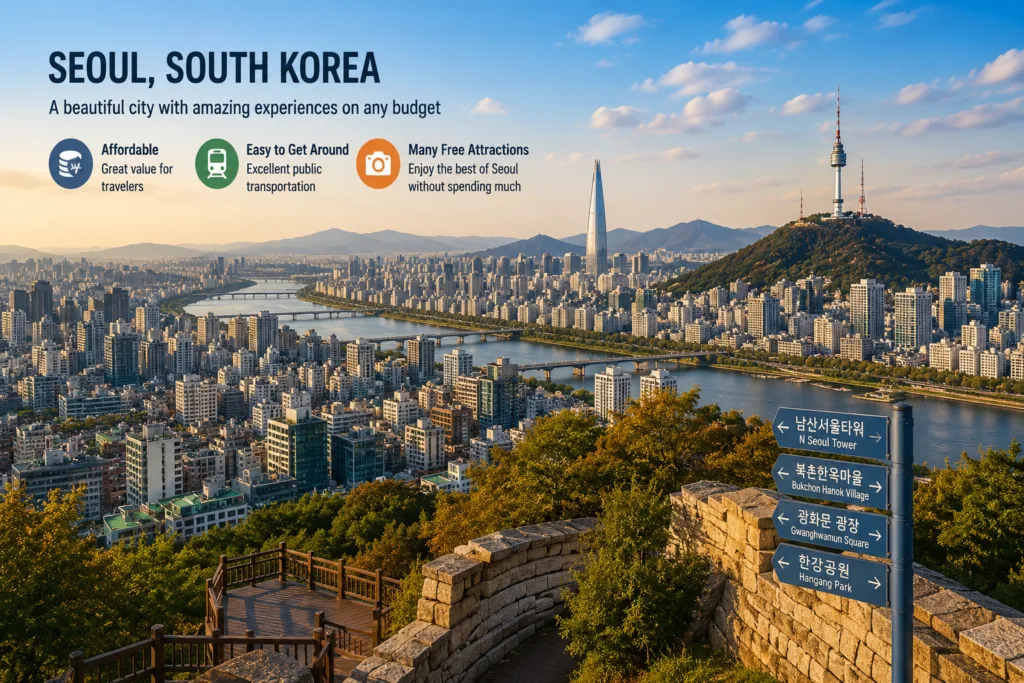
What makes Seoul expensive—or affordable?
Seoul gives travelers more control than many large cities. Public transport is dependable enough that a taxi is rarely essential, palace admission is modest, and neighborhoods such as Seongsu, Ikseon-dong, Euljiro, Mangwon, and the Han River can fill half a day without an entrance fee.
The largest variable is accommodation. Spring blossoms, autumn foliage, holidays, concerts, and Friday or Saturday nights can lift room rates quickly. Food is the second variable: a simple kimbap-and-soup day is inexpensive, while three photogenic cafés and Korean barbecue can quietly double it.
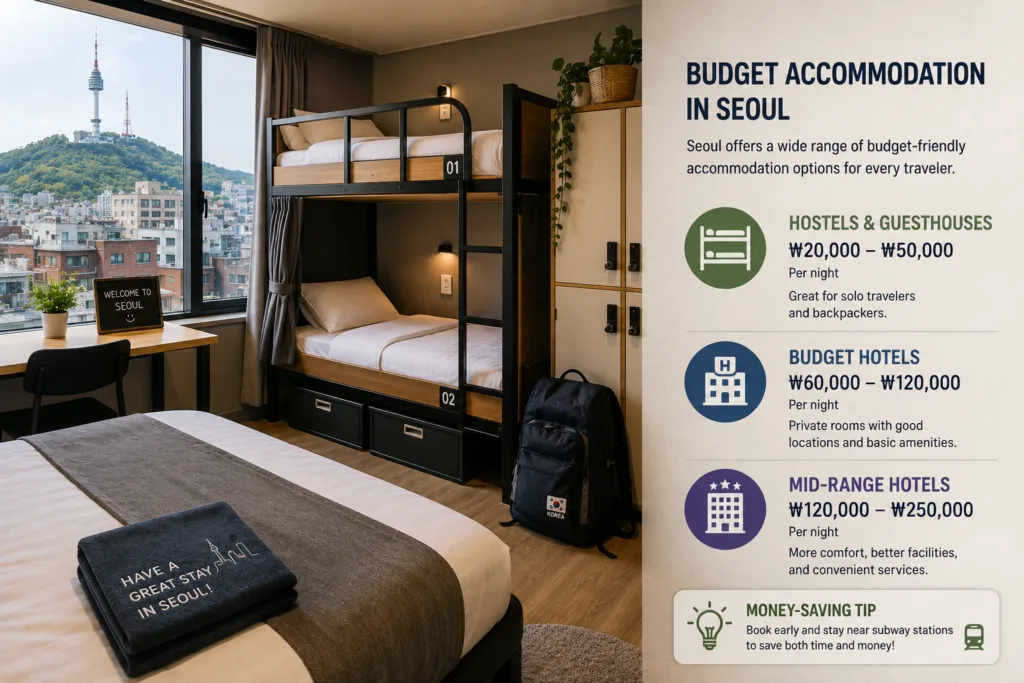
Accommodation costs in Seoul
| Stay type | Useful planning range per night |
|---|---|
| Hostel dorm bed | ₩30,000–₩60,000 |
| Guesthouse or simple private room | ₩60,000–₩110,000 |
| Business or mid-range hotel | ₩100,000–₩200,000 |
| Upscale hotel | ₩250,000 and up |
Treat these as search ranges rather than fixed prices. Always compare the final price after taxes, check whether breakfast is included, and look at the cancellation deadline before celebrating a bargain.
Where budget travelers should stay
- Hongdae: good for hostels, airport access and late-night food. Weekends can be lively in both the charming and sleep-destroying senses.
- Jongno: practical for palaces, markets and central sightseeing, with many simple hotels.
- Dongdaemun: convenient transport and a broad range of reasonably priced rooms.
- Yeongdeungpo or western Seoul: often better value, but check the door-to-door travel time to your planned sights.
Saving ₩20,000 on a room is not a victory if you spend two extra hours changing trains every day. Use our guide to the best areas to stay in Seoul to compare neighborhoods before booking.
How much does food cost in Seoul?
| Food or drink | Common planning range |
|---|---|
| Convenience-store breakfast | ₩4,000–₩8,000 |
| Kimbap, noodles or simple lunch | ₩5,000–₩10,000 |
| Local restaurant meal | ₩10,000–₩18,000 |
| Korean barbecue | ₩20,000–₩40,000+ per person |
| Café drink | ₩4,500–₩8,000 |
| Market snacks | ₩3,000–₩8,000 each |
A realistic food allowance is ₩25,000–₩40,000 per day for a budget traveler and ₩50,000–₩90,000 for someone mixing local meals with cafés, desserts or barbecue.
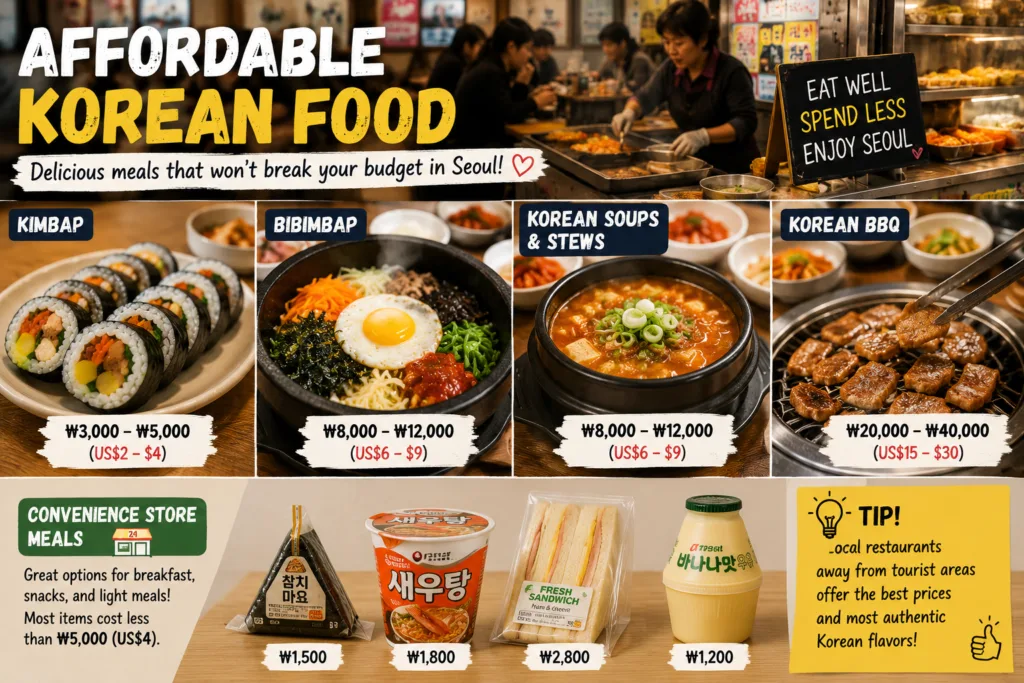
Look for restaurants with a short menu and steady local traffic. Department-store food courts and traditional markets are useful, but famous market stalls are not automatically cheap. Street food is a snack strategy, not always a budget meal strategy; five small treats can cost more than one proper bowl of bibimbap.
Transportation costs
Seoul’s subway adult base fare is ₩1,550 with a transportation card and ₩1,650 for a single-use ticket, according to the Seoul Metropolitan Government’s fare table effective June 28, 2025. Longer trips and some lines cost more. Most visitors can budget ₩6,000–₩10,000 per day for ordinary subway and bus travel.
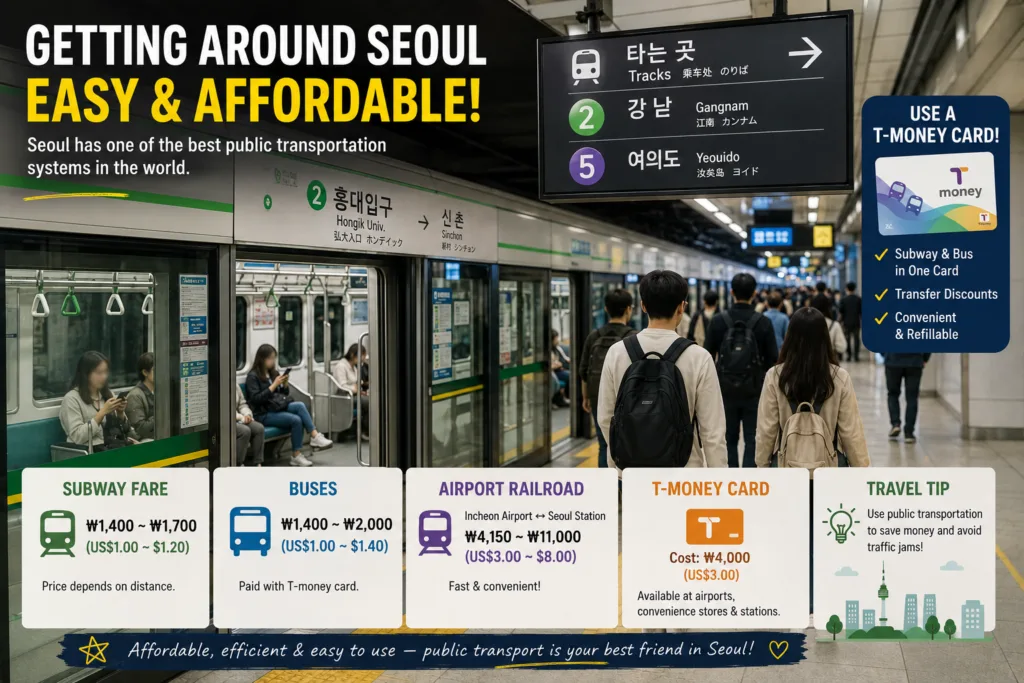
- Use a transportation card and tap when entering and leaving. Transfers only work correctly when the system can see your whole trip.
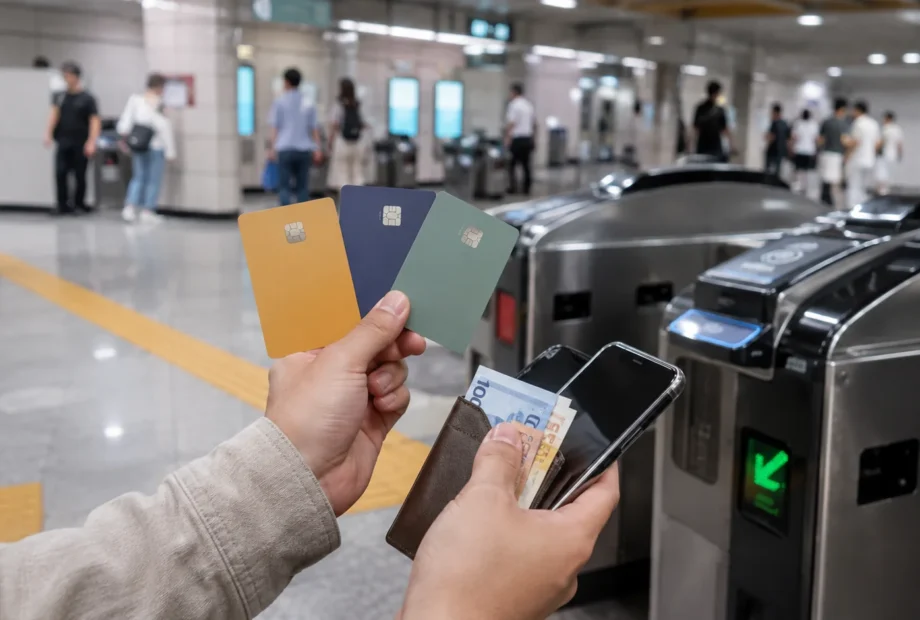
- Keep a little cash for recharging a physical T-money card; not every recharge point accepts an overseas card.
- A taxi can make sense late at night or for a small group with luggage, but it should be a choice rather than the daily default.
- Airport transport is a separate cost. Compare AREX, limousine bus and taxi before arrival instead of deciding while jet-lagged beside the baggage carousel.
For the details, see our T-money card guide, Seoul subway guide, and Incheon Airport to Seoul comparison. The current official subway fare is also listed by the Seoul Metropolitan Government.
Attraction costs: where the budget gets easier
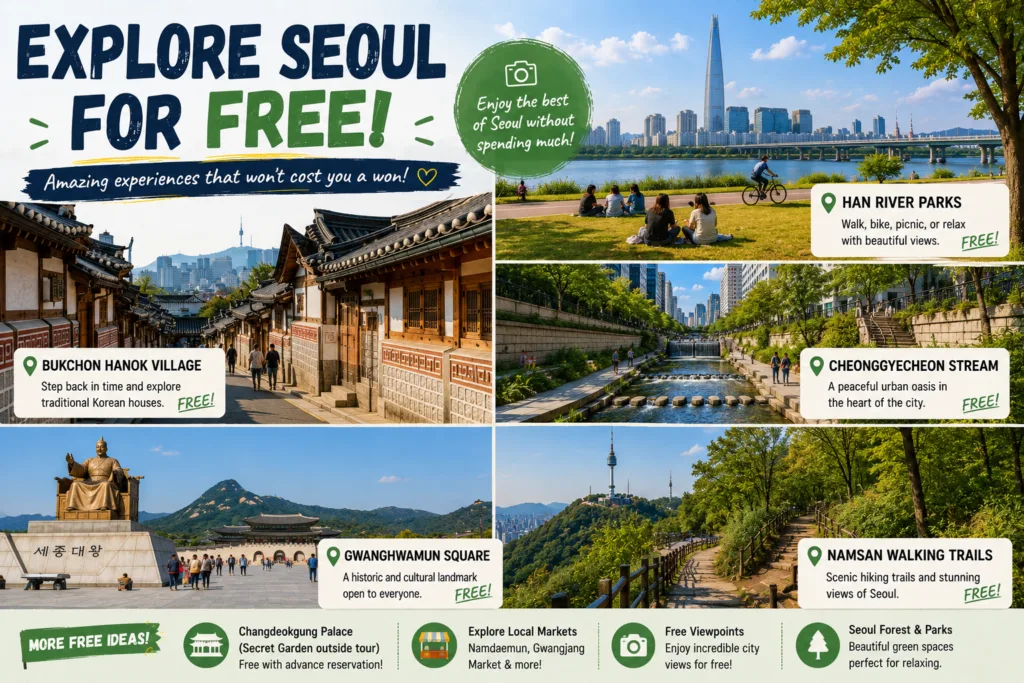
Many classic Seoul experiences are free: walking along the Han River, exploring Cheonggyecheon Stream, browsing traditional markets, hiking sections of the city wall, and wandering through neighborhoods. Bukchon Hanok Village is also free, although it is a residential area with visitor hours and noise rules—not an outdoor theme park.
Paid heritage sites remain affordable. Standard adult admission to Gyeongbokgung is ₩3,000, and the official integrated ticket for the four major palaces and Jongmyo is ₩6,000. Separate special programs, exhibitions and tours cost extra. Confirm opening days before building an itinerary around a locked gate.
Check the official Royal Palaces and Tombs Center fee page for current palace prices, and use our Gyeongbokgung guide for practical visiting details.
A realistic 5-day Seoul budget
Here is a usable example for one solo budget traveler. It excludes international flights, airport transport, shopping and nightlife because those categories have a talent for ignoring spreadsheets.
| Category | Five-day estimate |
|---|---|
| Hostel, 5 nights | ₩225,000 |
| Food and drinks | ₩160,000 |
| Subway and buses | ₩40,000 |
| Attractions | ₩35,000 |
| Laundry, water and small extras | ₩40,000 |
| Total | About ₩500,000 |
A mid-range solo traveler using a central hotel should plan roughly ₩950,000–₩1,500,000 for five days. A couple sharing the same room will usually spend less per person. Add airport transport, shopping, tours and evening drinks separately so they do not disguise themselves as “miscellaneous.”
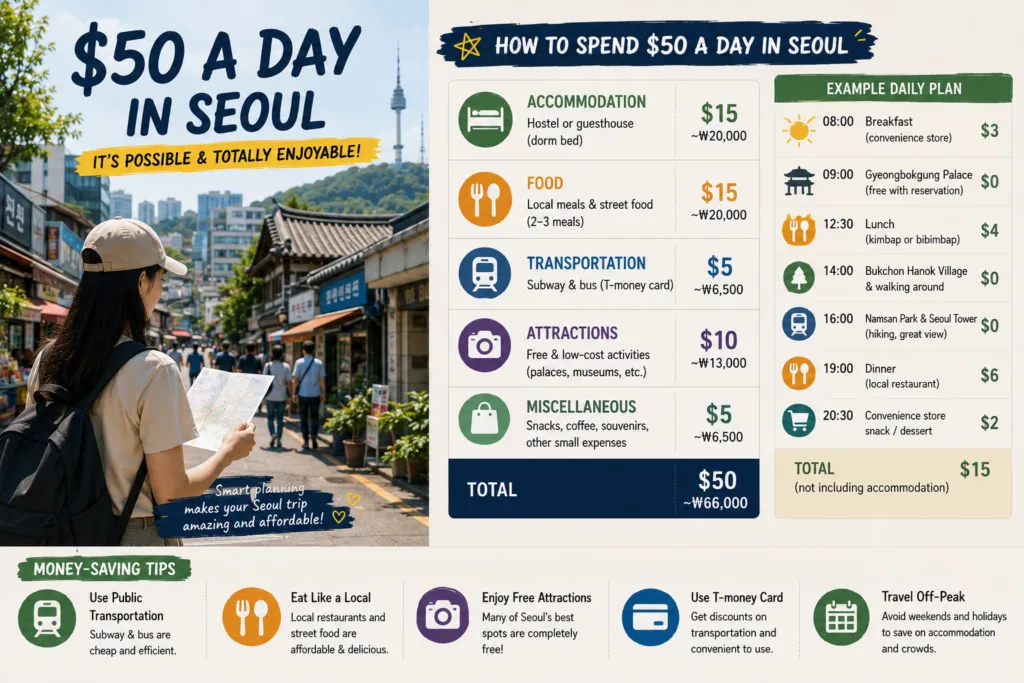
A sensible daily spending plan
- Morning: convenience-store or bakery breakfast, then a palace, museum or neighborhood walk.
- Lunch: choose a proper local meal rather than assembling six snacks that somehow cost more.
- Afternoon: group sights by neighborhood and walk between them when practical.
- Evening: keep room for one planned splurge—barbecue, a performance, rooftop drinks or a café worth the queue.
This works better than trying to make every hour cheap. A budget should protect the experiences you care about, not turn your holiday into an unpaid accounting internship.
Money-saving tips that actually help
- Book accommodation early for spring and autumn. Room prices usually matter more than saving a few thousand won on lunch.
- Compare the final hotel price. Taxes, breakfast and cancellation terms can reverse the apparent winner.
- Group your itinerary by area. Jongno sights belong together; crossing the city repeatedly wastes both time and fares.
- Use local restaurants at lunch. Set meals and noodles often provide better value than grazing through tourist streets.
- Choose one café, not every café. Seoul will provide another beautiful one approximately eleven steps later.
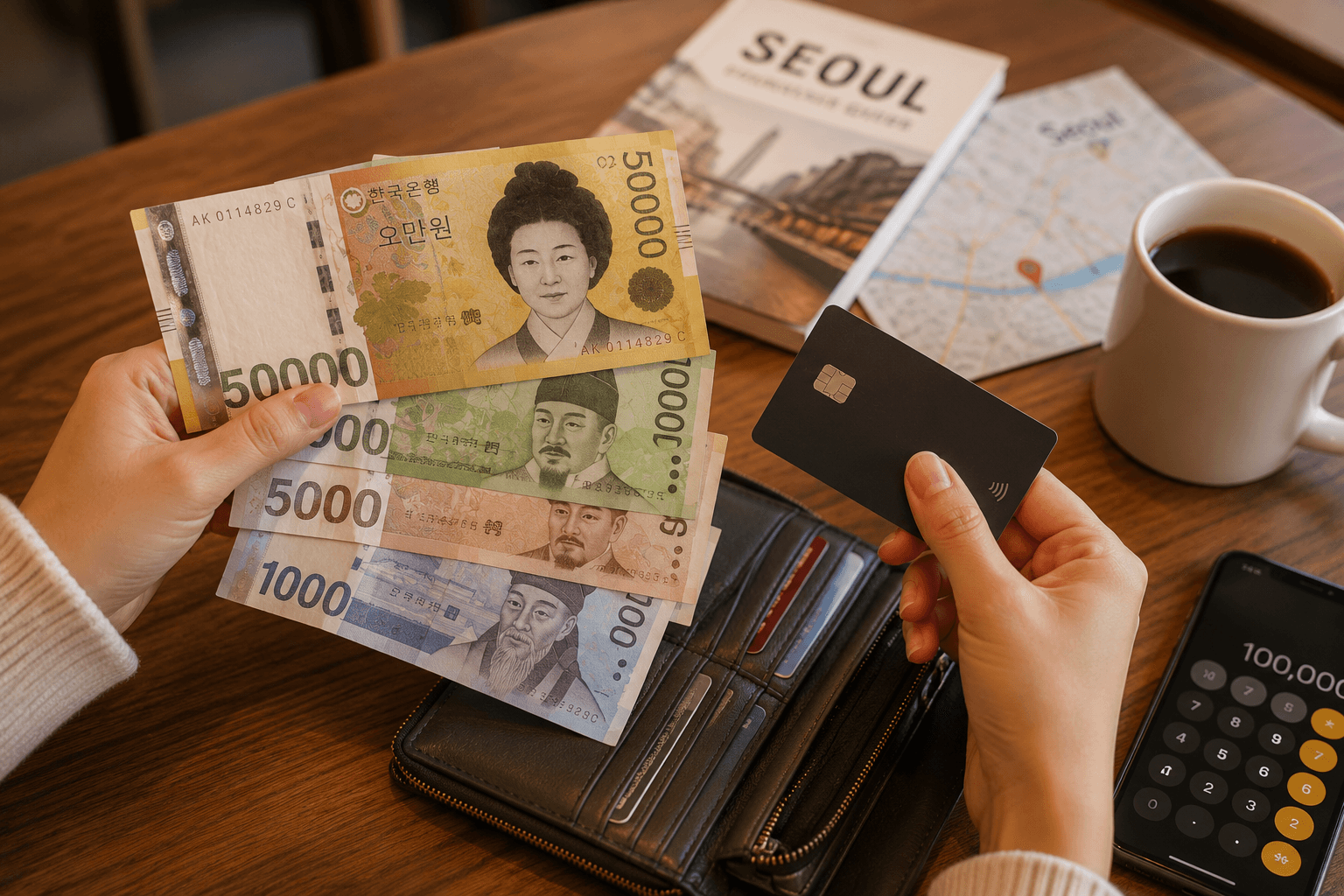
- Carry a payment backup. Cards are widely used, but a little cash is useful for markets and transportation-card recharging. Read our cash-versus-card guide before you arrive.
- Track shopping separately. K-beauty and fashion are optional trip costs, even when the sale sign feels emotionally persuasive.
When Seoul is cheapest
Winter outside the year-end holiday period often brings better accommodation value, although the cold is real. Summer can produce hotel deals during hot and rainy stretches. Spring blossom weeks and pleasant autumn weekends are popular, so flexible dates help.
Weekday stays are often cheaper than Friday and Saturday nights. Before booking, compare a few date combinations instead of assuming the first five-day block is the best one.
Final verdict: is Seoul expensive?
Seoul can be expensive, but it does not have to be. A traveler who books the room carefully, uses public transport and mixes free neighborhoods with a few paid highlights can enjoy the city without feeling deprived.
For the next planning step, pair this budget with our Seoul 5-day itinerary and the broader Korea travel costs guide. Decide your hotel ceiling first, add a daily food allowance, and leave a separate line for the things Seoul will convince you that you suddenly need.