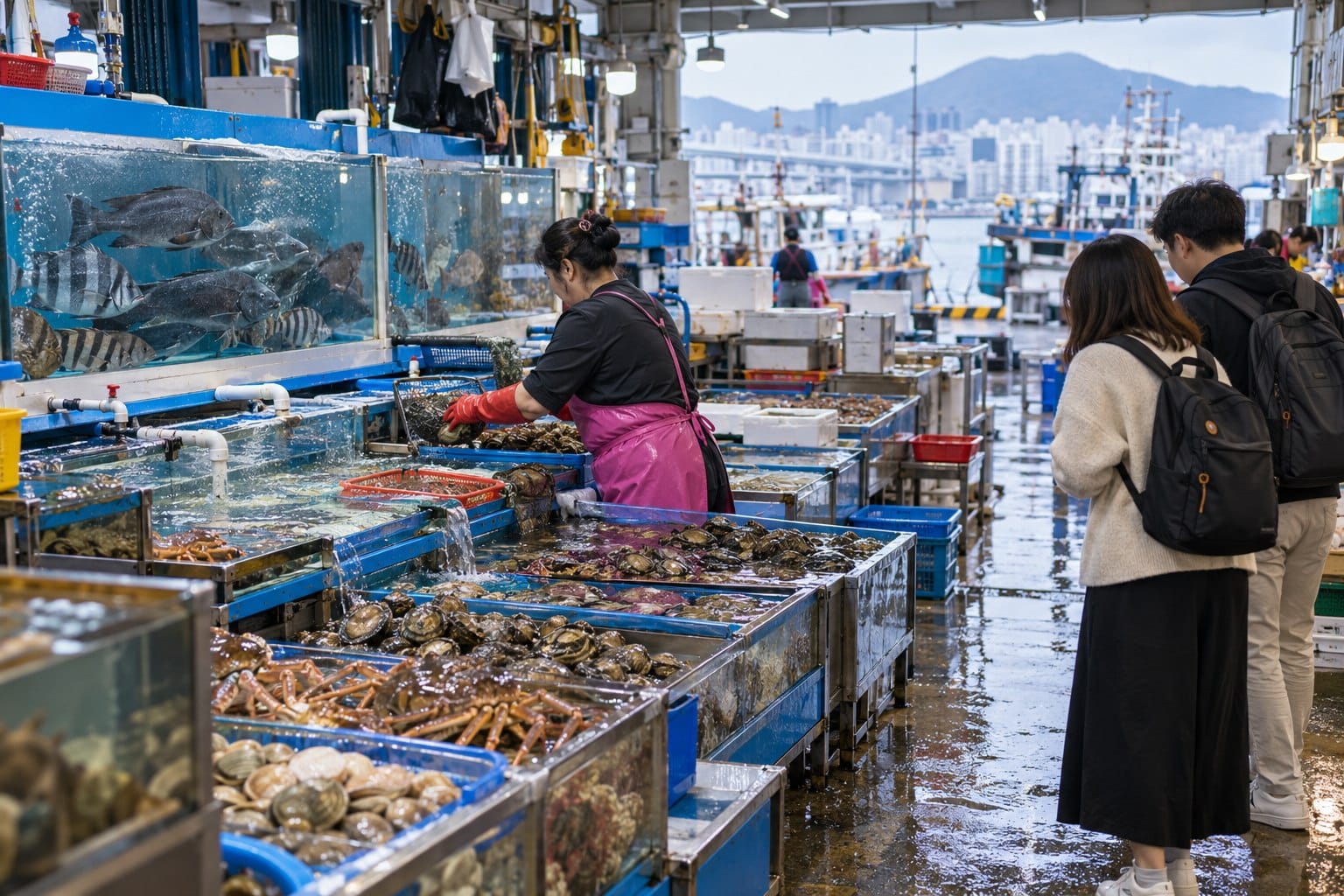
Jagalchi is louder, wetter and far more alive than the tidy phrase “fish market” suggests. Tanks bubble, vendors call across the aisle, water runs under rubber boots, and crabs sit there with the confidence of animals that have not read the menu.
Near Nampo-dong in central Busan, Korea’s largest seafood market brings live fish, shellfish, dried seafood, sashimi restaurants and a working harbor into one compact area. You can come for lunch, but you do not need to order anything to understand why the place matters.
Haeundae shows off Busan’s polished coastline; Jagalchi shows the city doing business with the sea. This guide explains when to go, how the two-part seafood bill works, and how to combine the market with BIFF Square and Nampo without turning lunch into a negotiation exam.
Table of contents
What Is Jagalchi Market?
Jagalchi Market is Korea’s largest seafood market, located along the waterfront in Jung-gu, Busan.
The market is famous for live seafood tanks, fresh fish, Korean sashimi, shellfish, crabs, dried seafood, and restaurants where visitors can eat seafood prepared on-site. It has long been one of Busan’s most important food and trading areas, and today it attracts both local shoppers and travelers.
The main market building is the easiest place for first-time visitors to start. On the lower floors, you can see vendors selling seafood from tanks and displays. In many cases, visitors can choose seafood downstairs and eat it in restaurants upstairs or nearby, depending on the shop system.
Outside and around the main building, the wider Jagalchi area continues into seafood stalls, street food, Nampo-dong, BIFF Square, Gukje Market, and other central Busan attractions.
This is why Jagalchi works well in a Busan itinerary. It is not isolated. You can visit the seafood market, walk to street food areas, explore shopping streets, and continue toward Gamcheon Culture Village or Yongdusan Park.
Jagalchi is not the calmest place in Busan. But calm is not why you came.
Is Jagalchi Market Worth Visiting in 2026?
Yes, Jagalchi Market is still worth visiting in 2026, especially if you want to experience Busan’s seafood culture and local market atmosphere.
It is one of those places that makes Busan feel different from Seoul. The market is tied directly to the sea. You see it in the seafood tanks, smell it in the air, hear it in the vendors’ voices, and notice it in the way people shop and eat.
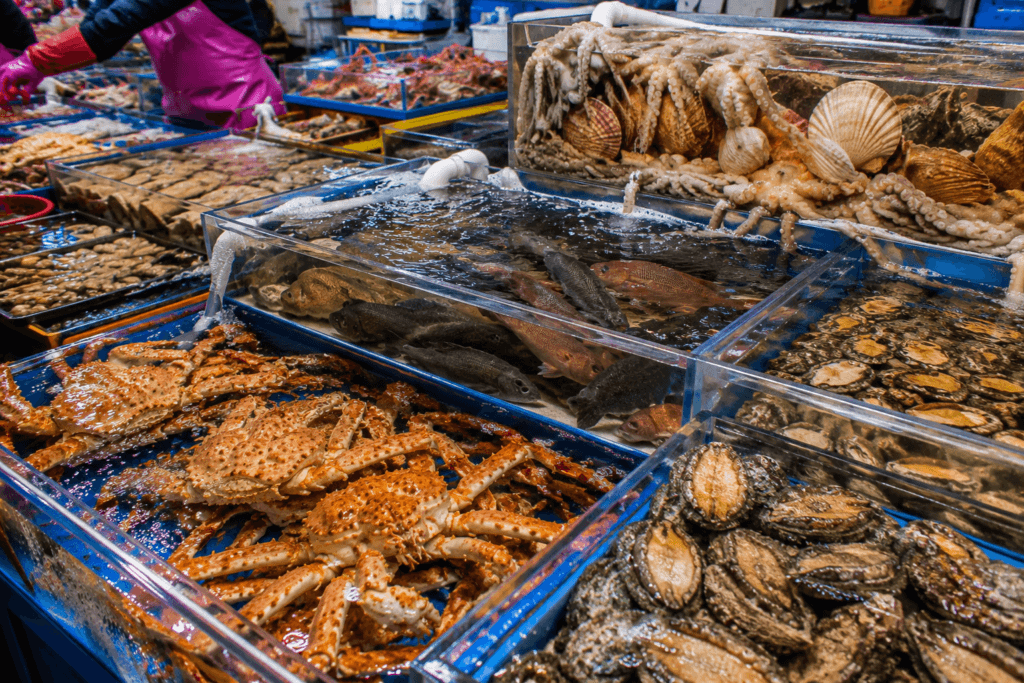
Even if you are not planning to eat raw fish, Jagalchi is worth a walk. The seafood variety alone makes it interesting: fish, crab, abalone, shellfish, sea squirts, octopus, and things that may make you pause and politely ask the ocean for an explanation.
For seafood lovers, the main experience is choosing seafood and eating it fresh. For casual travelers, the market is still useful because it connects easily with Nampo-dong, BIFF Square, Gukje Market, and Busan’s old downtown area.
That said, Jagalchi may not be for everyone. If you are sensitive to seafood smells, wet floors, or busy markets, keep the visit short. If you love polished food halls and quiet dining rooms, Jagalchi may feel intense.
But if you want Busan with the volume turned up and the sea still dripping from the tanks, Jagalchi belongs on your itinerary.
Quick Visitor Information
| Item | Details |
|---|---|
| Name | Jagalchi Market |
| Korean Name | 자갈치시장 |
| Location | Jung-gu, Busan |
| Address | 52 Jagalchihaean-ro, Jung-gu, Busan |
| Nearest Subway | Jagalchi Station, Busan Subway Line 1 |
| Best Exit | Exit 10 |
| Main Market Hours | 05:00–22:00; individual stalls and restaurants vary |
| Live Fish Section | 06:00–22:00 |
| Regular Closures | First and third Tuesdays; check ahead on a fifth Tuesday |
| Best Visit Length | 1.5 to 3 hours |
| Best For | Seafood, Korean sashimi, market atmosphere, harbor views, Nampo-dong route |
| Nearby Areas | BIFF Square, Gukje Market, Nampo-dong, Yongdusan Park, Gamcheon Culture Village |
The official listings agree on the first and third Tuesday closures, while Visit Busan currently also lists fifth Tuesdays. If your date lands on any of those Tuesdays—or you plan to arrive near opening or closing—check the market notice before crossing the city.
How Buying and Eating Seafood Works
- Walk through the live fish section on the first floor and compare a few clearly marked per-kilogram prices.
- Choose the seafood and confirm its weight, seafood price and preparation method before saying yes.
- For dine-in, the vendor will direct you to a second-floor chojangjip, where the seafood is sliced, cooked or steamed.
- Before sitting down, ask what the restaurant charge covers and whether rice, drinks, spicy fish stew or steaming cost extra.
Keep the two bills separate in your head: the seafood itself and the restaurant’s preparation or table charge. A friendly “total price?” before the fish leaves the tank is much easier than doing seafood mathematics after it reaches the table.
Best Things to Do at Jagalchi Market
Explore the Live Seafood Stalls
The live seafood stalls are the heart of Jagalchi Market.
This is where you see tanks packed with fish, crabs, shellfish, abalone, octopus, and other seafood. Vendors move quickly, water splashes, customers point, prices are discussed, and the market feels fully awake.
For many visitors, this is the most memorable part of the experience. It feels different from simply eating seafood at a restaurant because you see the market process before the food reaches the table.
Take your time walking through the aisles. Look at the tanks, watch how locals choose seafood, and notice the different sections. Some vendors are used to tourists, but the atmosphere still feels like a working market rather than a staged attraction.
A small warning: the floor can be wet. Wear shoes with decent grip. Jagalchi is not the place for delicate footwear trying to have a fashion moment.
Try Fresh Korean Sashimi
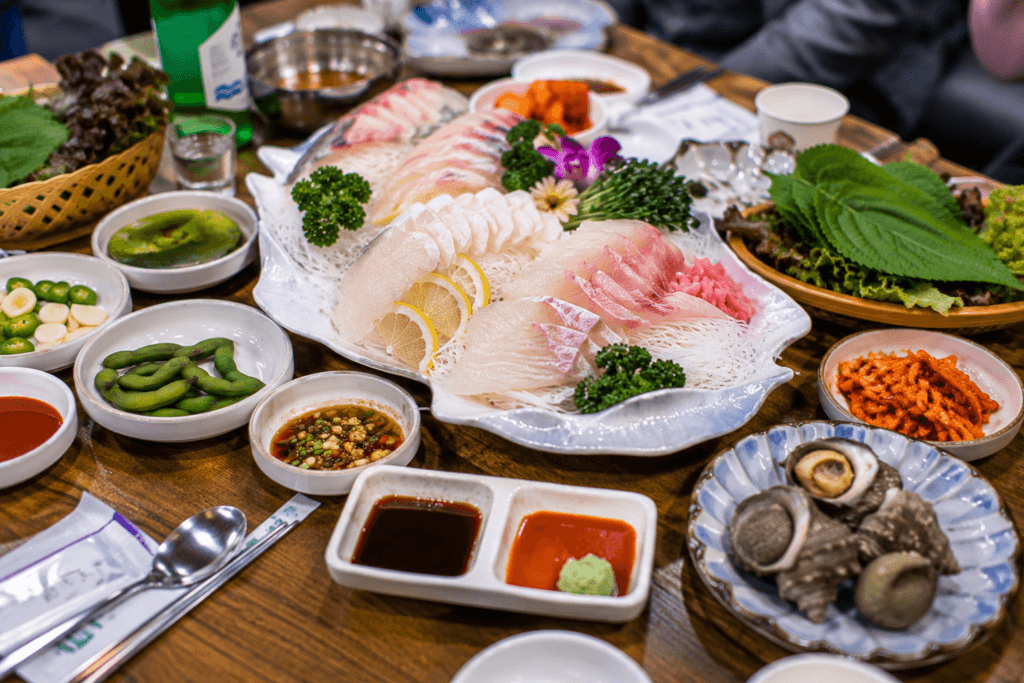
One of the most popular experiences at Jagalchi Market is eating Korean sashimi, known as hoe.
The usual system is simple in theory: choose seafood from a vendor, then have it prepared and served at an associated eating area or restaurant. In practice, the exact process can vary depending on the stall, restaurant, and language situation.
If you are unsure, point to the displayed price and ask the vendor to show the weight and seafood subtotal. Then confirm the separate restaurant charge, what it includes, and whether rice, drinks, stew or steaming will be added. You do not need fluent Korean; you do need one clear total before everyone starts carrying fish upstairs.
Korean sashimi is usually eaten with sauces, garlic, chili, lettuce or perilla leaves, and side dishes. It is different from Japanese sashimi culture, and that difference is part of the fun.
If it is your first time, choose a simple fish option or ask for recommendations. You do not need to prove anything by ordering the strangest creature in the tank. Travel courage is admirable, but so is lunch you actually enjoy.
Eat Crab, Abalone, or Shellfish
Jagalchi is also a good place to try crab, abalone, shellfish, grilled fish, and seafood stews.
King crab and snow crab are popular but can be expensive, so check prices carefully before ordering. Abalone and shellfish can be more manageable options depending on your budget and appetite.
If you are traveling with a group, sharing seafood can make the experience easier and more affordable. Solo travelers may prefer a simpler sashimi plate, grilled fish meal, or nearby street food instead of ordering a large seafood set.
The market has options, but it is better to decide your budget before sitting down. Seafood has a way of becoming ambitious.
Enjoy the Harbor Views
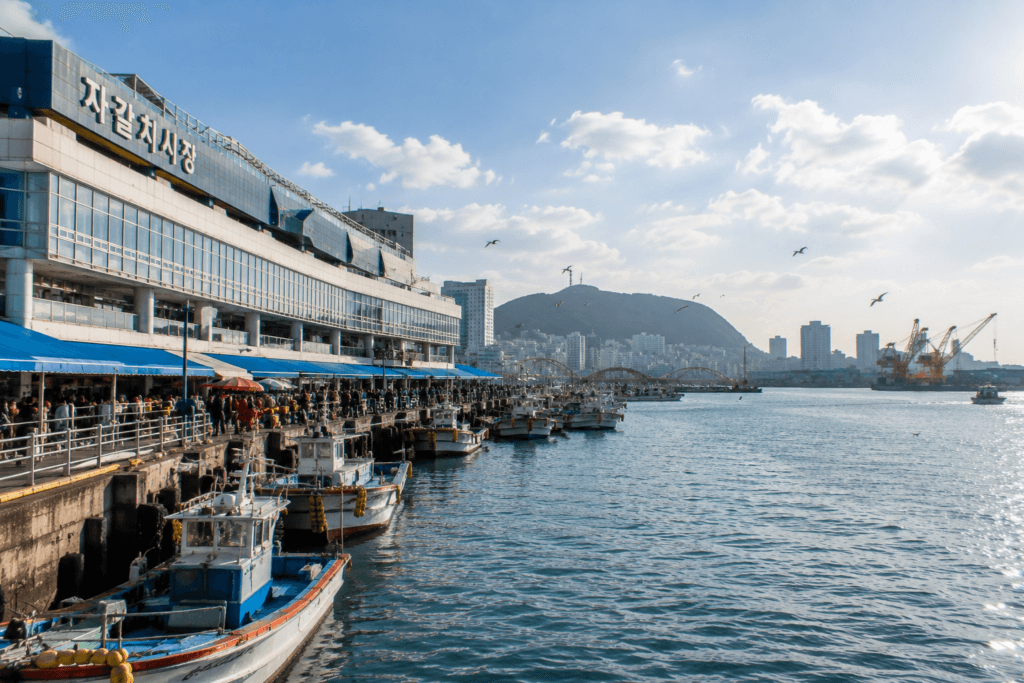
Outside Jagalchi Market, the waterfront gives you a different mood from the busy indoor market.
After walking through the tanks and food stalls, step outside for harbor views, sea air, and a little breathing room. The contrast is nice: inside, everything is movement and negotiation; outside, the water stretches out and Busan feels wider.
Late afternoon is especially pleasant if the weather is clear. The light softens, boats and buildings reflect on the water, and the market feels less overwhelming after you step outside.
This is also a good moment for photos. The market building, harbor, and nearby city scenery help show why Jagalchi is such a Busan landmark.
Walk Around Nampo-dong
Jagalchi Market sits next to one of Busan’s most useful sightseeing areas: Nampo-dong.
After visiting the market, you can easily walk to BIFF Square, Gukje Market, Bupyeong Kkangtong Market, Yongdusan Park, or shopping streets around Nampo. This makes the area perfect for a half-day or full-day route.
Nampo-dong gives you street food, shopping, old downtown energy, and easy access to some of Busan’s classic attractions. Jagalchi is the seafood anchor of the area, but the surrounding streets complete the experience.
A good plan is to visit Jagalchi first, then continue into Nampo-dong for snacks and shopping. If you do it the other way around, you may arrive at Jagalchi already full, which is risky because the market will still try to feed you.
What to Eat at Jagalchi Market
Korean Sashimi
Korean sashimi, or hoe, is the signature food experience at Jagalchi.
It is usually served with dipping sauces, garlic, chili, leafy wraps, and side dishes. Many visitors enjoy it because it feels fresh, local, and specific to Busan’s seafood culture.
If you are unsure what to order, ask for a basic white fish option or a mixed sashimi plate. Keep the order simple on your first visit.
King Crab and Snow Crab
Crab is popular at Jagalchi, especially for groups.
It can be delicious, but prices vary depending on size, season, and market conditions. Always ask clearly before ordering. If the price feels unclear, pause. The crab will not be offended.
Abalone
Abalone is another popular seafood option in Busan.
It can be served raw, grilled, steamed, or in porridge depending on the restaurant. It is a good choice if you want something special but not as large as a crab feast.
Grilled Fish
If raw seafood is not your thing, grilled fish can be a safer and more familiar option.
It is flavorful, filling, and usually easier for travelers who want seafood without dealing with live tank decisions.
Seafood Stews
Seafood stews are a good choice in colder weather or if you prefer something hot and comforting.
After walking around the market, a bubbling seafood soup can feel like Busan giving you a warm handshake.
Street Food Near Jagalchi Market
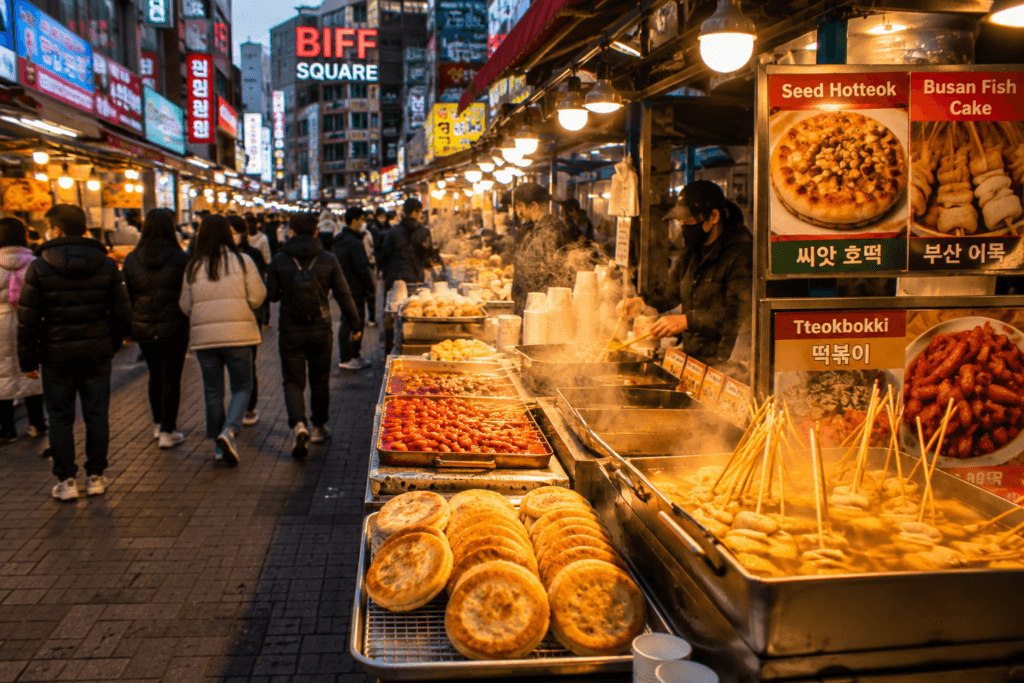
One of the best things about visiting Jagalchi is that you are close to some of Busan’s best street food areas.
A short walk brings you to BIFF Square and nearby Nampo-dong streets, where you can find snacks and casual food. This is especially useful if you are traveling with someone who does not want a full seafood meal.
Seed Hotteok
Seed hotteok is one of Busan’s most famous snacks.
Unlike regular sweet hotteok, Busan-style seed hotteok is filled with seeds and nuts, giving it a crunchy texture with warm syrup inside. It is sweet, hot, messy, and extremely convincing.
Eat carefully. The syrup inside can be hotter than your travel budget after booking hotels.
Busan Fish Cake
Busan is famous for fish cake, known as eomuk.
You can find it at street stalls and shops around Nampo-dong. It is often served with warm broth, making it especially good on cooler days.
Fish cake is one of the easiest local snacks to try because it is simple, affordable, and very Busan.
Tteokbokki
Tteokbokki, spicy rice cakes in a sweet and spicy sauce, is another classic street food option.
Around BIFF Square and Nampo-dong, it pairs well with fish cake, fried snacks, and hotteok. This is a good backup plan if the seafood market feels too intense.
Best Time to Visit Jagalchi Market
The best time to visit Jagalchi Market depends on what you want to experience.
Morning is good if you want to see the market at its freshest and most active. The seafood atmosphere feels more local, and the tanks are full of movement.
Late morning to early afternoon is best for most first-time visitors. The market is active, restaurants are open, and it is a practical time for lunch.
Late afternoon can also be nice if you want to combine the market with harbor views and a walk through Nampo-dong.
The first and third Tuesdays are regular closing days. Visit Busan also currently lists fifth Tuesdays, so check the official notice if your calendar produces that occasional bonus Tuesday. Individual stalls and restaurants may keep shorter hours than the building.
If you dislike crowds, avoid peak lunch hours and weekends. Jagalchi is already energetic enough without adding a full crowd layer.
How to Get to Jagalchi Market
The easiest way to reach Jagalchi Market is by subway.
Take Busan Subway Line 1 to Jagalchi Station and use Exit 10. From there, the main market area is about a five-minute walk.
The route is simple, and the market is easy to locate once you are above ground. Follow signs toward the waterfront and Jagalchi Market.
If you are using public transportation in Korea, read T-money Card Guide before your trip. The same card can be useful for subway and bus rides in Busan.
If you are planning your first Busan trip, Busan Travel Guide and Busan 3-Day Itinerary can help you place Jagalchi into a realistic route.
Suggested Half-Day Itinerary
A simple half-day route starts at Jagalchi Station.
Begin at Jagalchi Market and walk through the live seafood stalls. If you want to eat seafood, have lunch at the market or in one of the nearby restaurants.
After that, step outside for harbor views, then walk toward BIFF Square for seed hotteok, fish cake, or tteokbokki. Continue to Gukje Market or Bupyeong Kkangtong Market if you want more shopping and street food.
This route is easy, compact, and full of Busan flavor. It also works well if you only have one afternoon in central Busan.
Suggested Full-Day Nampo Route
For a fuller day, start with Gamcheon Culture Village in the morning.
After exploring the colorful hillside neighborhood, head down toward Nampo-dong and Jagalchi Market for lunch. Spend time walking through the seafood market, then continue to BIFF Square, Gukje Market, and Yongdusan Park.
In the evening, you can stay around Nampo for food or move toward Gwangalli or Haeundae depending on your hotel location.
This route gives you one of Busan’s classic contrasts: colorful village streets, seafood market energy, old downtown shopping, and evening city lights.
Your step count may become dramatic, but the route makes sense.
Nearby Attractions
BIFF Square
BIFF Square is a short walk from Jagalchi Market and is famous for street food, movie history, and a lively pedestrian atmosphere.
It is a great place to try seed hotteok, fish cake, tteokbokki, and other snacks after visiting the market.
Gukje Market
Gukje Market is one of Busan’s most famous traditional markets.
It offers shopping, household goods, clothing, souvenirs, street food, and old-market energy. It pairs naturally with Jagalchi because the two areas are close and easy to walk between.
Bupyeong Kkangtong Market
Bupyeong Kkangtong Market is another nearby food and market area.
It is especially known for evening food stalls and a livelier night market atmosphere. If Jagalchi is seafood-focused, Bupyeong gives you more general street food variety.
Gamcheon Culture Village
Gamcheon Culture Village is one of Busan’s most colorful attractions and can be combined with Jagalchi Market on the same day.
Visit Gamcheon earlier in the day, then come down to Jagalchi and Nampo-dong for lunch, snacks, and market exploring.
Haeundae Beach
Haeundae Beach is not next to Jagalchi, but it is one of Busan’s most famous coastal areas.
Haeundae feels modern and polished, while Jagalchi feels older, more local, and seafood-heavy. Visiting both gives you a stronger sense of Busan’s different personalities.
Common Mistakes to Avoid
The first mistake is treating every Tuesday alike. The first and third Tuesdays are regular closures, and Visit Busan currently also lists fifth Tuesdays. Check the date and the official notice before making a special trip.
The second mistake is asking only for the seafood price. Confirm the weight and seafood subtotal first, then the preparation or table charge and any extras. Crab steaming, rice, drinks and spicy fish stew may not be part of the first number you hear.
The third mistake is wearing slippery shoes. The floors can be wet, especially around the seafood tanks.
The fourth mistake is expecting a clean, quiet food hall. Jagalchi is a working seafood market. It smells like the sea, sounds busy, and moves quickly.
The fifth mistake is skipping the surrounding area. BIFF Square, Gukje Market, Bupyeong Kkangtong Market, and Nampo-dong are close enough to explore together.
The sixth mistake is forcing a seafood meal if you do not actually like seafood. You can still enjoy the market as a cultural stop, then eat street food nearby. Travel is not a courtroom. You do not need to prove your loyalty to octopus.
Official Sources and Last Check
- Visit Busan: Jagalchi Market — address, access, operating hours and closure listing
- VISITKOREA: Jagalchi Market — market overview, hours and regular holidays
- Busan Metropolitan City: How to Eat at Jagalchi — first-floor buying and second-floor dining process
Last checked: September 13, 2026. Seafood prices, stall hours and restaurant charges change, so confirm the displayed price and full dine-in cost before ordering.
Optional Tours
This article may contain affiliate links, which means we may earn a small commission if you book through them, at no extra cost to you.
If you want help navigating the seafood system, consider a Busan seafood market food tour that includes Jagalchi Market and nearby Nampo food streets.
For a wider route, a Busan day tour including Gamcheon and Jagalchi Market can be convenient if you want to reduce transit planning.
FAQ
Is Jagalchi Market worth visiting?
Yes. Jagalchi Market is worth visiting if you want to experience Busan’s seafood culture, live fish tanks, local market energy, Korean sashimi, and nearby Nampo-dong street food.
What is Jagalchi Market famous for?
Jagalchi Market is famous for being Korea’s largest seafood market, with live seafood tanks, fresh fish, Korean sashimi, crab, shellfish, dried seafood, and seafood restaurants.
What are Jagalchi Market opening hours?
The main market is officially listed as 05:00–22:00, and the live fish section as 06:00–22:00. Individual stalls and restaurants may open later or close earlier.
Is Jagalchi Market closed on Tuesdays?
The first and third Tuesdays are regular closures. Visit Busan currently also lists fifth Tuesdays, so check the official notice before a fifth-Tuesday visit.
What subway station is closest to Jagalchi Market?
Jagalchi Station on Busan Subway Line 1 is the closest station. Exit 10 is the most convenient exit for most visitors.
How long should I spend at Jagalchi Market?
Most visitors should allow 1.5 to 3 hours. If you plan to eat seafood and explore nearby BIFF Square or Gukje Market, allow half a day.
Can I eat seafood at Jagalchi Market?
Yes. Choose seafood on the first floor, then follow the vendor to an associated second-floor restaurant for preparation. Confirm the seafood subtotal and the restaurant charge separately before ordering.
What should I eat near Jagalchi Market?
Try Korean sashimi, crab, grilled fish, seafood stew, seed hotteok, Busan fish cake, tteokbokki, and other street foods around BIFF Square and Nampo-dong.
Can I visit Jagalchi Market and Gamcheon Culture Village on the same day?
Yes. Many travelers visit Gamcheon Culture Village and Jagalchi Market on the same day because both are in western/central Busan and connect well with Nampo-dong.
Related Guides
If you are planning a Busan itinerary, these guides can help:
Busan Travel Guide gives you the full overview of Busan’s major neighborhoods and attractions.
Busan 3-Day Itinerary helps you organize Jagalchi, Gamcheon, Haeundae, Gwangalli, and Haedong Yonggungsa without wasting time.
Gamcheon Culture Village Guide is useful if you want to combine colorful hillside streets with Jagalchi and Nampo-dong.
Haeundae Beach Guide helps you compare Busan’s polished beach side with Jagalchi’s old-market energy.
Korean Food Guide is helpful if you want to understand common Korean dishes before visiting markets and seafood restaurants.
T-money Card Guide can make subway and bus travel around Busan easier.
Gwangalli Beach Guide is a good evening option if you want bridge views after a market day.
Final Thoughts
Jagalchi Market is not a gentle introduction to Busan.
It is loud, wet, salty, crowded, and full of things moving in tanks. That is exactly why it stays with you.
This is one of the best places to feel Busan’s connection to the sea. Not the postcard version of the sea, but the working version: fish delivered, seafood chosen, meals prepared, vendors calling, water splashing, and people eating what the ocean brought in.
Come with curiosity. Wear practical shoes. Ask prices clearly. Eat seafood if you want to, or simply walk through and continue to BIFF Square for snacks.
Either way, Jagalchi Market gives you a version of Busan that feels real, direct, and hard to forget.
The market does not whisper “welcome to Busan.”
It splashes a little water near your shoes and lets the seafood tanks do the talking.