
The Korail Pass is worth comparing for a rail-heavy Korea trip. It is not an automatic money-saver just because your itinerary includes the KTX.
For a straightforward Seoul–Busan return, start with individual tickets. For several substantial journeys, calculate the fares and the number of separate travel days before choosing a pass. Those are two different numbers, and confusing them is where a convincing-looking saving can disappear.
This guide focuses on that purchase decision. For station navigation and the wider booking process, use our Korea KTX guide.
Last checked November 1, 2026. Prices are in Korean won. Reconfirm your specific trains, availability and seller conditions before paying.
Affiliate disclosure: Some links below are affiliate links. Korea Travel Lab may earn a commission at no additional cost to you. We recommend comparing individual tickets even when a pass could generate a commission.
Table of contents
Count travel days before you count savings
Write your itinerary on a calendar, with each intercity train underneath its date. Then mark the dates containing rail travel. A trip lasting a week does not necessarily need a week of rail coverage; several nights in the same city may involve no intercity journey at all.
The official Korail Pass guide lists 2, 3, 4 or 5 selected travel days within a ten-day window from the starting date. It is for foreign visitors, not Korean nationals; adult pricing begins at 13, and child pricing covers ages 6–12.
| Select pass | Adult | Child |
|---|---|---|
| 2 days | ₩131,000 | ₩66,000 |
| 3 days | ₩186,000 | ₩93,000 |
| 4 days | ₩234,000 | ₩117,000 |
| 5 days | ₩275,000 | ₩138,000 |
These are official published prices, not a reseller checkout quote. Compare the exact product offered rather than relying on an older article's consecutive-day or group-price table.
For example, Seoul to Busan on day 2 and Busan to Seoul on day 6 means two rail-travel dates. Add a separate rail excursion on day 4 and you now have three. The extra excursion may require a different pass even if the overall holiday has not become any longer.
Build the itinerary first. Buying rail coverage and then hunting for places to use it is a surprisingly efficient way to spend a holiday moving your luggage.
Seoul–Busan return: the simple comparison
KORAIL's official high-speed integration announcement set out a Seoul–Busan fare reduction from ₩59,800 to ₩54,400, with integrated operation beginning September 1, 2026. Use the fare displayed for your actual service at booking; routing, class and available offers can affect the comparison.
Using that published fare as a benchmark, the calculation is straightforward:
| Option | Calculation | Total |
|---|---|---|
| Two individual journeys | ₩54,400 × 2 | ₩108,800 |
| Adult 2-day pass | Published pass price | ₩131,000 |
| Extra cost of the pass | ₩131,000 − ₩108,800 | ₩22,200 more |
That is arithmetic based on the announced fare, not a live seat quote. Nevertheless, it explains why “we are taking the KTX twice” is not enough reason to buy a pass.
You can compare Seoul–Busan individual train tickets on Trip.com. Select your dates, inspect the specific train and compare the final total with KORAIL directly. This link is for standalone tickets, not seat reservations against an existing pass.
Do the outbound and return searches separately if necessary. A cheaper outward departure does not mean the return will have the same price or availability. Keep the comparison in one currency so exchange-rate display differences do not masquerade as savings.
The extra-day trap
Suppose your return journey occupies two different dates. Adding another eligible journey on one of those dates may change the value of the same pass. Adding it on a third date changes the product you need to compare.
Using the benchmark above, a three-day pass costs ₩77,200 more than the original return-ticket total—not merely ₩22,200 more. A small extra excursion therefore does not automatically rescue the pass calculation.
The practical test is: Does the added journey fit the coverage I already need, or does it push me into a more expensive pass? Ask that before treating another train ride as free.
Three cities can still be better on individual tickets
“Seoul, Gyeongju and Busan” sounds like a natural rail-pass itinerary. It is a good route to consider, but the list of cities does not settle the ticket decision.
Our seven-day Korea itinerary helps you decide how those stops fit together. Once you have a route, price the journeys between them and count the actual rail dates. Include the return to Seoul only if it is part of your trip; an open-jaw holiday ending in Busan has different costs.
Here are hypothetical fare totals, not current quotes for any named route:
| Your quoted eligible fares across three travel dates | Adult 3-day pass | Result before other costs |
|---|---|---|
| ₩150,000 total | ₩186,000 | Individual tickets cost ₩36,000 less |
| ₩190,000 total | ₩186,000 | Pass saves only ₩4,000 |
| ₩230,000 total | ₩186,000 | Pass saves ₩44,000 |
A narrow saving deserves more scrutiny than a large one. If the rail itinerary is awkward, a small discount is not a persuasive reason to keep it. Conversely, substantial savings on journeys you already want are a sensible reason to investigate further.
Compare like with like: similar departure times, the same class and the tickets you could realistically buy. Comparing a discounted pass with the most expensive possible individual tickets makes an attractive chart, but not necessarily a useful decision.
Where a pass becomes more interesting
A pass deserves attention when your existing plan contains enough eligible, substantial rail travel to clear the price comfortably. Think in terms of a journey pattern rather than a required number of cities.
A traveler returning to the same base after longer excursions may have a different fare total from someone progressing steadily through several cities. A traveler staying three nights in each place may have fewer rail dates than someone changing hotels every morning.
Before adding another destination, count the time around the train itself: hotel checkout, getting to the station, finding storage, reaching the attraction and returning for the next departure. Fast trains cannot make those steps vanish.
If you want to test an extra stop, remove it again after calculating the saving. Would you still miss the experience? If the honest answer is no, its ticket price is probably not a meaningful saving. A pass should support a trip you want, not commission a new one on your behalf.
A pass purchase and a seat reservation are separate jobs
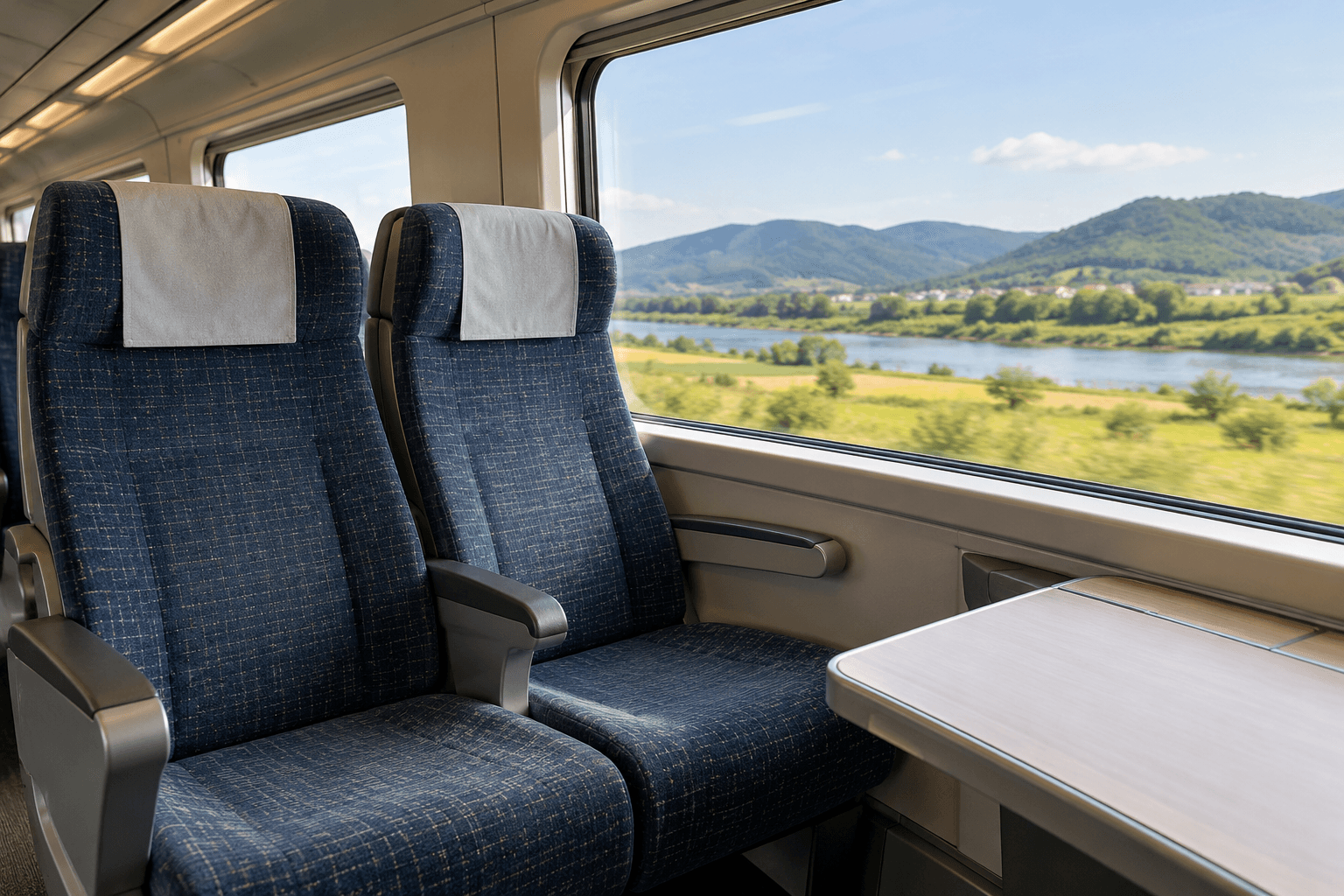
Comfort matters more than collecting departures. AI-generated rail-planning illustration, not an exact KTX carriage or confirmation of onboard amenities.
Register travel dates, then use MY TICKET → SEAT RESERVATION. KORAIL currently allows two months' advance booking and two seat reservations per person daily. Carry your valid pass, passport and reserved-seat ticket; ticket screenshots are invalid.
The distinction matters before you pay. A product promising broad rail access is not a promise that every preferred departure has a seat. Inspect the trains your itinerary depends on and leave a workable alternative if the first choice is unavailable.
KORAIL's guide permits standing travel with a valid pass and passport when seats are sold out. We would still confirm arrangements with staff and not build a long journey around standing if a seat is important to your group. Standing beside a suitcase is transport, but it is not everyone's preferred holiday activity.
For couples or families, check the whole party's arrangements, not just one person's success screen. Separate confirmations can leave people with different departures, and “we both booked the afternoon train” is not a precise enough description.
When changing plans, inspect the existing reservation before making another. The guide says to cancel the original before departure when changing the time of the same journey. Keep the final train number, departure station, date and seat assignment together so an obsolete confirmation does not send you to the wrong platform.
What not to put into the savings total
KORAIL excludes metropolitan rail and temporary tourist trains. An operator name alone does not establish coverage; check unusual services before buying around them.
For first class, budget 50% of the route's first-class seat price as the pass-holder charge—not a free upgrade.
Use a separate payment plan for local transport. Our T-money, WOWPASS and NAMANE comparison explains the different roles of those cards. An intercity rail decision should not be mistaken for an all-in-one urban travel purchase.
For Busan sightseeing, there is another product with a confusingly similar role in travel planning: the Visit Busan Pass. Evaluate that as an attraction purchase, separately from the intercity train calculation. Two products containing the word “pass” are not automatically substitutes—or automatically a good bundle.
And keep station transfers honest. A fare saving can shrink if a particular departure requires an inconvenient cross-city trip or expensive last-minute taxi. Compare the journey from your actual hotel, not from an imaginary location directly above the platform.
Choose the seller after choosing the product
Once the numbers favor a pass, compare Korail Pass options on Klook with the official offer. Check the selected travel-day count, traveler category, start date, final currency and cancellation conditions. The linked listing offers multiple pass lengths, not a single product that fits every itinerary.
Klook's current listing says each passport holder can hold a maximum of one pass and warns buyers to cancel or let other pass bookings expire before making a new one. Check an uncertain order's status rather than buying a second pass as a troubleshooting technique. A second successful payment is rarely the solution you were hoping for.
Before submitting, compare each traveler's details with the passport. Read the confirmation process carefully and establish which number is the pass number used for rail reservations. A reseller order reference and the railway credential may serve different purposes.
KORAIL's own guide limits pass refunds to before the starting date. For an agency purchase, also read that seller's applicable conditions and contact route. Do not infer that a rule about an unused individual train ticket automatically applies to the entire pass.
If the payment screen fails, check your order history and card notification before retrying. If details do not match or retrieval fails, contact the issuing seller with the booking reference. Avoid posting passport or pass numbers in public comment sections while asking for help.
Keep the overnight plan independent of the rail bargain
Saving on trains can be undone by poorly placed accommodation or unnecessary hotel changes. Decide where you want to spend the evening, then evaluate how the next departure fits.
For a Busan stay, our best areas to stay in Busan guide helps you choose between a convenient transport base and the neighborhood you actually want to explore. Being close to a long-distance station is useful on travel days; it is not the only definition of a good hotel location.
After choosing an area, compare Busan hotels on Agoda. This is a citywide search, not a shortlist beside Busan Station. Use the map and compare the full room total, cancellation terms and the time needed to reach your departure station.
Do not book a very early return simply because it fits a tidy rail plan if it removes the evening you wanted in Busan. Sometimes the better value is another relaxed breakfast, with a slightly different train afterward.
The five-minute decision before checkout
Put your actual journey quotes in one list and mark their dates. Compare that total against the appropriate pass and any extras you would need. Then check whether the important departures work and whether everyone in the party can follow the same plan.
Choose individual tickets when they are cheaper or when a small theoretical saving comes with inconvenient compromises. Choose the pass when eligible journeys you already want fit its structure and produce a worthwhile advantage.
Finally, remove any train you added solely to improve the spreadsheet. If the purchase stops making sense without it, keep the simpler trip and buy the tickets you need. Korea is a place to visit, not a rail pass to finish.