Korean Folk Village is worth a day outside Seoul if you want traditional houses, live performances and time to explore between them. It is a less convincing choice if you only want a quick hanok photograph before lunch back in the city.
The planning mistake is arriving whenever transport happens to deliver you, then discovering that the performance you wanted has just finished. Choose a show first. Build the journey and walking route around it.
For a first visit, we would allow four to six hours inside, plus the journey each way. That is our planning allowance, not an official minimum. October and early November offer seasonal reasons to stay longer, but the evening schedule needs its own transport plan.
Last checked: October 25, 2026. Prices are in Korean won. Operating calendars, performances and ticket conditions can change.
Affiliate disclosure: Some booking links are affiliate links. Korea Travel Lab may earn a commission at no additional cost to you. Official tickets and public transport may suit your trip better; compare before booking.
Table of contents
First, make sure this is the village you mean
Korean Folk Village, 한국민속촌, is in Yongin, south of Seoul. The address is 90 Minsokchon-ro, Giheung-gu, Yongin-si, Gyeonggi-do. Save the Korean name in your map app rather than searching for a generic “folk village.”
This is a traditional cultural attraction with restored Joseon-era houses, demonstrations, performances and an amusement area—not an ordinary residential neighborhood. The Korea Tourism Organization's introduction explains that cultural focus.
It is not Bukchon in central Seoul, and it is not Andong's Hahoe Folk Village. If you want the latter, use our separate Hahoe Folk Village day-trip guide. A ticket for Yongin will not become an Andong ticket through sheer optimism.
Choose Yongin for a day organized around culture and performances. Choose a central Seoul hanok walk when you have only a spare hour or two. If you are still comparing destinations, our best day trips from Seoul helps you judge the opportunity cost before committing a full day.
The ticket comparison starts below the headline adult price
The official admission page displayed these rates on October 25:
| Ticket | Adult | Child |
|---|---|---|
| Weekday all-day | ₩37,000 | ₩30,000 |
| Weekend all-day | ₩39,000 | ₩32,000 |
| Weekend entry from 14:00, April–May and September–November | ₩35,000 | ₩28,000 |
| Weekend entry from 16:00, same months | ₩31,000 | ₩25,000 |
Crucially, the same page lists a ₩22,000 foreign-visitor preferential rate through 2026, with a passport or alien registration card as proof. Confirm its application for your visit before paying. Children are defined as 36 months through elementary school; younger children enter free with supporting documentation.
The rules also say no re-entry after leaving. Do not plan to exit for lunch and stroll back inside on the same admission.
The park's October online-ticket page separately listed weekday all-day tickets at ₩22,000, weekend/public-holiday all-day tickets at ₩24,000, and timed-entry products from ₩17,000–₩20,000. These were October products, not guaranteed November prices. Check date coverage, entry time and purchase requirements on the actual sales page.
Those distinctions matter more than a large percentage-off badge. A cheaper late-entry ticket can be poor value if it excludes the hours containing your preferred shows. An all-day ticket is not automatically the best option if you only want the evening program.
Before paying, match the visitor category, date, admission window and refund terms. Check whether the confirmation gives you direct entry or requires an exchange, and keep the actual admission credential accessible. A payment receipt and a usable ticket are not always the same screen.
Pick the show, then pick the day
The current official performance list is more useful than a photograph of an old timetable. Selected examples when checked:
| Performance | Listed time | Location |
|---|---|---|
| Samdo Pangut, 삼도판굿 | Mon–Thu 12:30; Fri–Sun/public holidays 12:00 | Folk Village no. 37, performance ground |
| Urigarak, 우리가락 좋을씨고 | Daily 11:30, 14:30 and 16:30 | Folk Village no. 19, Wanhyangru |
| Yeonbun, 연분 | Fri–Sun/public holidays 20:00 | Folk Village no. 37 |
For Samdo Pangut specifically, the individual show page describes percussion and dynamic movement, and says operation in rain is decided according to conditions. Do not treat a listed performance as an all-weather guarantee.
Our choice for a culture-focused first visit would be to anchor the day around the midday Samdo Pangut slot, then leave room for another performance or a slower village circuit. You do not need a dense list of appointments to make admission worthwhile.
Keep the Korean show name and location number on your phone. Asking for “the traditional dance” becomes less helpful when several programs could fit that description. At entry, check for changes and find out which route gets you to your first performance without an unnecessary detour.
Arrive with a little breathing room. Toilets, ticket exchange and finding the performance ground are all legitimate uses of time; they just do not appear in a route planner's arrival estimate.
October evenings and the November 15 cutoff
The official October operating calendar, checked in the live site, showed 10:00–19:00 on Monday–Thursday and 10:00–22:00 on Friday–Sunday and public holidays. October 25 itself was listed as 10:00–22:00. These are the October calendar's hours, not a promise for every month.
For November or later travel, open the calendar for your actual date. An extended closing time also does not mean every shop, ride or activity runs until the final minute.
The operator's current Ghost World / Ghost Play event page lists an end date of November 15, 2026. Its starting date differs between official homepage and detail-page text; that does not affect the shared November 15 endpoint. We would use the endpoint for late-October planning and reconfirm the specific program before traveling.
Treat an evening visit as a different outing from a daylight architecture-and-performance day. Check the ticket's entry window and the events you actually want. Do not assume a haunted experience is included in general admission, suitable for every child, or available without a separate booking.
If your group dislikes scares, choose the daytime cultural plan and inspect seasonal content before joining it. If you want a night program, settle the return journey first. Atmospheric darkness is enjoyable; discovering your transport plan was based on an afternoon bus is less so.
For clothing and broader seasonal plans, read our Korea in November guide. Layers are useful for a visit that begins with walking in daylight and ends with sitting still outdoors.
Getting there: choose the last leg, not just the train line
The park's official transport guide lists these approaches:
- Sanggal Station, Suin–Bundang Line: Exit 3, then bus 37 or 10-5. The operator identifies Sanggal as the nearest station.
- Suwon Station: Exit 4, then bus 37 or 10-5 toward the village.
- From Seoul: direct-bus options include 1560 from Gangnam, 5001-1 from Sinnonhyeon and 4101 from the Seoul Station/Sungnyemun area.
The listed stops include 한국민속촌 and 민속촌 입구, depending on the route. Check the precise boarding point, direction, walking section and live service before leaving. A bus described as departing “Seoul Station” need not board outside the railway concourse door.
Rail and local bus: the flexible choice
Use Sanggal when the rail route works sensibly from your hotel. Use Suwon when you are already based there or its overall connection suits you better. The nearest station on paper is not always the easiest journey from your particular neighborhood.
Seoul's Line 1 is one way to reach Suwon; a reserved mainline train can be an alternative for travelers starting near Seoul Station. If you want to compare that optional leg, check Seoul–Suwon train options on Trip.com. Verify the actual train, fare and station. This is not a direct ticket to the village, and advance mainline booking is not required for the ordinary subway option.
Do not automatically search for a KTX simply because this is a day trip outside Seoul. The useful result is a manageable door-to-door journey, not the most impressive train name.
Before boarding the final bus, check that you are on the correct side of the road. Save the return stop separately: reversing a map's outbound instructions can overlook a different stop location. If the last leg looks inconvenient, compare a taxi from the station rather than assuming you need one all the way from Seoul.
Our Korea travel apps guide covers useful planning tools. Search the Korean destination name, refresh the route on the day and keep enough phone battery for the return.
Direct bus: fewer transfers, more exposure to road traffic
A direct bus can be appealing when your hotel is convenient for its boarding point. Compare the actual walk and current wait rather than assuming that “direct” means quicker.
Allow a buffer around a show you really want. Road traffic and a missed departure can alter your arrival, and the performance will not wait for a bus full of excellent intentions.
This guide deliberately does not promise a fixed Seoul-to-village journey time or a universal last bus. Check a live route for your starting point, date and intended departure from the park—especially after an evening event.
When a tour makes more sense
A tour is worth comparing if you want a combined outing, prefer an organized meeting point or do not want to manage the final bus connection. Independent travel is better if the village itself is your priority and you want control over how long you stay.
You can compare Korean Folk Village and Suwon tour options on Klook. The linked page offers multiple itineraries: select the option explicitly including Korean Folk Village. Its Starfield/cave/fortress alternative is not the same itinerary. Confirm transport, admission, language, meeting point, time at the village and cancellation terms in your chosen package.
Do not assume an advertised day tour stays for an evening show. Ask about the actual departure from the village if night programming is the reason you want to go. A coach heading back to Seoul cannot double as a flexible late-night pickup.
Likewise, check luggage arrangements before bringing a suitcase. Traveling light makes either approach easier. If you are changing hotels that day, solve bag storage before turning a cultural visit into an equipment-moving operation.
A show-first route that leaves room to look around
This is an editorial route framework, not a confirmed tour schedule or a claim of personal attendance. Adapt it to the day's performance notices and your group's pace.
Arrival: solve the practical questions once
Check the show board, identify the first performance location and ask about any workshop you specifically want. Deal with toilets, storage questions and meeting points before splitting up.
Then take a short first circuit rather than attempting to see everything before lunch. Notice the contrasts between house types, gates, courtyard arrangements and working spaces. The village is more rewarding when you look at how the spaces fit together instead of treating every doorway as an isolated photo backdrop.
Midday: protect the performance slot
Aim to be near your chosen show before it begins. If lunch service is busy, shift your meal rather than gambling the one performance you organized the day around.
You do not need to understand every spoken line to appreciate rhythm and movement. Still, character interactions or spoken activities may depend more on language than an instrumental performance. Check language arrangements if a particular guided experience is central to your visit.
Afternoon: choose a quieter layer
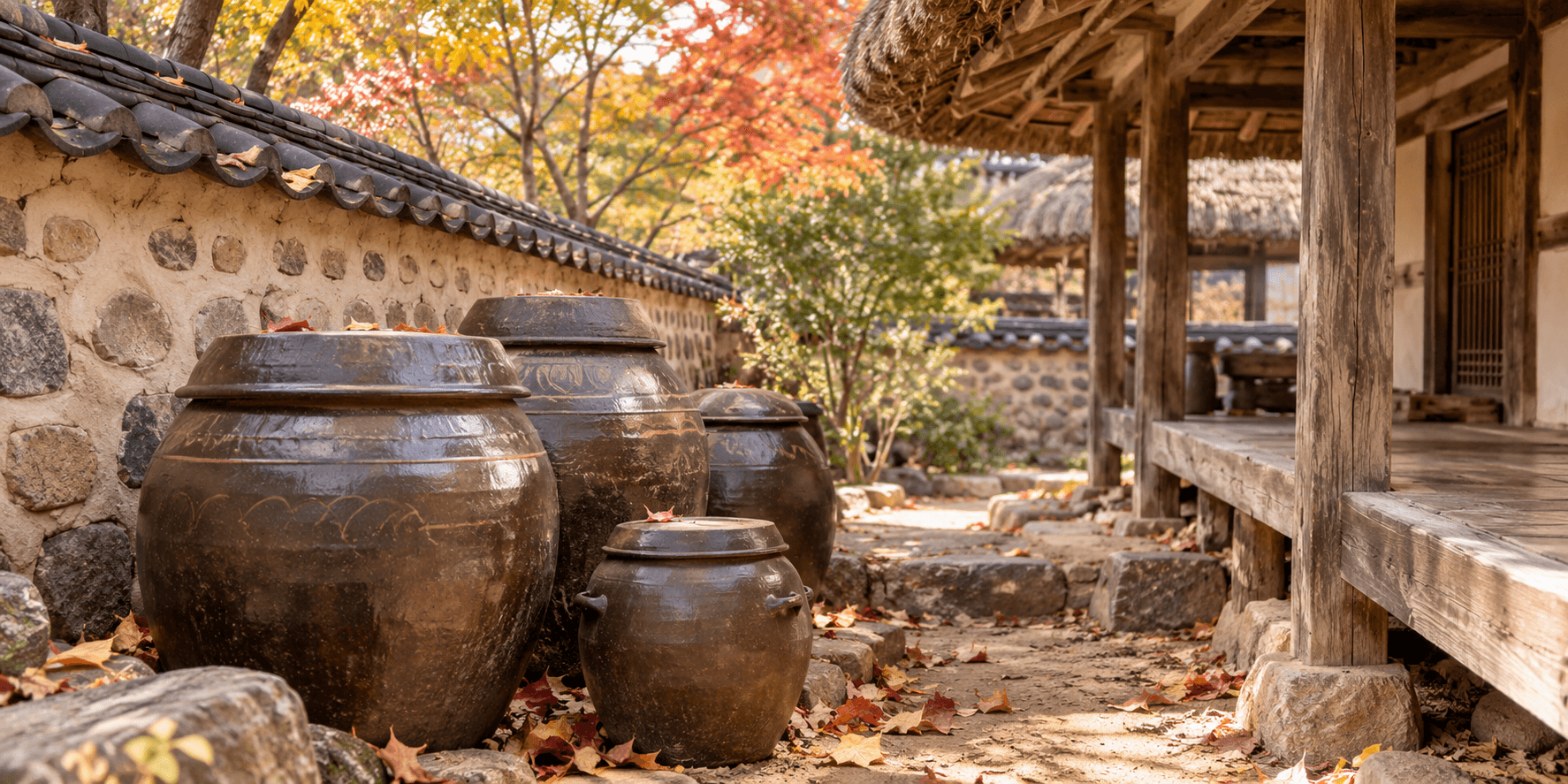
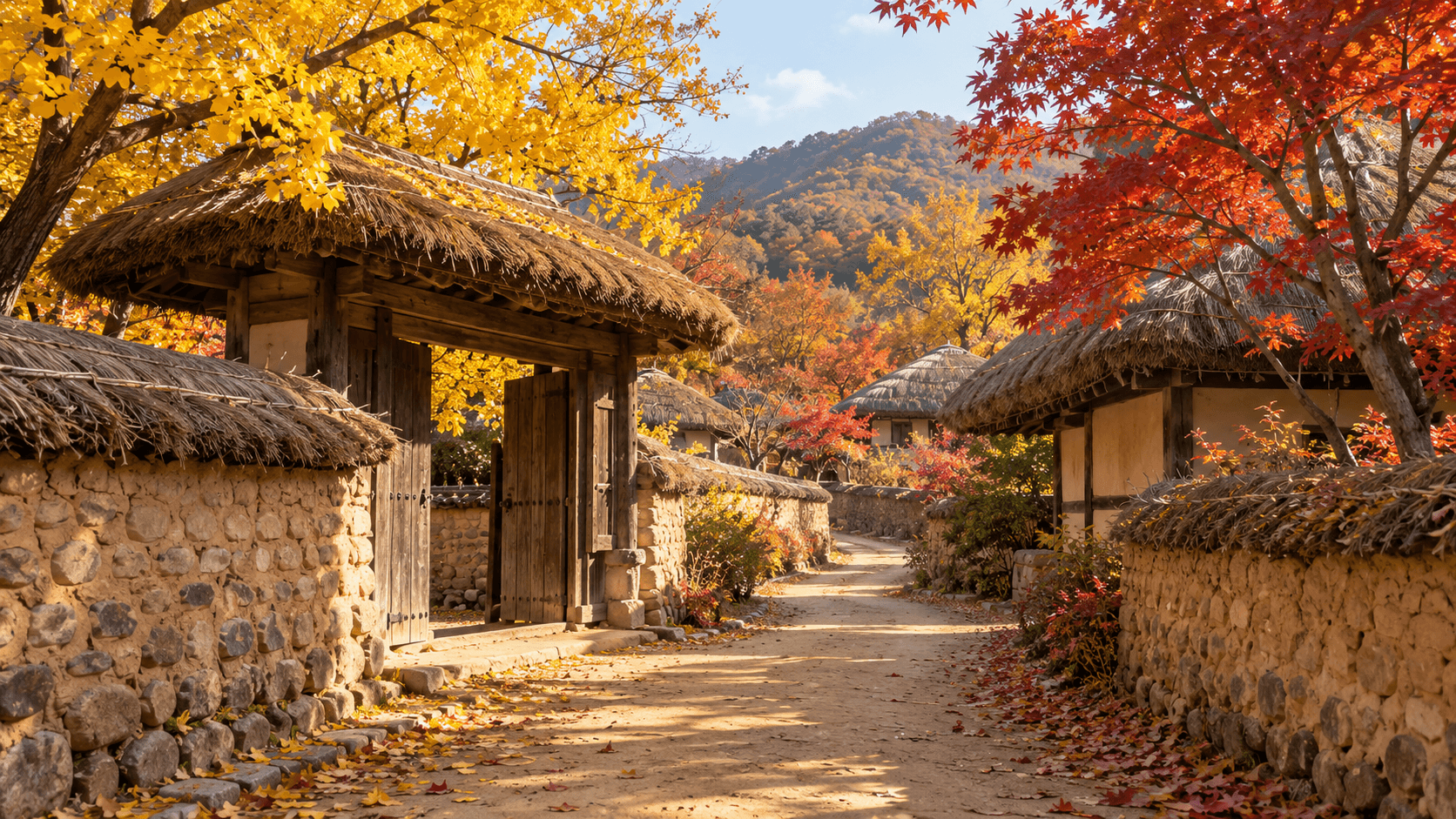
Leave time for everyday-life details between performances. AI-generated village concept illustration, not a current photograph or an exact location inside Korean Folk Village.
After lunch, choose one interest: household details, craft-related stops, another performance or the amusement area. Looking properly at fewer things is a reasonable strategy, not a failure to use your ticket.
If a workshop interests you, ask about its fee, remaining capacity and duration before joining. Do not promise a child an activity on the assumption that every experience is included and continuously available.
Take photographs without blocking a working doorway or a performance route. For portraits, look for a quieter background rather than waiting forever for the busiest spot to empty. Buildings tend to be patient; traveling companions sometimes are not.
The final hour: leave deliberately
Check your return route while you still have time to choose between it and an alternative. If you have a reserved train, include the village-to-station connection and station navigation—not merely the train departure time.
If staying into the evening, revisit your plan when the daytime portion ends. A warm drink and a short rest can be more useful than adding another long loop simply because the gate is still open.
The small decisions that change the day
Food and payment: Decide whether lunch belongs before or after your anchor performance. Keep a backup payment method and a modest amount of cash; do not infer every stall's card policy from one successful purchase. Ask about ingredients when dietary needs matter instead of relying on a photograph alone.
Children and mobility: This is an outdoor walking day. Discuss a shorter route, rest stops and any mobility needs before departure. Check the park's convenience-facilities directory for relevant assistance rather than assuming a full circuit or every historic threshold will suit everyone.
Rain: Separate admission from the performances that motivate your visit. A park remaining open does not guarantee the same show program. If persistent rain removes the main reason you wanted to go, our indoor Seoul alternatives may produce a better day than forcing the original plan.
Accommodation: We would not change hotels solely for this excursion on a short Seoul trip. Choose a base for your whole itinerary, using our best areas to stay in Seoul guide, then compare the actual morning route.
If you are still arranging that base, compare Seoul hotels on Agoda. The link opens citywide accommodation results, not hotels within walking distance of the village. Use the map, check the useful station and compare the full room cost and cancellation terms.
What we would book—and what we would leave open
For a culture-focused first visit, we would choose a workable midday performance, compare the foreign-visitor rate with the actual online offer, and leave enough daylight for an unhurried circuit and lunch.
We would use a tour if its combination of stops genuinely appealed and its village time suited the goal. We would not buy one just to avoid learning a bus route, then discover that its short stop misses the show we wanted.
Before leaving Seoul, confirm the operating calendar, the first show, the admission credential and the return journey. Leave the small discoveries between those fixed points unbooked. That is usually where a well-planned day starts to feel like a holiday.