Choosing a Busan hotel is less about finding the city’s single “best” neighborhood and more about deciding which long ride you do not want to repeat every day.
Haeundae puts the eastern coast outside your door. Gwangalli gives you the bridge at night. Seomyeon makes it easier to split time between east and west, while Nampo keeps markets, Gamcheon and Busan Station close.
This guide compares those four bases by the trips they make easier, the evenings they suit and the compromise hiding behind the hotel photos. Ocean view is lovely; discovering that breakfast is 70 minutes from your first attraction is less romantic.
Table of contents
Understanding Busan’s Layout
Busan’s main visitor areas sit along different parts of the coast and metro network. Line 2 links Seomyeon with Gwangan and Haeundae, while Line 1 connects Seomyeon, Busan Station, Nampo and Jagalchi. Places such as Gamcheon and Haedong Yonggungsa still need a bus, taxi or uphill walk after the train.
Choose the neighborhood that matches two of your three days, not the attraction with the most dramatic thumbnail.
| Area and Station | Best For | Main Trade-Off |
|---|---|---|
| Haeundae · Line 2 | Beach mornings and eastern coast | Longer trips to Nampo and Gamcheon |
| Gwangalli · Line 2 | Bridge views and waterfront evenings | Busy event nights; station is inland |
| Seomyeon · Lines 1 and 2 | Splitting east and west | No beach outside the hotel |
| Nampo · Line 1 | Markets, old downtown and Busan Station | Longer trips to the eastern coast |
Haeundae: Best for Beaches and East Busan
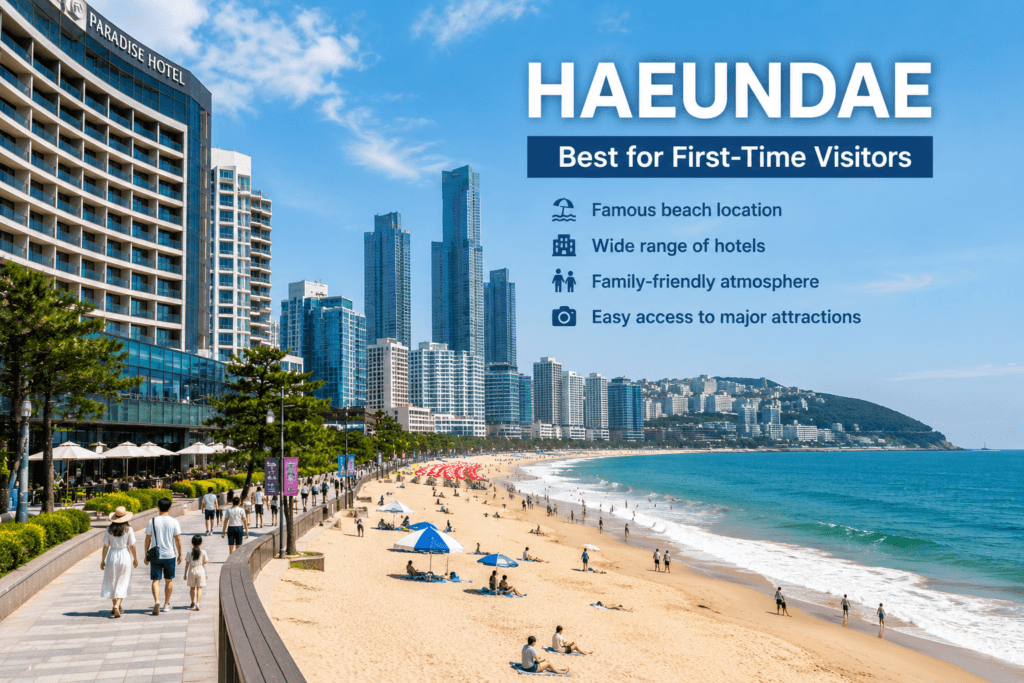
Haeundae is the easiest choice when beach time and the eastern coast are central to the trip—not simply because it is the name everyone recognizes first.
The area combines beautiful beaches, modern hotels, shopping, restaurants, and easy access to major attractions.
Many travelers staying here spend their mornings walking along the beach and their evenings enjoying ocean views from nearby cafés and restaurants.
The neighborhood also connects well with attractions featured in the Haeundae Beach Guide 2026 and Haedong Yonggungsa Guide 2026.
Pros
- Walkable beach, market, restaurants and evening atmosphere
- Broad hotel range from practical rooms to oceanfront stays
- Convenient for Mipo, Blue Line Park, Songjeong and Haedong Yonggungsa
- Easy mornings for families and travelers who prefer a resort-style base
Cons
- Summer weekends and major events can raise prices sharply
- Nampo, Jagalchi and Gamcheon require long cross-city trips
Gwangalli: Best for Bridge Views and Slow Evenings
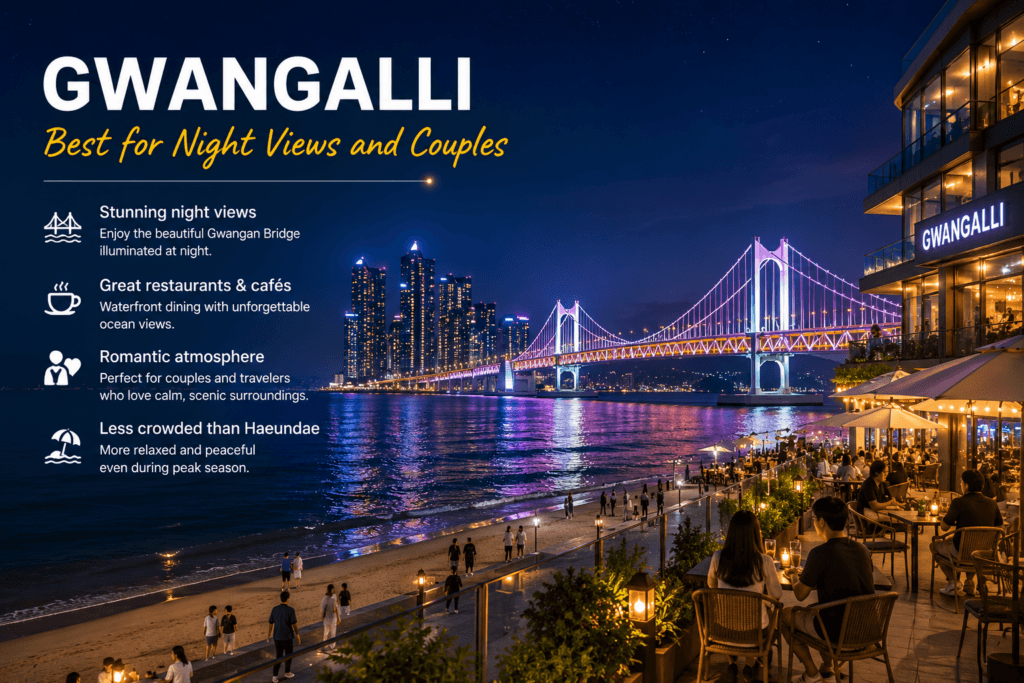
Gwangalli works best for travelers who care about where the day ends. Cafes, casual restaurants and the illuminated Gwangan Bridge make it easy to return to the waterfront without planning another evening transfer.
It feels more neighborhood-like than Haeundae on an ordinary weekday, although Saturday drone shows and special events can turn “relaxed evening” into “apparently everyone had the same idea.”
The combination of the beach, waterfront cafés, and the illuminated Gwangan Bridge creates one of the most memorable night scenes in Korea.
Travelers who enjoy evening walks, photography, and relaxed coastal atmospheres often prefer Gwangalli over Haeundae.
For more ideas, see the Gwangalli Beach Guide 2026.
Pros
- Beautiful night views
- Great restaurants and cafés
- Relaxed neighborhood feel outside weekend and event crowds
- Excellent atmosphere after sunset
Cons
- Fewer large resort hotels than Haeundae
- Some hotels are a noticeable walk from Gwangan or Geumnyeonsan Station
Seomyeon: Best for Splitting East and West

Not every traveler visits Busan for the beach.
If your priority is transportation, shopping, and easy access to different parts of the city, Seomyeon is difficult to beat.
Seomyeon is the transfer point between Metro Lines 1 and 2, which makes it the most balanced base for alternating between Nampo in the west and Gwangalli or Haeundae in the east.
Many visitors staying here find it easier to explore different neighborhoods without spending excessive time in transit.
The area is also packed with restaurants, shopping streets, cafés, and nightlife options.
For travelers planning day trips around Busan, Seomyeon is often one of the smartest choices.
Pros
- Direct access to both Metro Lines 1 and 2
- Balanced travel times for mixed east-and-west itineraries
- Wide range of restaurants
- Strong nightlife scene
Cons
- No coast or beach atmosphere
- Busy nightlife streets can mean noise around some hotels
Nampo: Best for Markets and Busan Station Access
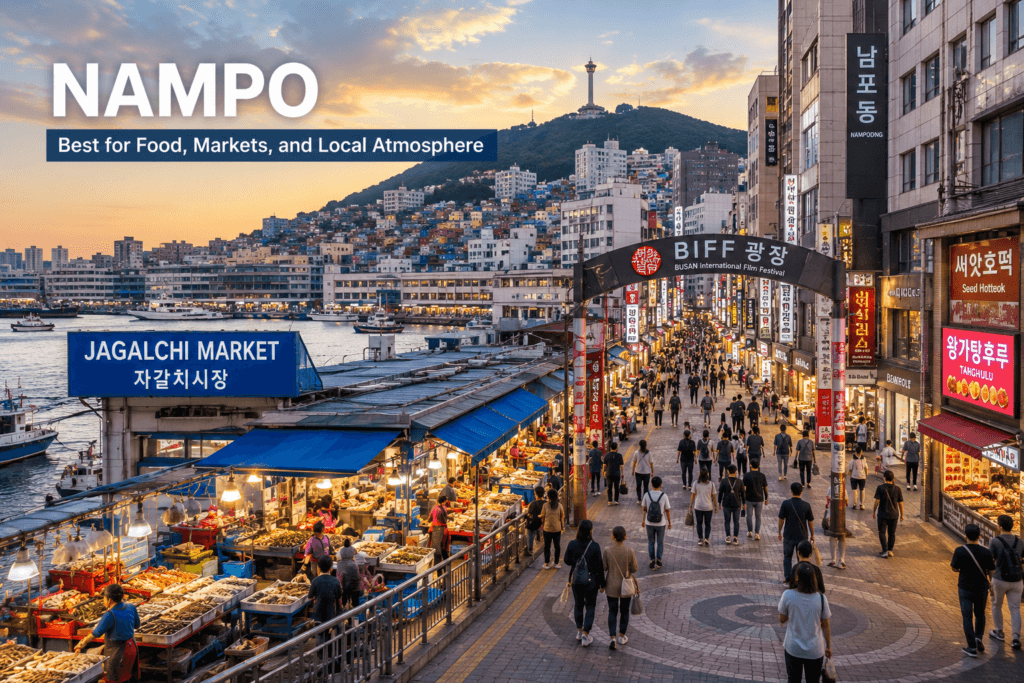
If you want to experience a more traditional side of Busan, Nampo is worth considering.
This area is home to some of the city’s most famous markets, shopping streets, and cultural attractions.
Many travelers who stay in Nampo enjoy being able to walk between restaurants, seafood markets, and local shopping areas without relying heavily on public transportation.
The neighborhood is also closely connected to attractions featured in the Jagalchi Market Guide 2026 and Gamcheon Culture Village Guide 2026.
Compared with the beach districts, Nampo feels older, denser and less resort-oriented. It is also only a short Line 1 ride from Busan Station, which is useful for an early KTX departure or a luggage-heavy arrival.
Pros
- Excellent food scene
- Older downtown streets and a working port-city atmosphere
- Close to Jagalchi, BIFF Square, Gukje Market and the Gamcheon route
- Often better value than the main beachfront districts
Cons
- Room size and renovation quality vary widely in older properties
- Haeundae, Songjeong and Haedong Yonggungsa are long trips east
Which Area Is Best for You?
Choose Haeundae when two or more eastern-coast stops matter most. Choose Gwangalli when bridge views and waterfront evenings are the reason for the trip. Pick Seomyeon for the most even transport compromise, or Nampo when Day 1 markets, Gamcheon and quick Busan Station access outweigh beach mornings.
For a four-night trip split evenly between east and west, changing hotels once can work—but only if packing does not consume the time you hoped to save. For three nights or fewer, one well-chosen base is usually calmer.
Common Mistakes Travelers Make
Look Beyond the Lowest Price
A cheaper hotel can become expensive if you spend extra time and money traveling across the city every day.
Plan for Busan’s Size
Check the first and last fixed activity on each day, then compare the route from the hotel. A central dot on a booking map does not mean central to the attractions you actually saved.
Choose Haeundae for the Right Reasons
Haeundae is excellent for beach time and eastern Busan. It is a poor shortcut to Nampo or Gamcheon, so choose it for the coast—not because it appears first in every hotel search.
Check Subway and Transport Connections
Check the walking route from the actual hotel entrance to the station, including hills and large roads. “Near the beach” and “near the subway” can describe opposite ends of the same neighborhood.
Consider Gwangalli
Gwangalli deserves consideration when evenings matter more than resort facilities. Just check the date: a peaceful weekday and a drone-show Saturday are two very different versions of the same beach.
FAQ
What is the best area to stay in Busan for first-time visitors?
Haeundae is generally the most popular choice thanks to its beach, hotels, restaurants, and tourist-friendly atmosphere.
Is Haeundae or Gwangalli better?
It depends on your travel style. Haeundae offers larger beaches and more hotels, while Gwangalli is famous for its night views and relaxed atmosphere.
Where should families stay in Busan?
Many families choose Haeundae because of its beach access, family-friendly hotels, and nearby attractions.
What is the most convenient area in Busan?
Seomyeon is often considered the most convenient location due to its transportation connections.
Is Nampo a good area to stay?
Yes. Travelers interested in markets, seafood, and local culture often enjoy Nampo more than the beach districts.
How many days should I stay in Busan?
Most visitors find that three to four days provides enough time to explore the city’s major attractions comfortably.
Official Sources and Last Check
- Busan Transportation Corporation — route map, station search and current timetables
- Gimhae International Airport: Subway Access — airport light rail transfers to Metro Lines 2 and 3
- Gimhae International Airport: Public Transportation — current airport bus and ground-transport options
- Visit Busan Official Travel Portal — district and attraction planning
Last checked: September 13, 2026. Hotel prices, airport buses and late-night transport vary by date; verify the exact property location and final connection before booking.
Optional Hotel Search
This section contains affiliate links. If you book through one, we may earn a small commission at no extra cost to you.
Choosing the right hotel can significantly improve your Busan trip. Many travelers compare Busan Hotels before booking to find the best location and value.
Compare the hotel’s exact station, hill, room type and cancellation terms—not only the district name. Two properties listed as “Haeundae” can create very different morning walks.
Related Guides
Busan 3-Day Itinerary shows which neighborhood reduces travel time on each day.
Gamcheon Culture Village Guide 2026
Final Thoughts
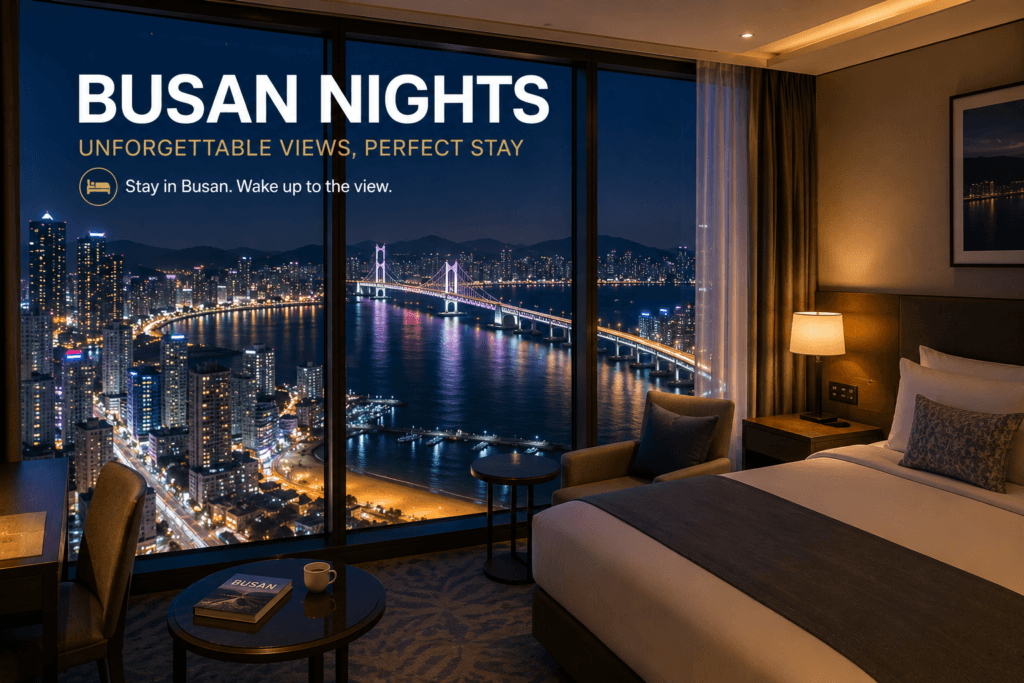
The best area to stay in Busan isn’t necessarily the most famous one.
Many travelers arrive convinced they should stay in Haeundae.
Others choose Gwangalli for the views.
Some prefer Seomyeon for convenience or Nampo for its local character.
Quite often, the best neighborhood is simply the one that matches your travel style.
Whether you’re visiting for beaches, food, culture, or nightlife, Busan offers a district that feels perfectly suited to the experience you’re looking for.
Choose the right base, and exploring Korea’s coastal city becomes much easier, more enjoyable, and far more memorable.